March 3 is easy to recognize in Japan. Hina dolls appear for Hinamatsuri. May 5 brings carp streamers and Children’s Day. July 7 means Tanabata, bamboo branches and wishes written on strips of paper.
Then there is September 9.
Historically, it belongs in the same sequence. Chōyō no Sekku (重陽の節句)—usually called the Chrysanthemum Festival in English—is one of Japan’s traditional Five Seasonal Festivals, or Gosekku (五節句).
Yet in modern Japan, September 9 can pass almost unnoticed.
That raises a more interesting question than simply asking what Chōyō is: why did this particular seasonal festival fade from everyday life while several of the others remained highly visible?
There is no single cause. But the history points to a powerful combination: Chōyō lost its official place in the modern state calendar, the adoption of the new calendar separated September 9 from the season that gave the festival meaning, and the festival never developed a modern household ritual as strong as hina dolls, carp streamers or Tanabata wishes.
- The missing member of Japan’s Five Seasonal Festivals
- Chrysanthemum wine, dew-soaked cotton and long life
- It was important in Edo-period Japan
- The Meiji era broke the old calendar—but that is only half the story
- The new calendar moved September 9 away from chrysanthemum season
- Why did Hinamatsuri, Children’s Day and Tanabata survive better?
- Japan did not forget the chrysanthemum
- Chōyō is not extinct
- What would a modern Chōyō look like?
- A festival displaced from its season
- Sources
The missing member of Japan’s Five Seasonal Festivals
The Five Seasonal Festivals are traditionally associated with dates that mark important points in the year: Jinjitsu on January 7, Jōshi on March 3, Tango on May 5, Tanabata on July 7, and Chōyō on September 9.
Chōyō came to Japan from customs with roots in ancient China. In traditional yin-yang thought, odd numbers were associated with yang. Nine is the largest single-digit odd number, so the repetition of nine on the ninth day of the ninth month carried special significance. The name Chōyō literally refers to the repetition of yang.
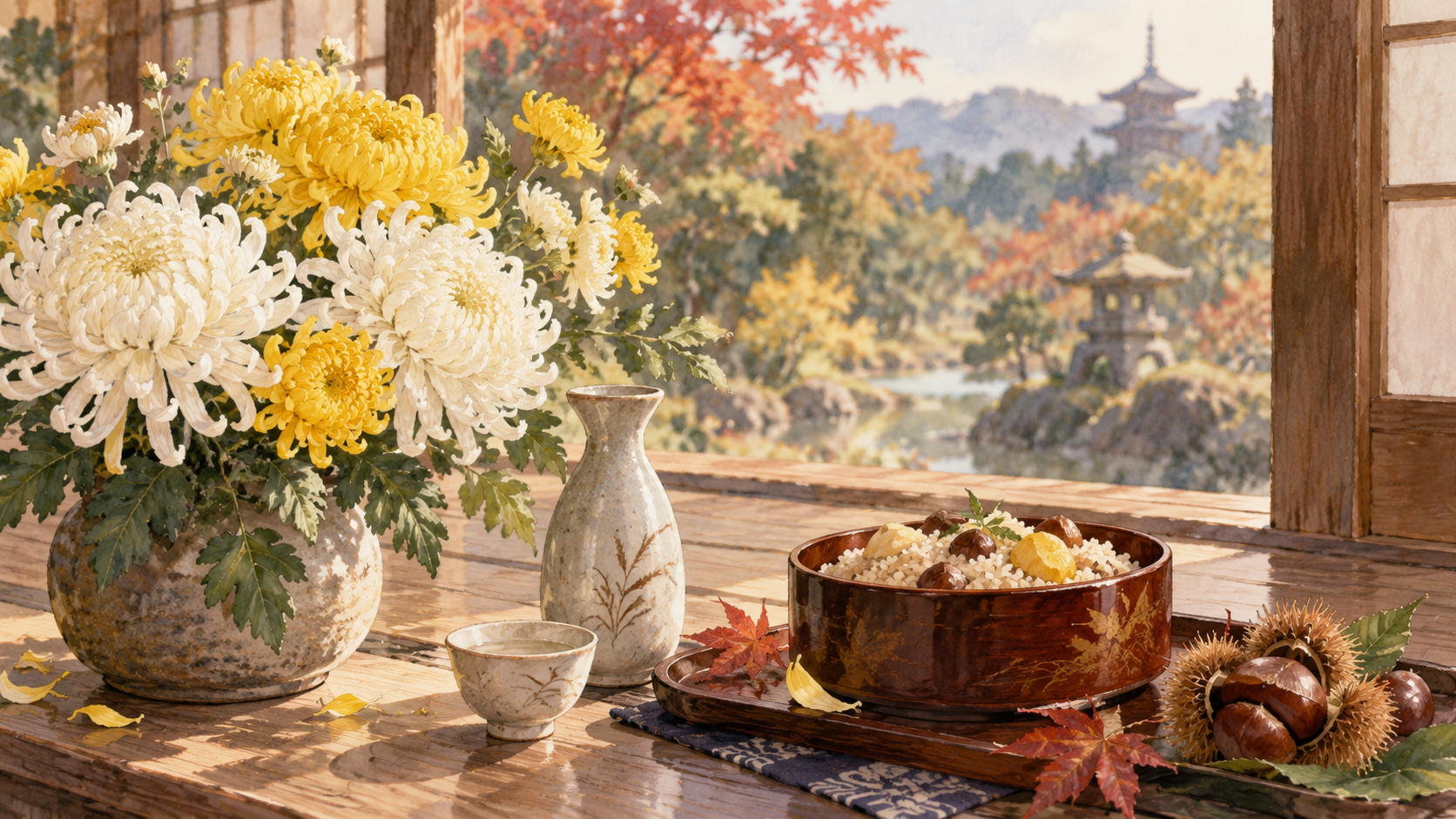
In Japan, the day became strongly associated with chrysanthemums. The flower was believed to have the power to ward off misfortune and promote longevity, and Chōyō became known as Kiku no Sekku—the Chrysanthemum Festival.
The festival was not originally obscure. It belonged to elite court culture and later became part of the formal seasonal calendar of early modern Japan.
Chrysanthemum wine, dew-soaked cotton and long life
Chōyō’s rituals are unusually botanical.
At the imperial court, people admired chrysanthemums, composed poetry and drank kikuzake, sake associated with chrysanthemum flowers. Another custom, kisenwata or chrysanthemum-covered cotton, involved placing cotton over chrysanthemum blossoms so that it absorbed dew and fragrance. The cotton was then used in a ritual connected with purification and wishes for long life.
The National Diet Library’s reference materials describe old September 9 as falling around the middle of October on today’s calendar—a time when chrysanthemums are naturally beautiful. Japan’s Ministry of Agriculture, Forestry and Fisheries also lists chrysanthemum sake, chrysanthemum dishes and chestnut rice among foods associated with Chōyō. Among ordinary people, the festival was sometimes called the Chestnut Festival, reflecting its connection with the autumn harvest.
In other words, Chōyō once made intuitive seasonal sense. Chrysanthemums were flowering. Chestnuts were available. The harvest season was underway. A festival of flowers, food, health and longevity belonged naturally to that moment of the year.
It was important in Edo-period Japan
By the Edo period, Chōyō was not merely a private court custom.
The Five Sekku were treated as formal seasonal observances under the Tokugawa shogunate. National Diet Library materials note that the shogunate celebrated Chōyō on a large scale, while chrysanthemum appreciation spread among the wider population through flower contests and chrysanthemum displays.
This matters because it rules out a simple explanation for Chōyō’s modern obscurity.
It did not disappear because it had always been a tiny, forgotten tradition. It faded despite once having substantial cultural and institutional weight.
The Meiji era broke the old calendar—but that is only half the story
The turning point came during the Meiji period.
Japan adopted the Gregorian calendar at the beginning of 1873. In the same modernization of the official calendar, the traditional Five Sekku lost their status as formal state festival days. The National Archives of Japan preserves the Meiji-government record concerning the abolition of the Five Sekku and the establishment of a new holiday system.
It is tempting to stop there and say that Chōyō vanished because the government abolished the old festivals.
But that explanation does not work on its own.
March 3 also survived. May 5 survived so successfully that it became the modern national holiday Children’s Day. July 7 remains one of Japan’s most recognizable seasonal customs.
The same institutional break affected all of them. Something else made Chōyō more vulnerable.
The new calendar moved September 9 away from chrysanthemum season
This is probably the most important piece of the puzzle.
The old September 9 was not the September 9 we experience today.
Kyoto City’s official tourism information on Chōyō explains the mismatch directly: the traditional date fell in what is now roughly October, during the harvest season. By contrast, September 9 on the modern calendar is still often hot in Japan, and the best season for viewing chrysanthemums generally comes later, around late October and November.
That shift damaged Chōyō in a way that is easy to underestimate.
A festival centered on chrysanthemums works differently when the flowers are actually blooming. Chestnuts, harvest foods, morning dew and the atmosphere of deepening autumn all reinforce the meaning of the day. Move the same numbered date forward by more than a month and the symbols remain, but the environment supporting them becomes weaker.
The date survived. The season moved away from it.
This is one reason Chōyō can feel strangely abstract today. September 9 says “chrysanthemum festival,” while the weather may still say “late summer.”
Why did Hinamatsuri, Children’s Day and Tanabata survive better?
Calendar reform alone also cannot explain why the other Sekku remained visible. Their modern forms developed strong, repeatable rituals that work inside ordinary households, schools and commercial life.
March 3 has hina dolls and a clear family narrative centered on children. May 5 has carp streamers, warrior dolls, traditional foods and the enormous reinforcement of a national holiday. July 7 has one of the simplest participatory rituals imaginable: write a wish on a strip of paper and hang it from bamboo.
Even January 7 has a compact action that is easy to reproduce at home: eat seven-herb rice porridge.
Chōyō’s best-known customs are different. Chrysanthemum wine, chrysanthemum viewing and kisenwata are elegant traditions, but they are more dependent on a particular flower, a particular season and older forms of adult ceremonial culture. They are less easily converted into the kind of child-centered annual event that families repeat automatically from generation to generation.
This should be understood as a structural explanation rather than a single documented cause. Modern festivals survive not only because people remember their names, but because people have a clear action to perform.
For Chōyō, that everyday script became weaker.
Japan did not forget the chrysanthemum
There is a revealing contradiction here: Japan did not stop caring about chrysanthemums.
One of the country’s best-known chrysanthemum traditions is the annual exhibition at Shinjuku Gyoen National Garden in Tokyo. The Ministry of the Environment traces it to an imperial chrysanthemum viewing first held in 1878. The modern exhibition is held every year from November 1 to November 15.
That timing is striking.
The flower culture continued. The displays continued. Imperial-era chrysanthemum tradition continued. But it continued in November, when chrysanthemums make seasonal sense—not necessarily on September 9.
Japan did not forget the chrysanthemum. It largely forgot September 9 as the date attached to it.
Chōyō is not extinct
“Forgotten” also needs qualification.
Chōyō survives in religious and local traditions. Kyoto City lists several Chōyō-related events taking place on September 9, 2026, including rites at Kamigamo Shrine, Kifune Shrine and Kurumazaki Shrine. At Kifune Shrine, for example, the annual chrysanthemum rite includes a sacred dance performed with chrysanthemums and, after the ritual, chrysanthemum sake for participants.
These events show what happened to Chōyō particularly well.
It did not vanish completely. Instead, a festival that once occupied a broad place in the official seasonal calendar became more concentrated in temples, shrines, traditional households and cultural institutions.
What was once a nationally legible date became a tradition that many people now encounter only when someone explains it.
What would a modern Chōyō look like?
Perhaps Chōyō is easier to understand today if it is treated not as a lost holiday to be reconstructed perfectly, but as an autumn idea whose pieces still survive.
Chrysanthemum petals are still used as food in parts of Japan. Chestnut rice remains a familiar autumn dish. Chrysanthemum exhibitions still attract visitors. Shrines continue to hold rites for health and longevity. None of those practices requires pretending that early September already feels like late autumn.
There is even something fitting about celebrating Chōyō twice in spirit: recognizing September 9 as the historical date, then enjoying chrysanthemums and deeper autumn foods when the season actually arrives.
That tension between numbered calendar time and lived seasonal time is itself part of modern Japanese culture.
A festival displaced from its season
The disappearance of Chōyō from everyday life is therefore not a simple story of modernization erasing an old custom.
The Meiji state removed the old Five Sekku from its official holiday system, but several of those festivals found new lives. Chōyō faced an additional problem: the modern calendar separated September 9 from the chrysanthemums, chestnuts and autumn atmosphere that had made the day immediately understandable. At the same time, it lacked the powerful modern household ritual that helped other Sekku survive.
The result is visible every September.
Japan still has its Chrysanthemum Festival. Shrines still observe it. Traditional foods still exist. Chrysanthemum culture remains strong.
But the connection between all of those things and September 9 has become faint.
Chōyō was not erased. It was disconnected from the season that once made it make sense.
Sources
- Kyoto City Official Travel Guide — Chōyō no Sekku
- Ministry of Agriculture, Forestry and Fisheries — Seasonal festivals and traditional foods
- National Diet Library Image Bank — Chōyō no Sekku
- National Diet Library Reference Collaborative Database — Chōyō, chrysanthemums and the old calendar
- National Archives of Japan Digital Archive — record on abolishing the Five Sekku after calendar reform
- Ministry of the Environment — Shinjuku Gyoen Chrysanthemum Exhibition
- Kyoto City Official Travel Guide — Kifune Shrine Chrysanthemum Rite, September 9, 2026