For years, one of the standard pieces of advice given to travelers heading to Japan was simple:
Bring cash. Japan is still a cash society.
That advice is not entirely wrong. But in 2026, it is no longer entirely right either.
According to Japan’s Ministry of Economy, Trade and Industry (METI), the country’s cashless payment ratio reached 58.0% in 2025, representing ¥162.7 trillion in cashless payments.
More than half.
At first glance, that seems to suggest that the old image of “cash-only Japan” should finally be retired.
But there is a problem.
The 58% figure does not mean that 58 out of every 100 purchases in Japan are cashless.
And once you look inside the number, something even more characteristic of everyday Japan appears.
Japan has not simply replaced cash with digital payments.
Instead, it has built several generations of payment technology on top of one another.
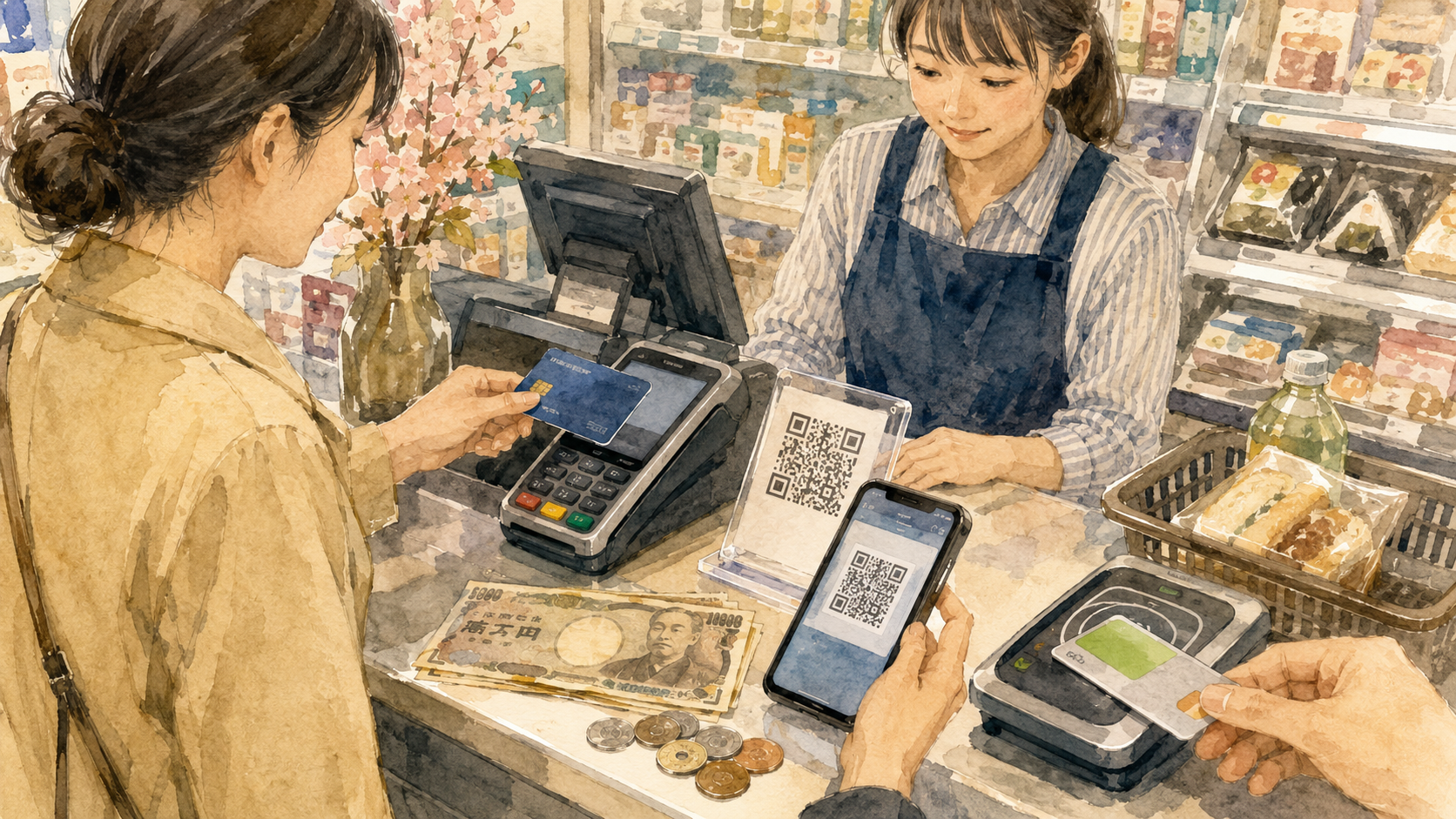
Cash, credit cards, transit IC cards, contactless payments, electronic money and QR codes all coexist.
The result is not quite a cashless society.
It is a layered payment society.
- First: what does “58% cashless” actually mean?
- And no, 58% does not mean 58% of purchases
- The surprising part: Japan’s cashless economy is still overwhelmingly about cards
- So why do QR payments feel much bigger than 10%?
- Japan did not replace old payment systems. It kept adding new ones.
- What this change looks like in my own family
- Japan’s points economy matters more than visitors may realize
- This is why the statistics and the travel experience seem to contradict each other
- What should visitors actually carry in Japan in 2026?
- Japan’s next target is 65% — but cash probably will not simply vanish
- Sources
First: what does “58% cashless” actually mean?
The 58.0% figure is real. But understanding what METI is measuring is important.
Japan’s official cashless payment ratio is calculated from the value of cashless payments, not from the number of transactions.
In other words, it is about yen, not checkout events.
METI’s domestic indicator compares payments made using credit cards, debit cards, electronic money and code payments with household final consumption expenditure after excluding items such as the imputed rent of owner-occupied homes.
That last detail sounds technical, but it matters.
For national-accounting purposes, people who own their homes are treated as if they were effectively receiving housing services from those homes. This theoretical expenditure is called imputed rent.
Nobody actually walks into a shop and pays it.
Japan therefore adopted a domestic indicator intended to be closer to consumers’ actual payment activity, while retaining an international-comparison indicator for continuity.
This also means readers need to be careful when comparing the new 58.0% figure with older headlines.
In March 2025, METI announced that Japan’s 2024 cashless payment ratio had reached 42.8% under the previous headline indicator.
Under the newer domestic indicator used for the government’s current targets, the 2024 level is 51.7%.
So Japan did not suddenly leap from 42.8% to 58.0% in one year.
Part of the apparent jump comes from a change in the denominator.
The trend is real. The discontinuity is partly statistical.
That distinction is easily lost in headlines.
And no, 58% does not mean 58% of purchases
There is another limitation.
METI now publishes the number of cashless payments as reference information, but it cannot calculate an equivalent national ratio by transaction count because Japan does not have a reliable denominator for the total number of payments, including cash.
So we cannot accurately say:
“58% of transactions in Japan are cashless.”
The official figure tells us that cashless methods account for 58% of the measured payment value under the domestic indicator.
That is a different statement.
And that difference helps explain why two visitors can spend a week in Japan and come away with completely different impressions.
One may use a credit card for almost everything.
Another may encounter a cash-only restaurant, recharge an IC card with banknotes and leave convinced that Japan remains strangely attached to physical money.
Both experiences can be real.
The surprising part: Japan’s cashless economy is still overwhelmingly about cards
The payment-method breakdown is even more interesting.
Of Japan’s ¥162.7 trillion in cashless payments during 2025:
| Payment method | Share of cashless value | Payment value |
|---|---|---|
| Credit cards | 82.7% | ¥134.6 trillion |
| Code payments | 10.2% | ¥16.6 trillion |
| Electronic money | 3.7% | ¥6.0 trillion |
| Debit cards | 3.4% | ¥5.5 trillion |
If you spend time walking around Japanese cities, that may feel slightly surprising.
QR-code stickers are everywhere.
PayPay signs appear at restaurants, pharmacies, cafés, small shops and counters. Other domestic payment apps compete for the same space.
It can sometimes look as though Japan has become a QR-payment economy.
Financially, it has not.
More than four-fifths of Japan’s measured cashless payment value still comes from credit cards.
QR and barcode payments account for only about one-tenth.
So why do QR payments feel much bigger than 10%?
Transaction frequency helps explain the difference.
METI’s 2025 reference data show that code payments are much closer to credit cards when measured by the number of payment events than when measured by monetary value.
That makes sense because different payment systems tend to occupy different spending ranges.
The Cashless Promotion Council’s Cashless Roadmap 2024, using 2023 data, estimated an average transaction of roughly ¥5,000 for credit cards, compared with around ¥1,600 for code payments and approximately ¥1,000 for electronic money.
A QR code used repeatedly for lunch, coffee, convenience-store shopping or other everyday purchases can therefore become extremely visible without accounting for anything close to the same total value as credit cards.
There is another statistical twist.
A QR payment can itself be funded by a credit card.
METI excludes credit-card- and branded-debit-linked code-payment value from the code-payment amount used in its cashless ratio in order to avoid double counting.
For the reference transaction-count statistics, however, METI explicitly warns that a card-linked code payment may appear in both the card and code counts.
So even the question “Was that a card payment or a QR payment?” does not always have a simple answer.
To the customer, they scanned a QR code.
To the underlying payment system, a credit card may have supplied the money.
Japan’s payment landscape is less tidy than the logos at the cash register suggest.
Japan did not replace old payment systems. It kept adding new ones.
This may be the most useful way for a visitor to understand payments in Japan.
Many countries have moved toward one overwhelmingly dominant consumer behavior.
Japan has instead accumulated payment layers.
Layer 1: Cash
Cash remains completely normal.
It is particularly useful at smaller businesses and in some rural or independent establishments, and there are still situations where it is the only practical option.
Even the Japan National Tourism Organization continues to advise travelers to keep some yen on hand.
Cash has not disappeared simply because cashless payments have become large in aggregate.
Layer 2: Credit cards
Cards are the financial giant that is surprisingly easy to overlook.
Major hotels, department stores, chain retailers, larger restaurants and many ordinary shops accept international cards, while contactless card payments have also expanded considerably.
For a foreign visitor, this is usually the most important cashless layer because it is already available before arriving in Japan.
Layer 3: IC cards
Then there is a payment system that visitors quickly discover but that does not fit neatly into the usual “cash versus card” discussion.
Suica, PASMO and other interoperable transit IC cards are effectively small-payment wallets embedded inside the transportation system.
They can pay for trains and buses, but also convenience stores, vending machines and many other everyday purchases.
A traveler can therefore tap an IC card repeatedly during a day without thinking of those actions as part of Japan’s broader cashless economy.
Yet cash can still appear inside this digital system: some physical IC-card purchase and recharge processes still depend on banknotes.
Digital and physical money are not always opposites here.
Layer 4: QR and code payments
Finally, Japan has developed a large domestic smartphone-payment ecosystem.
For residents, services such as PayPay and other code-payment apps can be extremely convenient.
For international visitors, however, seeing a QR logo does not necessarily mean being able to use it.
PayPay, for example, currently requires a mobile phone capable of SMS authentication and states that overseas mobile phone numbers cannot be used for registration.
This creates an unusual situation:
A shop may look highly cashless to a Japanese resident while offering far fewer digital options to a foreign visitor standing at the same counter.
What this change looks like in my own family
National statistics describe the direction of travel. Everyday life shows how people actually get there.
In my own case, I now use cash very rarely.
One reason is convenience, but another is something that can be easy to underestimate when looking at Japan from outside: reward points.
Japan has an enormous ecosystem of credit-card points, airline miles, store points and payment-service rewards. There is even a common Japanese term, poikatsu — literally, “point activities” — for deliberately collecting and optimizing them.
Whenever I return to my hometown, I have to fly. So I tend to convert spending into airline miles. Other rewards can be redirected into points that reduce everyday expenses.
For me, cashless payment is therefore not simply a replacement for banknotes. It is part of optimizing household spending.
My parents provide a very different example.
They live in regional Japan and were much more cash-oriented for years. Recently, however, even they have begun shifting some of their spending to cashless payments — perhaps around one-third of their purchases.
The reason is surprisingly similar.
Not because cash suddenly became difficult to use.
Because cashless payment can be more rewarding.
They increasingly understand that paying the same ¥10,000 by card or another cashless method may generate points, while paying ¥10,000 in cash usually does not.
This is only one family, of course. Regional, generational and individual differences remain substantial.
But it illustrates something that national statistics alone cannot show.
Japan’s transition toward cashless payment is not necessarily happening because people have rejected cash.
In many cases, people are simply discovering that the alternatives offer them something extra.
And once that habit begins, cash can slowly become the exceptional payment method rather than the default.
Japan’s points economy matters more than visitors may realize
This reward culture is not just a private hobby.
For years, Japanese card issuers, retailers, airlines, telecom groups, e-commerce platforms and payment apps have competed through points, miles and cashback-style incentives.
The government itself used a cashless consumer-reward program after the 2019 consumption-tax increase, supporting point rebates at participating small and medium-sized businesses for a limited period.
That does not mean points alone caused Japan’s cashless shift.
But they help explain why adoption can spread even where cash remains perfectly functional.
The incentive is often not:
“Cash no longer works.”
It is:
“Why pay the same amount and receive nothing back?”
That logic can reach people gradually — including people who were previously comfortable using cash for almost everything.
This is why the statistics and the travel experience seem to contradict each other
Japan’s 58% figure is not an acceptance rate.
It does not mean that 58% of shops accept cashless payments.
It does not mean that 58% of purchases are cashless.
And it does not mean that every payment method used by Japanese residents is equally available to tourists.
It measures the monetary value flowing through several defined cashless systems.
That is why the old description of Japan as a “cash society” has survived even as well over one hundred trillion yen a year has moved through cards, phones and electronic wallets.
Interestingly, even Japan’s own official tourism information still advises visitors to keep cash available while describing the spread of cards, contactless payments and IC cards.
Those statements are not actually contradictory.
The country has changed without completely removing the old system.
What should visitors actually carry in Japan in 2026?
The simplest approach is not to choose between cash and cashless.
Use the layers.
A major international credit card is now useful for a very large portion of ordinary travel spending, especially in cities.
A Suica, PASMO or compatible IC card is extremely convenient for transportation and small everyday payments.
Keep some Japanese yen in cash for businesses, facilities and situations where digital payment is unavailable.
And do not assume that every Japanese QR-payment logo represents a service that a short-term foreign visitor can easily use.
This combination is more practical than either extreme:
“Japan is cash-only.”
or
“You no longer need cash in Japan.”
Neither describes the country particularly well.
Japan’s next target is 65% — but cash probably will not simply vanish
The Japanese government has now set an interim target of 65% cashless payments by 2030, using the domestic indicator.
Its longer-term target is 80%.
Japan is therefore clearly moving further toward cashless payment.
But looking at how the system has evolved so far, the future may not involve one payment technology eliminating all the others.
The more Japanese outcome may be continued coexistence.
Cards become more contactless.
QR payments become more common.
Transit IC remains embedded in everyday movement.
Cash becomes less frequently necessary but stays available.
New systems arrive without completely removing the old ones.
That is already what Japan looks like today.
The old image of a country where visitors need envelopes of banknotes for everything is increasingly outdated.
But describing Japan as simply “cashless” misses something equally important.
Japan has not switched from cash to digital. It has stacked digital payments on top of cash.
And that layered landscape may be a much more accurate description of how people actually pay in Japan now.
Sources
- METI — 2025 Ratio of Cashless Payment Among the Total Amount Paid by Consumers Calculated
- METI — Cashless policy and statistics
- METI — 2024 Ratio of Cashless Payment Among the Total Amount Paid by Consumers Calculated
- Cashless Promotion Council — Cashless Roadmap 2024
- Japan National Tourism Organization — Cashless Payments in Japan
- PayPay Help — Recommended operating environment