Recently, I ordered takeaway from Komeda’s Coffee.
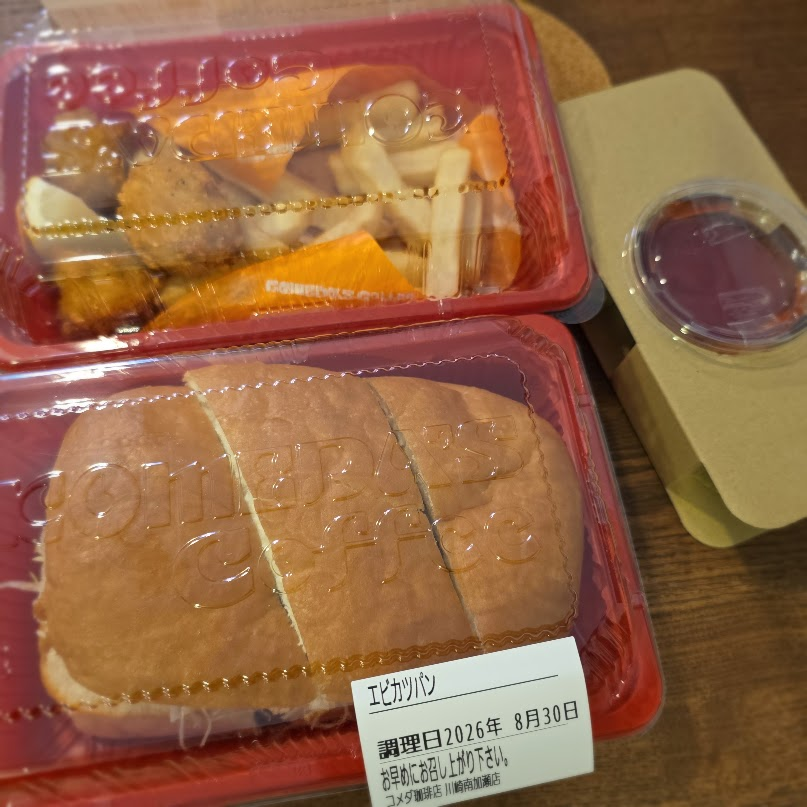
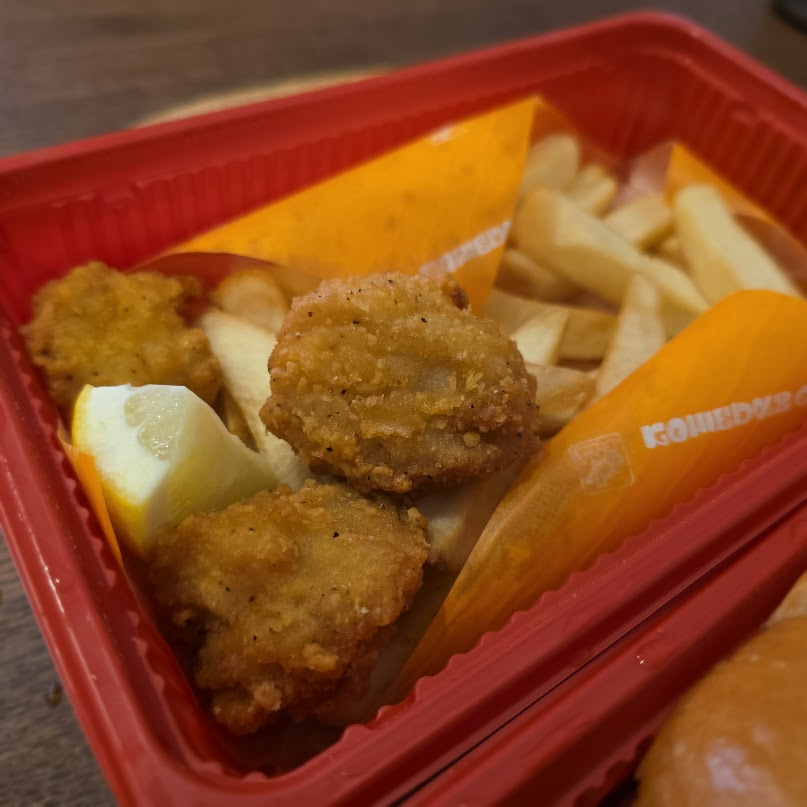
I chose an Ebi Katsu Pan, a shrimp-cutlet sandwich, with fried food and fries on the side. Everything was neatly packed into Komeda’s familiar red takeaway containers.
With the lids closed, it looked fairly normal.
Then I opened them.
The sandwich was enormous.
Not “slightly larger than expected.” It was the kind of sandwich that makes you look at the container, look at the food, and quietly reconsider how hungry you actually are.
And if you have eaten at Komeda before, this probably does not sound surprising at all.
Komeda’s Coffee has developed an affectionate reputation in Japan for something sometimes jokingly called 逆写真詐欺 (gyaku shashin sagi), literally a “reverse photo scam.”
Normally, the joke goes, restaurant food is smaller or less impressive than the photograph on the menu.
At Komeda, people complain about the opposite.
You see the photograph, order something that appears reasonable, and then a surprisingly large plate of food arrives.
It is a very pleasant kind of mistake.
- Komeda is a chain—but it does not quite feel like a modern café chain
- Komeda wants to be your “living room in town”
- To understand Komeda, you have to understand Aichi’s “Morning” culture
- Even the name “Komeda” has an unexpectedly local story
- And then there is the food
- Japan calls it the “reverse photo scam”
- The desserts follow the same philosophy
- A huge chain that still tries to behave like a neighborhood coffee shop
- Maybe the oversized sandwich is not the strange part after all
- Sources and further reading
Komeda is a chain—but it does not quite feel like a modern café chain
Komeda’s Coffee began in Nagoya in 1968, when founder Taro Kato opened the first shop in the city’s Nishi Ward. More than half a century later, it has become one of Japan’s largest full-service coffee-shop chains. According to Komeda Holdings, there were 1,079 Komeda’s Coffee locations as of February 28, 2026.
But understanding Komeda requires one important distinction.
The company does not primarily describe itself as a modern self-service café. It describes Komeda as a full-service kissaten.
Kissaten (喫茶店) is usually translated simply as “coffee shop,” but culturally the word suggests something a little different from a Starbucks-style café. A traditional kissaten is somewhere you sit down, order from a server and stay for a while. Coffee matters, but so do the chair, the table, the food, the conversation and the amount of time you spend there.
Komeda deliberately preserves that model.
The company describes its full-service format as one where staff guide customers to their seats, bring water and an oshibori wet towel, take orders at the table and deliver the food there.
In other words, Komeda is not primarily designed around grabbing coffee and leaving.
It is designed around sitting down.
Komeda wants to be your “living room in town”
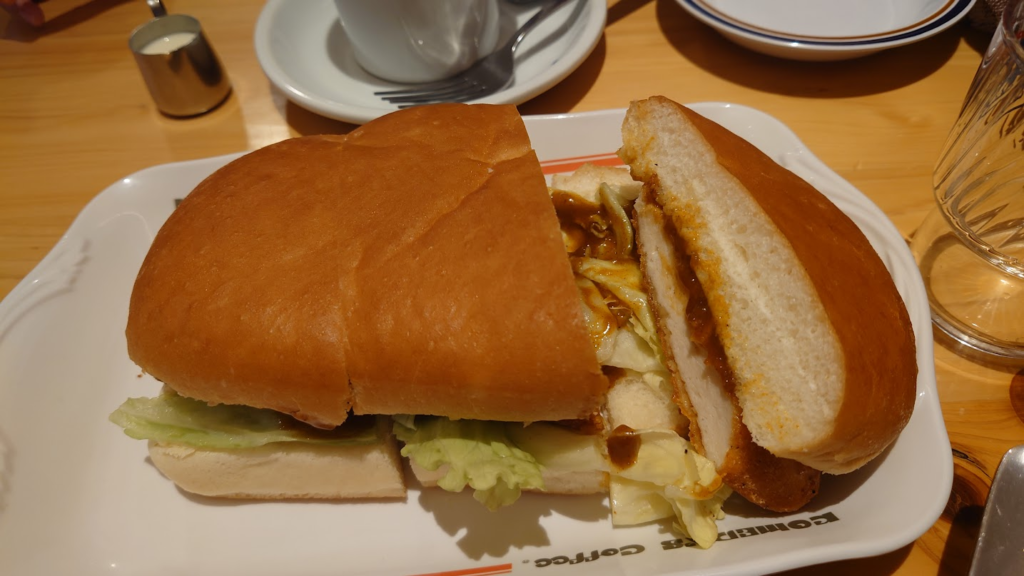
This becomes even clearer when you look at how the stores are designed.
Komeda says it wants its shops to function as a kind of “living room in town”—a place where people can rest and feel comfortable rather than simply consume coffee as efficiently as possible.
That philosophy explains many things that seem ordinary until you start paying attention to them.
The wood-grain interiors. The brick surfaces. The famously reddish upholstered seats. The relatively substantial tables. The partitions between seating areas. Even the dimensions of the tables and sofas are considered as part of the attempt to make people comfortable for longer periods.
This is one reason Komeda can feel strangely domestic despite being a large national chain.
You can go there with family. Elderly customers can sit for a long conversation. Someone can read. Someone else can work. Two people can share an enormous sandwich. A person alone can have coffee and breakfast without feeling hurried.
The product is partly the coffee.
But another part of the product is simply a place where you are allowed to remain.
That idea is deeply connected to the coffee-shop culture of the region where Komeda was born.
To understand Komeda, you have to understand Aichi’s “Morning” culture
Aichi Prefecture, which includes Nagoya, has an unusually strong coffee-shop tradition.
One of its most famous customs is simply called Morning (mōningu).
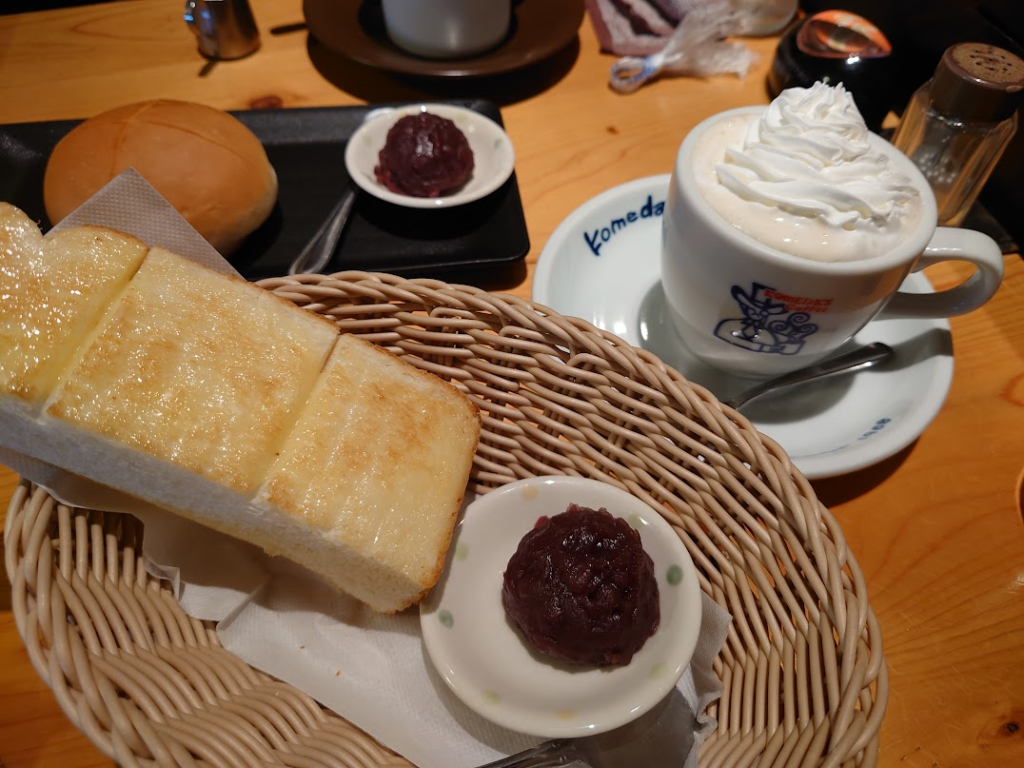
Despite the English name, a Japanese “Morning” does not merely mean breakfast. In Aichi coffee-shop culture, it usually means that when you order a drink in the morning, the shop adds some breakfast food—often toast and an egg—either free or for a very small additional charge.
At Komeda today, customers who order a drink between opening time and 11:00 a.m. can receive toast or a soft bread roll as part of the Morning Service, together with a choice such as a boiled egg, egg spread or Komeda’s sweet red-bean paste.
That combination of toast and ogura-an—sweet azuki bean paste—is particularly associated with the Nagoya area.
The history behind Morning Service is even more interesting.
The exact birthplace is sometimes debated, with both Ichinomiya and Toyohashi appearing in accounts of its origins. One well-established tradition traces it to Ichinomiya, northwest of Nagoya, during the booming textile years of the 1950s.
Textile machinery was extremely noisy, so business discussions were often held in coffee shops. Customers visited repeatedly. According to local tourism accounts, coffee-shop owners began adding small foods such as boiled eggs and peanuts to morning coffee as a gesture of hospitality. The practice spread.
What began as a little extra service gradually became part of the regional coffee-shop culture.
And that idea—give the customer a little more than expected—is important when trying to understand Komeda.
Even the name “Komeda” has an unexpectedly local story
“Komeda” sounds like it might be a carefully invented coffee brand.
Apparently, it is not.
According to an interview with a Komeda public-relations representative, founder Taro Kato grew up in a family that ran a rice shop.
The story goes that the name evolved from “komeya no Taro”—roughly, “Taro from the rice shop”—through wordplay into “Komeda.”
So one of Japan’s biggest coffee-shop brands has a name with roots not in coffee, but in rice.
There is now an amusing extra layer to this history: the Komeda group has actually launched an onigiri-focused brand called Komeya no Taro.
The old wordplay has effectively come full circle.
And then there is the food
This is the part first-time visitors usually remember.
Komeda officially describes one of the characteristics of its brand as its “voluminous snacks.”
That may be an understatement.
The sandwiches are large.
The cutlet sandwiches are large.
The burgers can be large.
The desserts can be large.
Even foods that sound like a small accompaniment to coffee can sometimes become an unexpectedly serious meal.
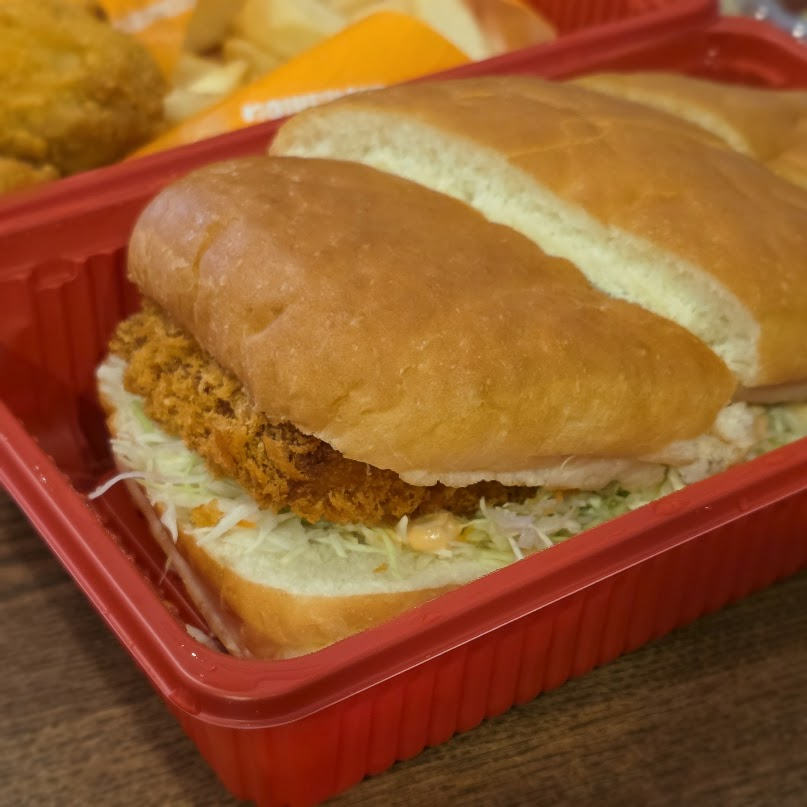
My recent Ebi Katsu Pan was a perfect example. The bread alone occupied most of the takeaway tray. Cut into three pieces, it could almost create the illusion of three ordinary sandwiches—until you realize those pieces were originally one item.
Inside were shrimp cutlet, shredded cabbage and sauce, all held between thick, soft bread.
And this is not simply an impression created by my own order.
In an interview about Komeda’s famously large menu items, a company representative explained that the portions are designed to work for a wide range of customers and situations: one person can eat a filling meal, while groups can order food and share it.
An earlier interview with founder Taro Kato also connected Komeda’s generosity with Nagoya’s culture of oneuchi—the feeling that something offers good value for what you pay. He discussed maintaining generous portions rather than simply shrinking them as ingredient costs rose.
This is an important distinction.
Komeda does not appear to have invented enormous food merely as a social-media gimmick.
The portions make more sense when understood as part of a broader philosophy: people come in different groups, they stay for a while, they may share food, and customers should feel that what arrived at the table was worth ordering.
Social media simply turned that philosophy into a meme.
Japan calls it the “reverse photo scam”
The phrase 逆写真詐欺, or “reverse photo scam,” is not an official Komeda slogan.
It is internet slang.
And the “scam” part is affectionate.
The joke works because restaurant advertising normally creates one familiar disappointment: the photograph looks magnificent, while the actual product looks smaller.
Komeda acquired the opposite reputation.
Japanese media have repeatedly covered customers posting photographs of items that appeared unexpectedly large compared with the menu image. In 2019, Japanese site Netorabo even contacted Komeda about one such case involving a sandwich, and variations of the “reverse photo scam” expression have continued to appear in coverage of the chain.
That does not mean every Komeda product is literally larger than every photograph. Portions also vary somewhat by item and preparation.
It is better understood as a piece of Japanese internet folklore surrounding the brand.
But it persists because it describes a genuine customer experience surprisingly well.
The waiter puts down the plate.
You look at it.
Then you look at the menu again.
The desserts follow the same philosophy
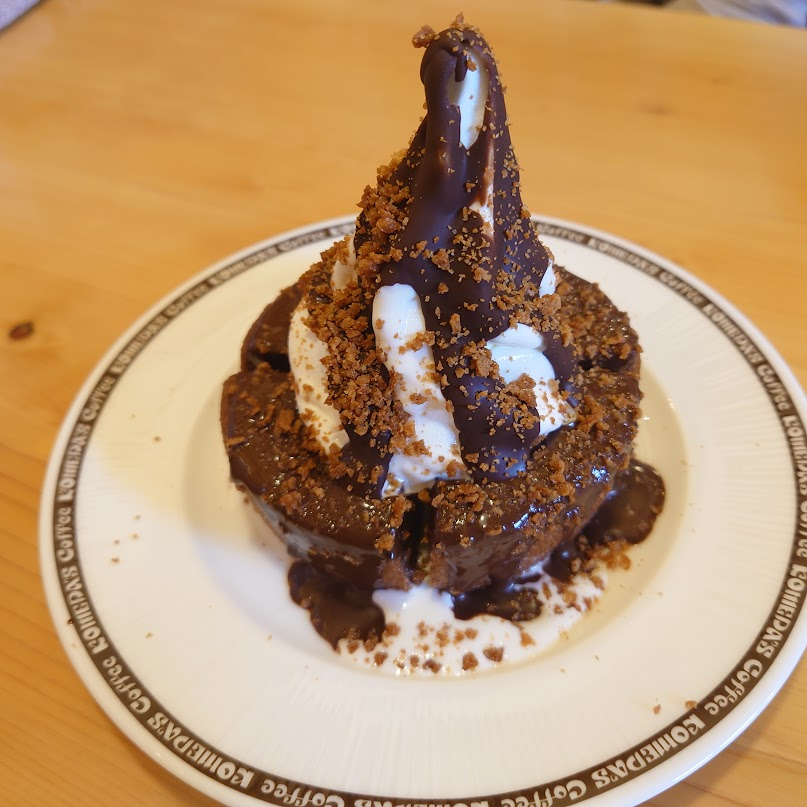
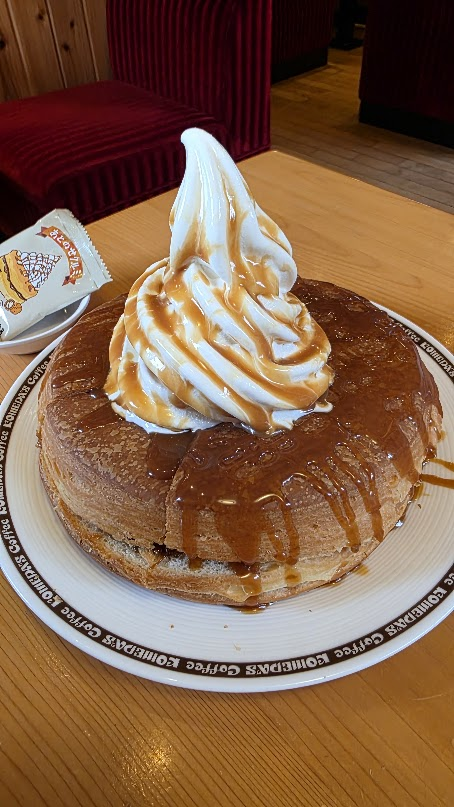
Komeda’s best-known dessert is Shiro-Noir, introduced in 1977.
It combines warm Danish pastry with cold soft-serve ice cream, usually served with syrup.
That contrast—hot pastry, cold ice cream—is central to the dessert. Komeda’s standard Shiro-Noir is substantial enough to be listed at 933 kcal, though a smaller Mini Shiro-Noir is also available.
It is an unusually good representation of Komeda itself.
It is familiar rather than sophisticated.
It is deliberately comforting.
And there is quite a lot of it.
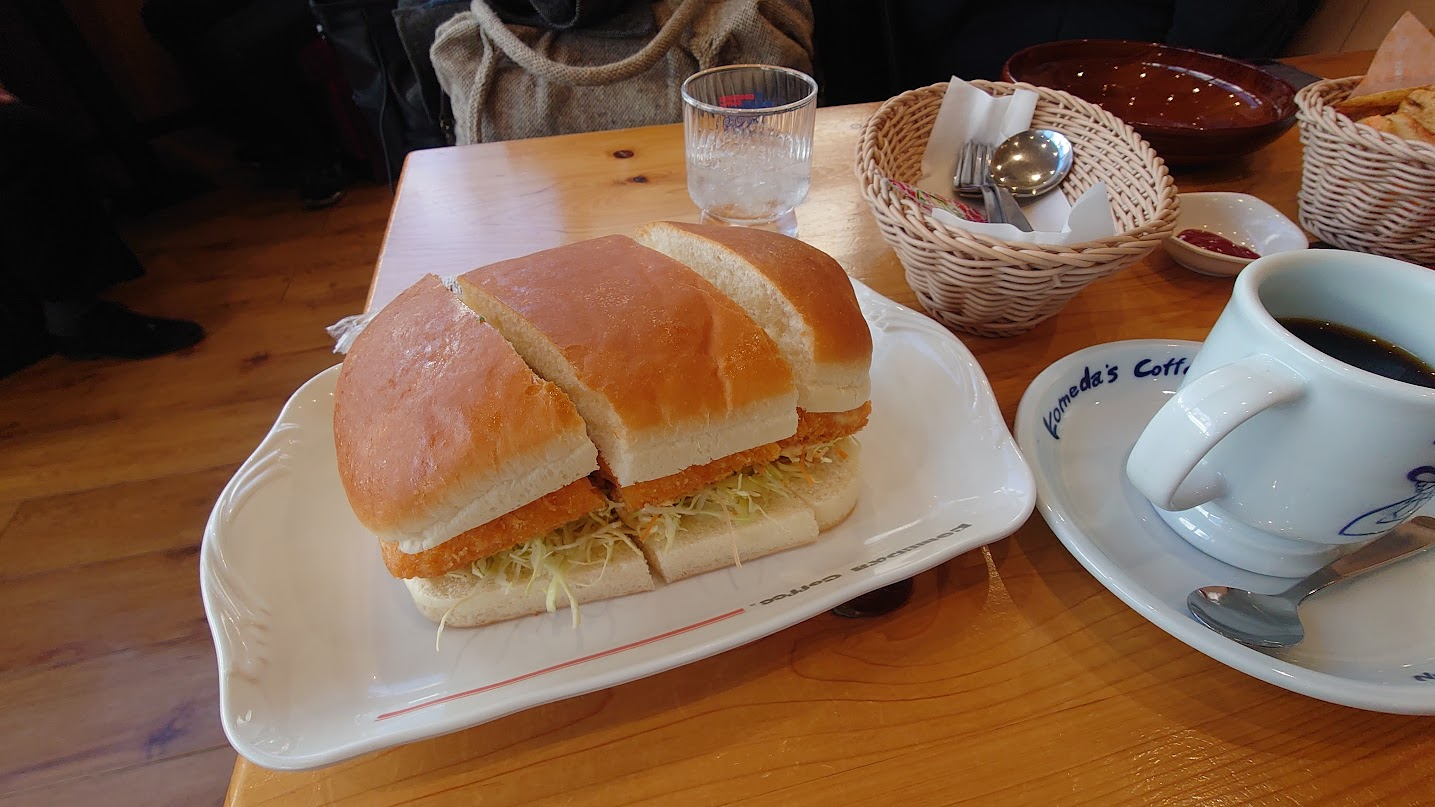
Looking through my older Komeda photographs, the same theme appears repeatedly: a large sandwich occupying most of a plate, thick toast, a substantial chocolate dessert topped with soft serve, coffee served beside food that is difficult to describe as a “light snack.”
None of these dishes is trying particularly hard to look elegant.
They are trying to make you happy.
A huge chain that still tries to behave like a neighborhood coffee shop
There is another interesting contradiction at the heart of Komeda.
It is enormous.
With more than a thousand Komeda’s Coffee locations, this is clearly no longer a local Nagoya coffee shop.
Yet structurally, the company still depends heavily on local franchise operators. Komeda Holdings’ 2025 integrated report said 94% of its stores were franchise-operated, and described franchise owners as independent business partners expected to create a form of kutsurogi—relaxation or comfort—appropriate to their own communities.
That may help explain why Komeda can feel both standardized and oddly local at the same time.
The coffee cup looks familiar.
The red sofa looks familiar.
The menu looks familiar.
But the experience has more of the rhythm of a neighborhood coffee shop than a highly optimized fast-service chain.
Komeda has essentially industrialized the kissaten experience without completely removing the things that make a kissaten pleasant.
That is harder to do than it sounds.
Maybe the oversized sandwich is not the strange part after all
My takeaway order initially made me think again about Komeda because the sandwich was so comically large.
But the more interesting question is why that enormous sandwich does not feel out of place there.
The answer seems to be that it belongs to a much larger system.
Komeda grew out of the coffee culture of Nagoya and Aichi, where a cup of coffee could come with breakfast because giving the customer something extra was normal. It retained table service when many café chains moved toward self-service. It designed stores around staying rather than leaving. It made food large enough to become either a full meal or something to share.
And then the internet gave all of this a wonderful name:
the reverse photo scam.
It is obviously not a scam.
It is almost the opposite.
You order something based on the picture.
The real thing arrives.
And somehow you receive more trouble than you expected.
The good kind of trouble.
You may have ordered too much.
You may have to share it.
You may wonder why a “coffee shop sandwich” is taking up most of your table.
But you will probably be happy about it.
And that may be the most Komeda thing of all.