A colleague recently came back from a trip to Nagasaki and brought some sweets to the office.
This is an entirely ordinary scene in Japan.
Someone goes on a trip. On the way home, they stop at a station, airport, or souvenir shop and buy a box of local sweets. Back at work, the box appears in the office. Everyone takes one.
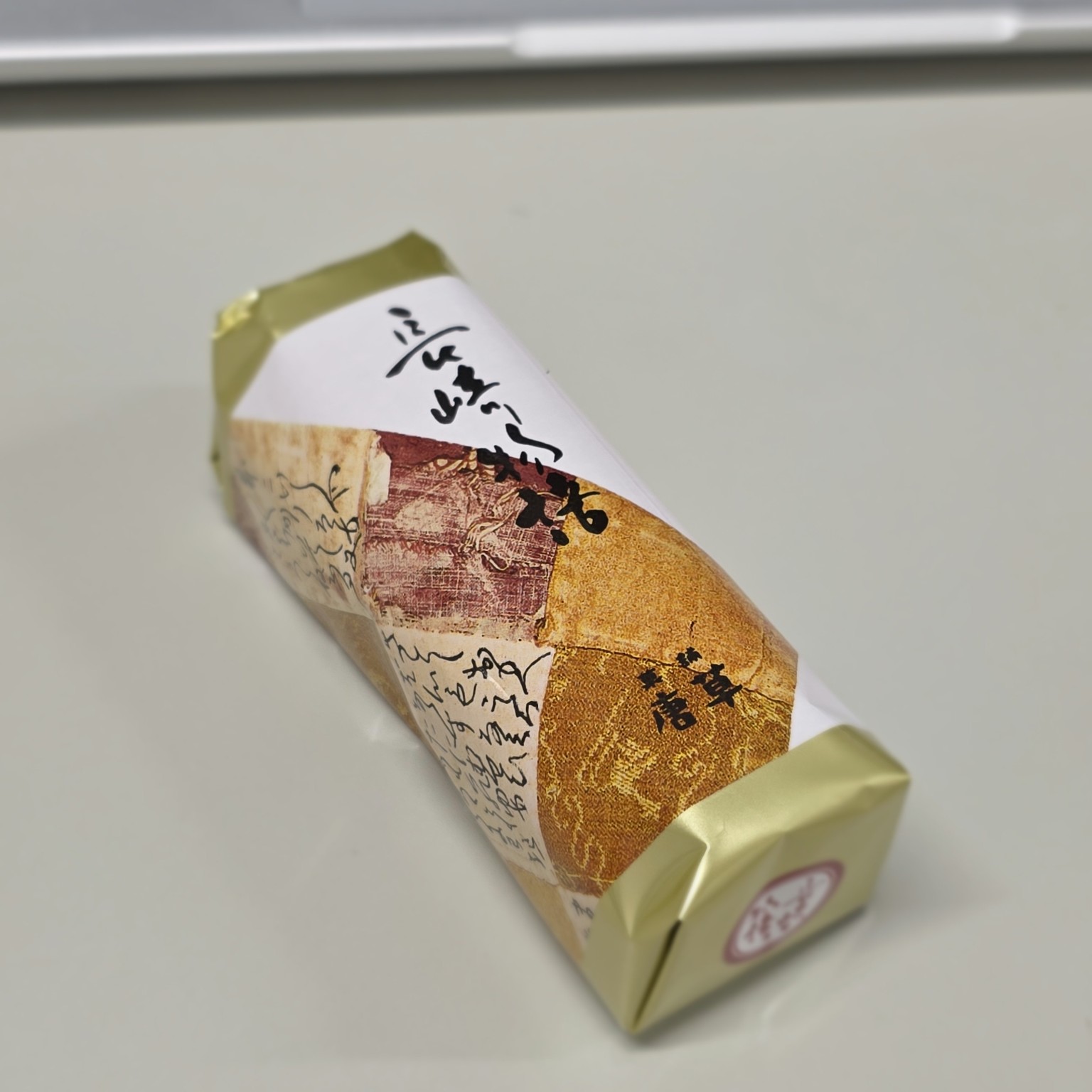
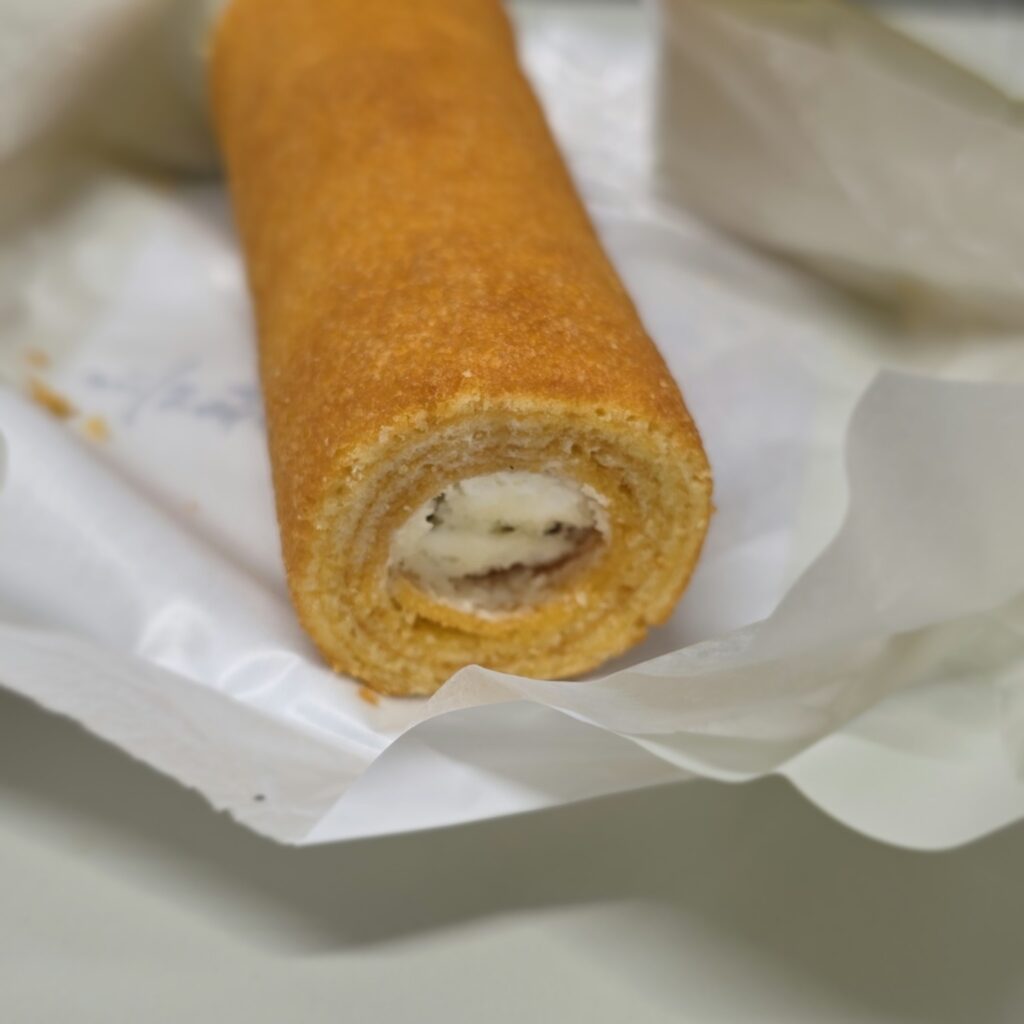
This time, mine was a small cake called Nagasaki Monogatari, or “Nagasaki Story.”
At first, I simply thought: Ah, a Nagasaki omiyage.
But then I looked more closely at the wrapper.
It was covered with what looked like fragments of an old handwritten letter.
That small observation eventually led back almost 400 years, to Nagasaki and Hirado, Batavia, forced exile, international trade, and a woman named Koshoro.
And it also made me think about something Japanese people rarely stop to explain:
What exactly is an omiyage?
- “Souvenir” is not quite the same word
- There is also pleasure in recognizing the classics
- Japan has designed food around this ritual
- And then there was my Nagasaki cake
- The old writing on the wrapper is real
- “How I long for Japan”
- A small cake can carry an extraordinary amount of geography
- The souvenir shop as a miniature map of Japan
- From Nagasaki to an office desk
- Sources and further reading
“Souvenir” is not quite the same word
Omiyage is usually translated into English as “souvenir.”
That translation works, but only approximately.
A souvenir is often centered on the traveler: a physical reminder that I went there. A magnet, T-shirt, keychain, postcard or local object can preserve the memory of a journey.
Japanese omiyage can do that too. But there is another strong direction built into the culture: you bring something from the place you visited back to people who did not go.
Japan’s National Museum of Japanese History describes omiyage as the custom of buying notable local items at a travel destination and giving them to friends, relatives and other acquaintances. Its exhibition on omiyage even examined what happens after the journey, including records of omiyage consumed in workplaces.
In other words, the little cake sitting on my desk was a textbook example.
I had not travelled to Nagasaki.
Someone else had.
Yet part of Nagasaki had arrived at my workplace.
There is also pleasure in recognizing the classics
But I do not think gift-giving alone explains why Japanese omiyage are interesting.
There is also something closer to collective recognition.
Tokyo Banana is an obvious example. Hato Sablé is another. White Lover in Hokkaido, yatsuhashi in Kyoto, Akafuku in Ise, momiji manju in Hiroshima, Hakata Torimon in Fukuoka—the exact list changes depending on who you ask, but Japanese people build strong associations between places and their “classic” sweets.
The interesting reaction is often not:
“What is this? I have never seen it before.”
It is:
“Oh, this one.”
That recognition is part of the enjoyment.
The familiar product itself becomes a geographical signal. You see the box and immediately know where someone has been.
So Japanese omiyage culture contains a slight paradox.
Travel is about encountering something new, but omiyage often succeed precisely because they have become familiar regional standards.
It is not “this again.”
It is more like: “Yes, this one.”
Japan has designed food around this ritual
Once you notice this, Japanese railway stations and airport shops begin to look different.
Many famous omiyage sweets share the same practical features. They come in boxes. They are divided into individual portions. They are easy to carry. They often keep reasonably well at room temperature. And there are different box sizes depending on how many people you intend to give them to.
That design makes enormous sense when the destination is not just your kitchen, but perhaps an office of ten or twenty people.
A 2023 study of 700 Japanese respondents found six major factors people seek in food omiyage: certainty, gift suitability, uniqueness, locality, experiences and memories, and famousness.
That last factor matters.
A good omiyage does not necessarily have to surprise the recipient.
Sometimes it works because the recipient already knows exactly what it represents.
This is one reason a Japanese souvenir shop can feel almost like a miniature map of the country. Rows of boxes tell you which foods a region has decided to associate with itself: local ingredients, landmarks, historical figures, traditional motifs, famous stories, and sometimes products invented only a few decades ago that have already become “the classic.”
The shop is commercial, of course. But it is also a small exhibition of regional identity.
And then there was my Nagasaki cake
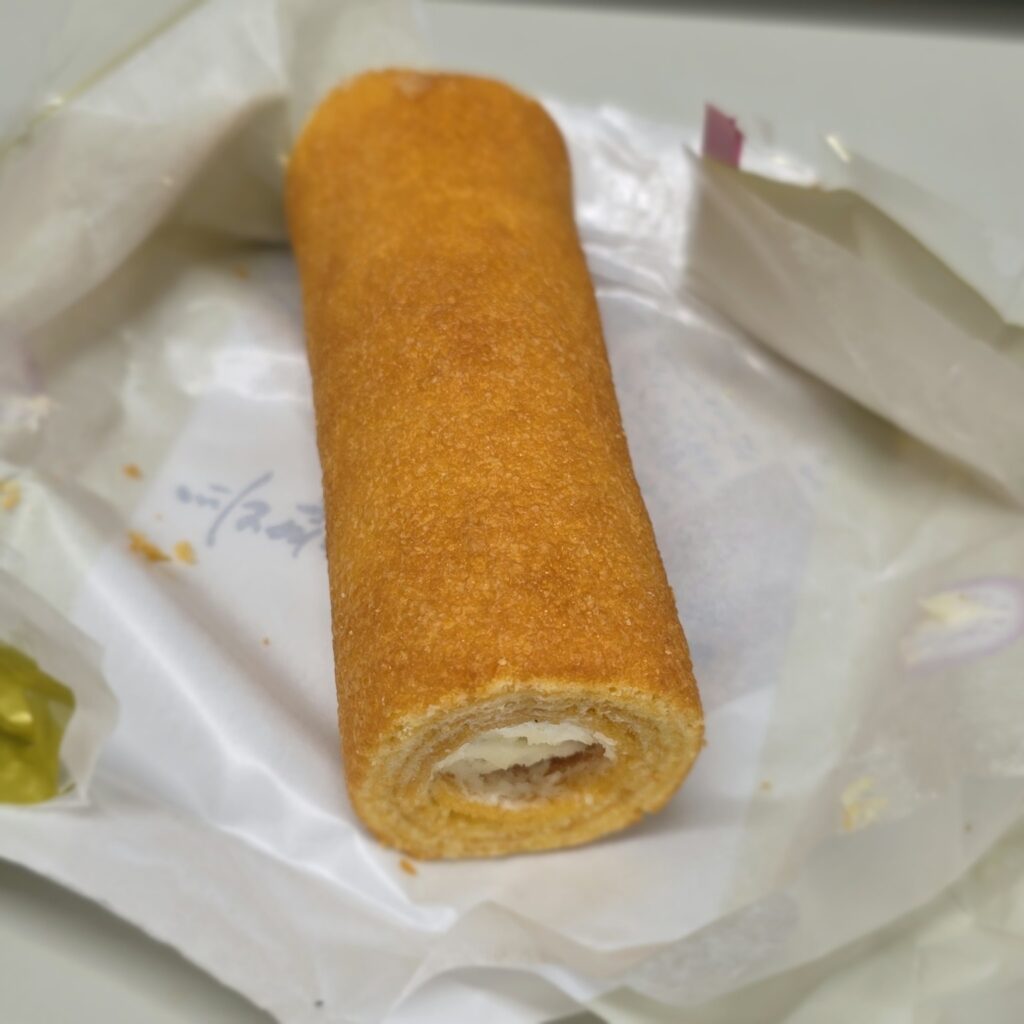
The sweet I received was Nagasaki Monogatari, made by the Nagasaki confectioner Kaho Karakusa.
The cake itself is unusual: a long, narrow Baumkuchen with cream running through the center.
Karakusa says Nagasaki Monogatari was developed in April 1967, when the confectionery division of Ehara Pan created a slender Baumkuchen filled with cream. Only two months later, it was adopted for ANA in-flight service. Karakusa became an independent company the following year, in 1968.
The shape was unusual enough at the time that the company says it worked with a machinery manufacturer to develop the equipment needed to bake the long, thin Baumkuchen. Even today, the cream is filled into the cakes one by one by hand.
It is already an interesting piece of Japanese confectionery history: a German-derived cake form, reworked into a local Nagasaki product in the 1960s.
But the wrapper is where the story becomes much stranger.
The old writing on the wrapper is real
The collage-like pattern on Nagasaki Monogatari is not simply “historical-looking” graphic design.
It reproduces a Jagatara-bumi, a letter associated with a woman named Koshoro.
In 1639, as the Tokugawa shogunate tightened restrictions on Christianity and foreign relations, children of European fathers and Japanese mothers were among those expelled from Japan to Batavia—today’s Jakarta, Indonesia.
Letters sent from there to relatives and acquaintances in Japan became known as Jagatara-bumi. “Jagatara” was an old Japanese name associated with Jakarta.
Koshoro’s surviving letter is particularly striking because it was not simply written on an ordinary sheet of paper.
According to Nagasaki City, the object is roughly 20 centimeters square and made from pieces of sarasa, patterned cotton fabric, sewn together in a checkerboard-like arrangement. Her writing appears on the light sections of this cloth wrapper.
Now look again at the package.
The patches of brown, red, cream and handwriting suddenly make sense. They are not just retro decoration. The design is reproducing the form of an actual historical object.
“How I long for Japan”
One of the best-known lines in Koshoro’s message is:
“Nihon koishi ya, koishi ya.”
Roughly: “How I long for Japan, how I long for Japan.”
Nagasaki City’s modern rendering describes someone who had left Japan, understood that she could not return to her homeland, and wept until she could scarcely distinguish dream from reality.
Karakusa deliberately chose Koshoro’s Jagatara letter for Nagasaki Monogatari’s packaging and has continued to explain the story as part of the product’s identity.
That creates an extraordinary contrast.
I received a small sweet because someone had taken a modern domestic trip to Nagasaki.
Its wrapper, however, preserves the words of someone who left Japan centuries ago and could not return.
The story underneath this light office snack is much heavier than the snack itself suggests.
A small cake can carry an extraordinary amount of geography
There are several layers of movement packed into this single product.
Baumkuchen came to Japan from Europe and became part of Japanese confectionery culture.
Nagasaki Monogatari turned it into a long cream-filled cake in the 1960s.
Its packaging evokes a 17th-century letter connecting Japan with Batavia.
The original letter was written on sarasa fabric, itself tied to the wider movement of textiles and designs across Asia.
And in 2026, a traveler bought one in Nagasaki and carried it back to an ordinary workplace.
Four centuries of movement ended, temporarily, on a desk.
That is perhaps a better way to understand omiyage than simply calling it a souvenir.
The souvenir shop as a miniature map of Japan
When visiting Japan, souvenir shops in major stations and airports are easy to dismiss as commercial spaces positioned conveniently between sightseeing and the train home.
But they are also interesting cultural spaces.
Rows of boxes tell you which foods a region has decided to associate with itself.
Some are based on local agricultural products. Some use famous landmarks. Some are modern inventions that became traditions surprisingly quickly. Others, like Nagasaki Monogatari, deliberately package a much older local history.
And Japanese consumers participate in that system.
We recognize the classics. We compare them. We have favorites. We sometimes deliberately choose the obvious one.
Receiving a famous regional sweet can feel less like discovering an unknown food and more like meeting an old representative of a particular place.
There is pleasure in that predictability.
From Nagasaki to an office desk
What I like most about this example is how little ceremony was involved.
A colleague travelled to Nagasaki.
They brought sweets back.
I received one.
That was all.
Yet by looking carefully at the wrapper, an ordinary piece of office omiyage opened onto the history of 17th-century Japan and Batavia.
The Japanese word omiyage can certainly be translated as “souvenir,” and cultures around the world have their own traditions of bringing gifts home from journeys. It would be wrong to claim that this impulse belongs only to Japan.
But Japan has developed the practice into a remarkably visible everyday system: regional classics, carefully designed boxes, individually wrapped portions, railway and airport shops, workplace distribution, and the shared pleasure of recognizing what comes from where.
Sometimes the sweet itself is the story.
Sometimes the box is.
And sometimes, as with Nagasaki Monogatari, even the wrapper has been carrying a story for nearly 400 years.
Sources and further reading
- Kaho Karakusa — Nagasaki Monogatari
- Kaho Karakusa — Company history
- Kaho Karakusa — The thinking behind its confectionery
- Nagasaki City — Koshoro and the Jagatara-bumi
- National Museum of Japanese History — Souvenirs as Mirror of Japanese Culture
- Suzuki, Hanai & Kim (2023) — What Do Tourists Require for Omiyage?