One of the small mysteries of traveling in Japan appears sooner or later when you finish a drink or open a snack.
You start looking for a trash can.
There may be vending machines everywhere. Convenience stores are easy to find. The streets are generally clean.
Yet a public trash can can be surprisingly difficult to find.
For people who live in Japan, this does not usually feel particularly strange. The usual expectation is simple: if there is nowhere appropriate to throw something away, you keep it with you and dispose of it later.
For years, Shibuya Ward promoted essentially the same idea: take your own trash home with you.
But in 2026, Shibuya changed its approach.
Since June 1, anyone caught littering in Shibuya can be charged ¥2,000. The rule applies throughout Shibuya Ward, not just around the famous scramble crossing. It applies to Japanese people and foreign visitors alike.
At first glance, this sounds like a simple story about stricter rules.
It is more interesting than that.
Because Japan’s clean streets have never depended entirely on Japanese people being unusually well behaved.
Japanese people litter too.
And Shibuya’s new rules are a useful reminder that keeping a city clean requires more than good manners.
- Japan’s Strange Combination: Few Trash Cans, Clean Streets
- People Respond to the Environment Around Them
- Shibuya Decided the Old System Was No Longer Enough
- If You Litter in Shibuya, It Can Now Cost ¥2,000
- Is Shibuya Becoming Like Singapore?
- Shibuya Is Not Only Punishing the Person Who Drops the Trash
- Why Not Just Put More Public Trash Cans Everywhere?
- Japan Is Clean, But Not Magically Clean
- A Small Rule That Says Something Bigger About Japan
- Sources
Japan’s Strange Combination: Few Trash Cans, Clean Streets
Visitors often notice the contradiction.
Japan has relatively few public trash cans, yet its streets are often remarkably clean.
This is frequently explained through Japanese culture.
People are expected not to inconvenience others. Carrying an empty bottle or food wrapper until you find somewhere appropriate to dispose of it is normal. Throwing rubbish onto the street is socially frowned upon.
There is truth in this.
But there is a danger in turning it into a story about Japanese people simply being cleaner or more disciplined than everyone else.
Japan is not spotless.
Japanese people do not always follow the rules.
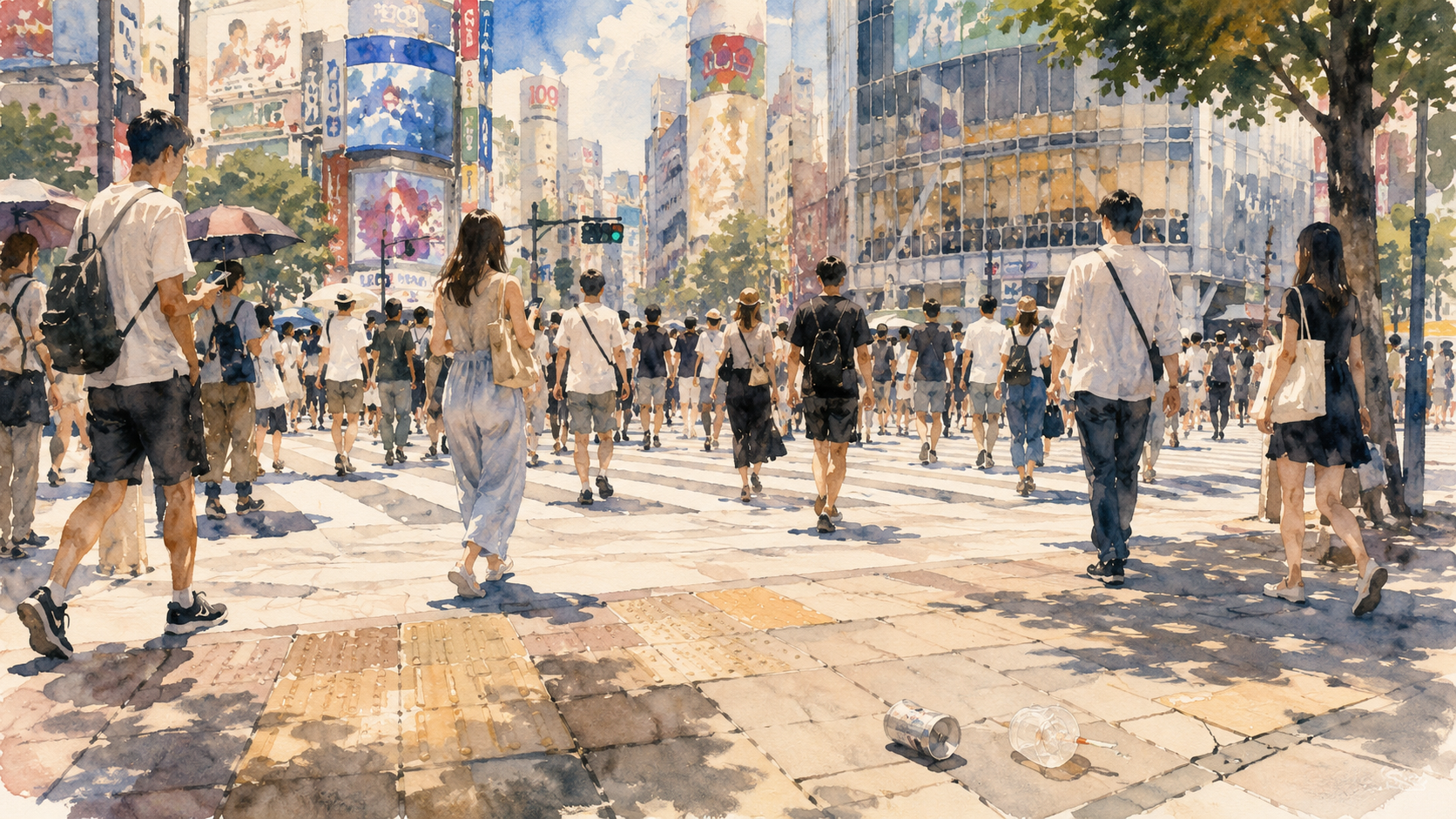
Walk through a busy entertainment district late at night or early in the morning and you can find discarded cans, cigarette butts, food containers and other rubbish.
Shibuya would hardly need a littering ordinance if everyone already behaved perfectly.
The cleaner streets seen during much of the day are not produced by manners alone.
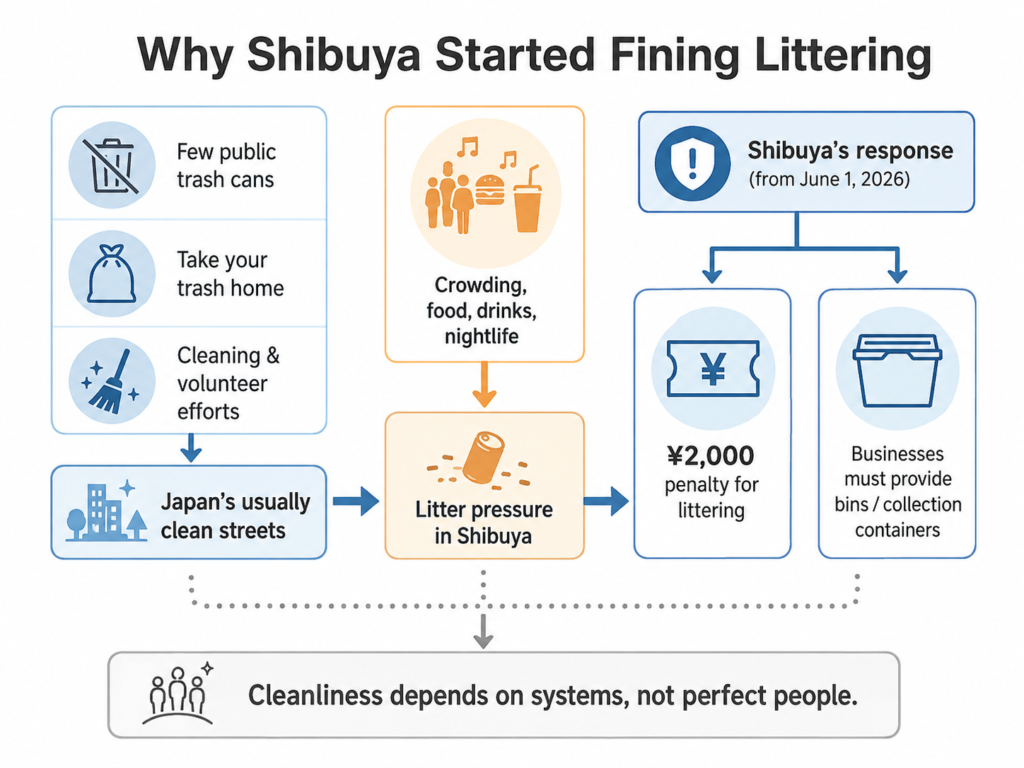
Stores deal with waste. Vending machines often have collection containers nearby. Railway stations and commercial buildings provide disposal points. Municipal workers, private businesses, neighborhood organizations and volunteers clean public spaces.
And most individuals usually cooperate with that system.
Cleanliness is therefore not simply a national personality trait.
It is the result of many people, organizations and rules working together.
People Respond to the Environment Around Them
There is another very ordinary part of human behavior that is worth acknowledging.
People tend to respond to the environment around them.
If a street is clean, most people hesitate to be the first person to drop something there.
If rubbish is already piling up, the psychological barrier becomes lower.
If thousands of people are eating and drinking in the same area, there are few convenient places to dispose of the resulting waste, and nobody seems personally responsible for the space, keeping that street clean becomes considerably harder.
Japanese people are not immune to this.
A crowded entertainment district can produce exactly the same problems here as elsewhere.
That distinction matters because Shibuya’s problem should not be reduced to a story about foreign tourists arriving in Japan and making the city dirty.
Shibuya is used by local residents, Japanese commuters, domestic tourists, young people coming for nightlife, shoppers, workers and international visitors.
All of them generate waste.
All of them can litter.
And all of them respond to the environment and rules around them.
The real issue is scale.
When enormous numbers of people concentrate in one district, a system that works perfectly well on a quiet residential street may stop working so well.
Shibuya Decided the Old System Was No Longer Enough
For years, Shibuya relied heavily on the familiar Japanese principle that people should take responsibility for their own rubbish.
The ward promoted people taking their trash home, alongside cleaning activities and awareness campaigns.
But Shibuya says the number of people visiting the area increased after the COVID-19 pandemic, while litter also increased.
Importantly, an increase in visitors does not automatically mean an increase in foreign tourists alone.
Shibuya attracts people from across Tokyo and across Japan as well as from overseas.
What matters is that more people means more drinks, more takeaway food, more packaging and more opportunities for rubbish to end up somewhere it should not.
The ward eventually concluded that awareness campaigns and voluntary cleanup activities were no longer sufficient on their own.
That is a significant change.
The old assumption was essentially:
People should take their trash home.
The new approach is closer to:
People should still take responsibility for their trash, but the city also needs enforcement and better disposal infrastructure.
If You Litter in Shibuya, It Can Now Cost ¥2,000
From June 1, 2026, Shibuya introduced a ¥2,000 administrative penalty for littering.
Ward patrol officers can impose the penalty when they directly observe someone littering. The rule applies throughout Shibuya Ward, including privately owned places covered by the ordinance, and to everyone.
By August 7, Shibuya had published preliminary figures showing 508 littering penalties in the first two months of enforcement: 325 in June and 183 in July.
This is worth emphasizing because it can easily be misunderstood overseas.
This is not a special rule for foreign tourists.
Nor is it a nationwide Japanese law.
It is a local ordinance adopted by Shibuya Ward.
Tokyo may look like one enormous city, but it is administratively divided into municipalities, including the 23 special wards.
Shibuya is one of them.
So you can travel through Tokyo without noticing that some everyday rules are being decided at a surprisingly local level.
Is Shibuya Becoming Like Singapore?
The obvious international comparison is Singapore.
Singapore is famous for strict enforcement against littering. Its National Environment Agency has long used financial penalties and, for some offenders prosecuted in court, Corrective Work Orders requiring them to clean public areas. NEA states that a first-time littering offender can receive a S$300 composition sum.
Shibuya’s ¥2,000 penalty is much more modest.
There is also a fundamental difference in scale.
Singapore’s system operates at the national level.
Shibuya’s rule was introduced by one local government inside Tokyo.
So it would be misleading to say that Japan has suddenly adopted the Singapore model.
The comparison is useful for another reason.
Both examples show that clean streets do not simply appear because the people living there possess unusually good manners.
Rules matter.
Enforcement matters.
Waste collection matters.
Urban design matters.
And social expectations matter.
Different places simply combine those elements differently.
Shibuya Is Not Only Punishing the Person Who Drops the Trash
This may be the most interesting part of Shibuya’s new policy.
Imagine introducing a littering penalty in a city famous for having relatively few public trash cans.
The obvious question is:
Where are people supposed to put their trash?
Shibuya’s answer is not simply to tell individuals to behave better.
The revised system also places more responsibility on businesses.
Operators of applicable vending machines are required to provide collection containers throughout Shibuya Ward.
And in designated busy areas around Shibuya, Harajuku and Ebisu, certain businesses selling food and drinks are required to provide trash cans where customers can easily use them.
That includes businesses such as convenience stores, supermarkets, drugstores, cafés, fast-food restaurants, bakeries, food trucks and some takeaway food operators.
Businesses that fail to comply can ultimately face a ¥50,000 administrative penalty after a staged process of guidance, recommendations, orders and public disclosure.
This makes the policy much more interesting than a simple ban on littering.
The message is no longer only:
Don’t drop your rubbish.
It is also:
If your business generates large amounts of disposable packaging, you have some responsibility for where that packaging ends up.
That is a much more systemic approach.
Why Not Just Put More Public Trash Cans Everywhere?
The obvious solution might seem to be installing more trash cans.
Perhaps Japan should in some places.
But a trash can is not just a metal box placed on a street.
Someone has to empty it.
Someone has to pay for that collection.
Someone has to deal with sorting, contamination and overflow.
The frequency of collection has to match the amount of waste being generated.
And when a business sells hundreds of disposable cups or food containers each day, there is a legitimate question about how much responsibility should fall on the municipality and how much should fall on the business.
Shibuya’s approach tries to distribute that responsibility.
Individuals are expected not to litter.
Businesses that generate certain types of waste are increasingly expected to provide disposal infrastructure.
The ward provides enforcement.
And cleaning still continues in the background.
The old Japanese habit of taking your own trash home has not disappeared.
It has simply stopped being the only answer.
Japan Is Clean, But Not Magically Clean
Japan’s cleanliness is real.
But the explanation is sometimes romanticized.
It is tempting to look at a clean Tokyo street and conclude that Japanese people simply do not litter.
That is not true.
Some do.
Others pick it up.
Businesses dispose of enormous amounts of waste behind the scenes. Cleaning crews work before many people wake up. Local governments create rules. Volunteers clean neighborhoods. Social expectations discourage littering, but they do not eliminate it.
And when conditions change, the system has to change with them.
That is what makes Shibuya’s new rule interesting.
It does not prove that Japanese society has suddenly become less clean.
Nor does it prove that tourists are making Japan dirty.
It shows something much more ordinary.
People are people.
When a place becomes more crowded, when more disposable products are consumed, and when the burden placed on an informal system becomes too large, relying on good behavior alone becomes difficult.
Even in Japan.
A Small Rule That Says Something Bigger About Japan
Most people walking through Shibuya will probably never think about any of this.
They will cross the famous intersection, buy a drink, eat something, look for somewhere to throw the container away and continue with their day.
Most will not receive a ¥2,000 penalty.
But the rule reveals something useful about how Japanese cities actually work.
Japan’s clean streets were never created by perfect people.
They were created by a combination of habits, expectations, infrastructure, cleaning and rules.
Most of the time, that combination works remarkably well.
Sometimes it does not.
And when it stops working well enough, even Japan has to redesign the system.
That may be a more realistic explanation for Japan’s clean streets than simply saying that Japanese people never litter.