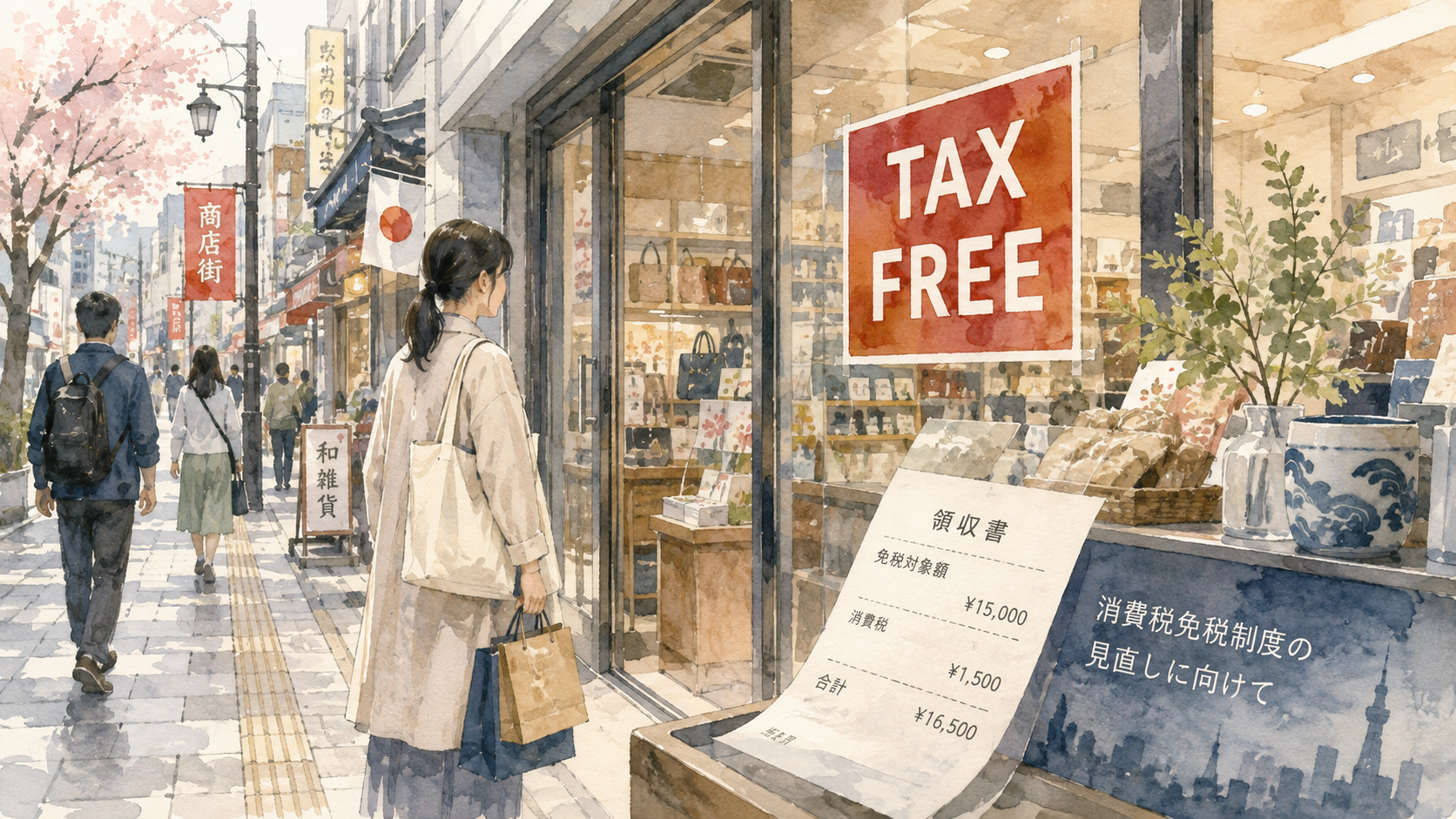
The familiar signs found in Japanese shops tell a larger story about consumption tax, the inbound-shopping boom, domestic resale, and how Japan changes a system after its weaknesses become visible.
Walk through a Japanese shopping district today and the words TAX FREE barely stand out anymore.
They appear at department stores, electronics retailers, drugstores, shopping malls, souvenir shops and increasingly ordinary stores outside the largest cities. For people who live in Japan, the signs have gradually become part of the visual background of the street.
But there is something slightly strange about this familiar scene.
People who live in Japan pay consumption tax when they buy everyday goods. Yet someone visiting from overseas can sometimes buy the same product without paying that tax.
Why?
And why is Japan about to change the system so substantially?
From November 1, 2026, Japan will move its tax-free shopping system to a refund method. Eligible purchasers will initially pay the tax-inclusive price. The tax-free transaction will effectively be completed only after customs confirms that the goods are actually being taken out of Japan, after which an amount equivalent to the consumption tax can be refunded. Japan Tourism Agency
At first glance, this sounds like a technical change affecting international visitors.
It is more interesting than that.
The reform is the latest stage in a much longer transformation of Japanese retail: a policy designed to encourage spending expanded rapidly, became embedded in ordinary Japanese streets, developed opportunities for abuse, and is now being redesigned around a simple question:
Did the supposedly tax-free goods actually leave Japan?
- Tax-free shopping is not simply a discount for foreigners
- How “TAX FREE” became part of the Japanese streetscape
- Then the weakness in the system became difficult to ignore
- The 2026 reform changes when Japan decides something is tax-free
- Curiously, some of the rules will become simpler
- A small sign that reflects a much larger change in Japan
Tax-free shopping is not simply a discount for foreigners
The first thing to understand is that Japan’s tax-free system is not based on the idea that foreign people deserve lower prices than Japanese people.
The legal logic is about where the goods are ultimately consumed.
Japan’s National Tax Agency explains that when eligible non-residents buy goods to take abroad, the transaction is treated in substance similarly to an export. That is why consumption tax can be exempted under specified conditions. National Tax Agency
This distinction matters.
A Japanese resident buying a bottle of cosmetics and using it in Japan is consuming the product inside the Japanese tax system. Someone who buys a product and takes it out of the country is doing something economically closer to exporting that product.
The distinction is also why the system should not be understood simply as a “foreigner discount.” Under certain conditions, Japanese nationals who are non-residents can also qualify for tax-free purchasing. Japan Tourism Agency
Seen this way, the system makes sense.
But it also reveals its fundamental vulnerability.
The tax exemption only makes sense if the goods really leave Japan.
If a product is purchased tax-free and then sold to somebody else inside Japan, the economic premise of the exemption disappears. The product has entered domestic circulation even though the consumption tax that would ordinarily accompany domestic consumption was never collected.
That gap eventually became important.
How “TAX FREE” became part of the Japanese streetscape
The enormous visibility of tax-free signs in Japan is relatively recent.
A major turning point came in October 2014, when Japan expanded the range of products eligible for tax-free sales to include consumable goods such as food, beverages, medicines and cosmetics. The government was explicitly using the system to encourage spending by international visitors and spread that spending beyond a narrow range of expensive goods. Ministry of Land, Infrastructure, Transport and Tourism
The response from retailers was dramatic.
In April 2014, Japan had 5,777 tax-free shops. By October 2015, that number had risen to 29,047. MLIT White Paper
The change coincided with the period in which Japan became familiar with the expression bakugai — literally “explosive buying.” Large purchases by international visitors, particularly visitors from China, became sufficiently important that the Bank of Japan discussed the phenomenon when describing changes in Japan’s travel balance and consumer economy. Bank of Japan
It would be easy to remember this period merely as an unusual episode of tourists buying rice cookers, cosmetics and other Japanese products.
But its physical legacy remains all around Japan.
Retailers reorganized counters. Passport checks became routine. Multilingual signs appeared. Dedicated tax-free counters were created. Drugstores and department stores increasingly designed parts of their businesses around overseas demand.
And the number of participating shops continued to grow.
As of September 30, 2025, Japan had 64,499 tax-free shops, including 24,448 outside the three major metropolitan areas. Japan Tourism Agency
That means the TAX FREE sign is not simply an accommodation made for tourists.
It is a visible remnant of a broader change in Japan’s retail economy.
Then the weakness in the system became difficult to ignore
The old system essentially allowed an eligible purchaser to receive the tax exemption at the point of sale, while a collection of rules attempted to ensure that the goods would later leave the country.
Consumables, for example, had special packaging requirements intended to prevent them from being used in Japan. There were purchase limits and different rules for general goods and consumables. The purchaser was required to take the tax-free goods abroad. Japan Tourism Agency
These restrictions were not arbitrary inconveniences.
They were attempts to protect the underlying assumption of the system: tax-free goods should not simply return to the Japanese domestic market.
But the incentives were obvious.
If a product that would normally carry consumption tax could be acquired without that tax and then resold inside Japan, the tax exemption itself created economic value.
Japan’s tax authorities say suspected cases of large quantities and high-value tax-free goods being diverted domestically became frequent enough that the problem could no longer be ignored. The National Tax Agency has also described schemes involving brokers who recruit eligible purchasers, direct them to particular shops and arrange the domestic resale of tax-free goods. It has even requested information about shops suspected of participating in such transactions. National Tax Agency
There was another problem.
Under the existing system, authorities could attempt to collect the exempted consumption tax when a person leaving Japan no longer possessed the goods they were supposed to export.
But according to the National Tax Agency, many such attempts resulted in unpaid tax. National Tax Agency
This exposed a structural weakness.
Japan was effectively trying to do this:
grant the exemption first, then recover the tax later if the assumption behind the exemption turned out to be false.
Recovering money from someone who is about to leave the country is not an especially strong enforcement mechanism.
So Japan decided to reverse the order.
The 2026 reform changes when Japan decides something is tax-free
From November 1, 2026, the logic becomes much simpler.
The goods are initially sold at a tax-inclusive price.
When the purchaser leaves Japan, customs confirms that the relevant goods are actually being taken abroad. For the tax exemption to apply, that confirmation must occur within 90 days of purchase. Once the required confirmation exists, the amount corresponding to consumption tax can be refunded. Ministry of Finance
The important change is therefore not the refund itself.
It is the movement of proof.
Under the previous model, the system largely depended on conditions intended to ensure that a future export would happen.
Under the new model, the exemption depends on confirmation that export is actually happening.
That makes domestic resale much less attractive as an exploitation of the tax-free system: if the goods are no longer available to be taken through customs, the condition necessary for the refund is not satisfied.
The Ministry of Finance states explicitly that the reform is intended to address improper domestic diversion of tax-free purchases. Ministry of Finance
Curiously, some of the rules will become simpler
A crackdown usually makes us imagine additional paperwork, more restrictions and more complicated procedures.
Parts of this reform move in the opposite direction.
Once customs confirmation becomes the central mechanism, Japan will abolish several preventive rules that were needed under the old system. The distinction between general goods and consumables will disappear for this purpose, the ¥500,000 upper limit for consumables will be removed, and the special sealed packaging requirement for consumables will also be abolished. Ministry of Finance
That tells us something important about the intent of the reform.
The Japanese government has not concluded that tax-free retail itself was a mistake.
The Ministry of Finance continues to describe the system as an important policy tool for expanding inbound consumption. The reform is supposed to remove improper use while also reducing burdens on retailers and simplifying some aspects of the system. Ministry of Finance
This matters because overseas shopping has become economically significant. Japan’s Tourism Agency estimated that spending by international visitors on shopping alone reached roughly ¥2.4 trillion in 2024. Japan Tourism Agency
Japan wants that spending.
What it no longer wants is a system in which the tax advantage can survive even when the goods do not leave Japan.
A small sign that reflects a much larger change in Japan
There is a temptation to interpret almost every policy involving international visitors through the language of tourism.
Is Japan becoming friendlier to tourists?
Is Japan becoming less friendly?
Will shopping become more inconvenient?
Those questions are not very useful for understanding this reform.
The more interesting story is domestic.
Over roughly a decade, Japan deliberately expanded a tax exemption to capture a growing form of international consumption. Retailers responded. Tens of thousands of shops joined the system. A distinctive shopping economy developed around it, and TAX FREE signs became part of the ordinary Japanese streetscape.
As the system grew, however, the cost of its original assumptions also grew.
Rules about packaging, purchase limits and eligibility tried to prevent abuse before it occurred. Yet domestic resale still emerged strongly enough for the National Tax Agency to describe the situation as one that could no longer be overlooked. National Tax Agency
The 2026 reform is therefore less a rejection of the tax-free system than a redesign of its logic.
Instead of trying to predict whether a purchase will eventually qualify as an export, Japan will increasingly rely on confirmation that the export actually happened.
That is a subtle administrative change, but it says a great deal about how modern Japan works.
Policies create incentives. Successful policies grow. Growth exposes assumptions that were less important at smaller scale. Digital administration and enforcement make those weaknesses harder to ignore. Eventually, the rules are rebuilt around what can actually be verified.
And so one of the most ordinary signs in a Japanese shopping street turns out to contain a surprisingly large piece of recent Japanese economic history.
The next time you notice TAX FREE printed across a shop window, it is worth seeing it not simply as an invitation to visitors, but as evidence of how much Japan’s relationship with international consumption has changed in little more than a decade.
From November 2026, the sign may look much the same.
The system behind it will not.