Old Japanese books preserved more than words. Human hairs trapped inside their recycled covers now offer a chemical record of how ordinary urban residents lived and ate centuries ago.
An old Japanese book can tell us what people once thought.
Apparently, it can also tell us what they ate.
Researchers in Japan have discovered that human hairs embedded inside the covers of old Japanese books preserve chemical traces of everyday life from centuries ago. By analyzing those hairs, they reconstructed part of the diet and material environment of ordinary urban residents from the seventeenth to nineteenth centuries.
The result is not simply a story about Edo-period food.
It is a story about recycling, publishing, fish, rice, salt, cosmetics—and the unexpected ways ordinary lives survive in physical objects long after the people themselves have disappeared.
- There is human hair inside old Japanese books
- Whose hair was it?
- Reading a diet from a strand of hair
- Rice was not just rice
- The sea reached deep into urban life
- Salt was not simply seasoning
- And not every element came from food
- The ordinary technologies behind a meal
- Japan was already a recycling society—but not for modern reasons
- Books preserve more than words
- A history of people whose names disappeared
There is human hair inside old Japanese books
Traditional Japanese bound books, or wahon, were often made with sturdy covers.
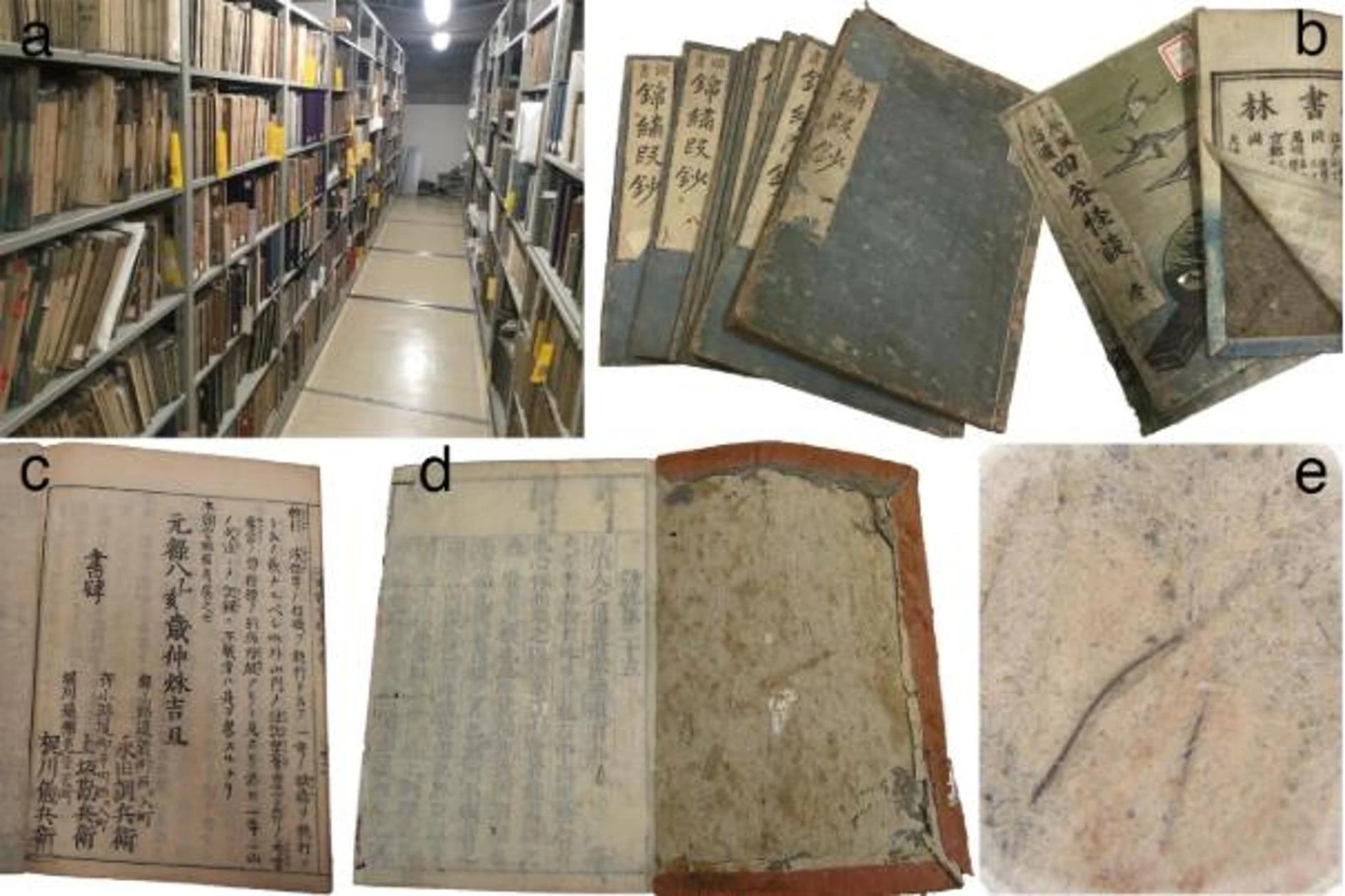
Beneath the better-quality paper visible on the outside was a thicker board made from recycled paper. When discarded paper was pulped and reused, loose human hair sometimes became embedded inside it. Researchers note that the hair may have entered accidentally during recycling, although it is also possible that some hair was deliberately mixed into the pulp to strengthen the material.
This seemingly trivial detail created an extraordinary historical archive.
Researchers screened approximately 70,000 volumes, many held at Ryukoku University’s Omiya Library in Kyoto. Because old Japanese books frequently retain a colophon recording information such as the publication year and location, hairs recovered from their covers could be associated with particular cities and periods.
That is unusually valuable.
Archaeological human remains can reveal a great deal about the past, but bones and teeth are limited in number and involve obvious ethical and preservation issues. Hair records a much shorter period of a person’s life and can preserve both elemental and stable-isotope information.
Here, instead of excavating a grave, researchers could carefully pull a strand of hair from a piece of recycled cardboard.
The book had become a time capsule without anyone intending it to be one.
Whose hair was it?
We do not know.
There are no names attached to these strands. The hairs generally lack roots, making reliable individual identification difficult, and the researchers cannot determine attributes such as age or sex from the available samples.
But that anonymity is part of what makes the study interesting.
Historical records naturally preserve some people better than others. Lords, warriors, wealthy merchants, religious leaders and intellectuals left documents behind. Most people did not.
A loose hair caught in recycled paper is different.
The researchers argue that these hairs probably came largely from urban commoners living around the places where the paperboard was produced and the books were printed. Commercial publishing and paper recycling were concentrated in cities such as Kyoto, Osaka and Edo, and low-value recycled cover material was unlikely to have been transported over great distances.
These are therefore not biographies.
They are fragments of population history.
Reading a diet from a strand of hair
The researchers used two complementary approaches.
First, they analyzed ten elements in historical hair using particle-induced X-ray emission, or PIXE. This allows multiple elements to be measured from a tiny solid sample without dissolving it.
The study compared 104 historical hair samples with 40 contemporary samples collected in Kyoto, Osaka and Tokyo.
Historical hair contained significantly higher levels of chlorine, potassium, calcium, manganese, iron, copper and lead. Sulfur and zinc were higher in modern hair, while silicon showed no significant difference.
Second, the team examined stable isotopes of carbon and nitrogen.
These chemical signatures provide clues about the types of food that contributed to a person’s diet. The historical samples showed a strong dependence on C3 plants—particularly staples such as rice—and a substantial contribution from marine fish.
This broadly fits what historians already know about urban food culture in early modern Japan.
Rice occupied the center of the diet, while relatively inexpensive fish such as sardine and mackerel provided an important source of animal food. Mammalian meat played a much smaller role than it does in contemporary Japan.
But the elemental analysis added something new.
A relatively simple rice-and-fish diet did not necessarily mean low exposure to minerals.
Rice was not just rice
Modern consumers often think of “rice” as a single food.
Historically, how thoroughly the grain was polished mattered.
Minerals including potassium and silicon are concentrated toward the outer portions of a rice grain and are progressively removed by polishing. In the historical hair samples, potassium declined over time, a pattern the researchers interpret as being consistent with increasingly intensive rice polishing.
That seemingly small technological change had consequences.
White rice became strongly associated with urban prosperity, particularly in Edo. Yet removing the outer layers of rice also removes nutrients.
This is the background to the historical disease once called Edo wazurai—the “Edo affliction”—now recognized as beriberi caused by vitamin B1 deficiency.
The prestige of polished white rice and its nutritional consequences are a reminder that a food cannot be understood only by its name.
Processing is part of the diet too.
The sea reached deep into urban life
The isotope results also show the importance of marine foods.
Nitrogen isotope values increased over time in the historical samples, consistent with increasing reliance on marine fish.
That tells us something larger than what appeared on the dinner table.
Cities such as Kyoto and Edo were not coastal fishing villages. Supplying large urban populations with marine products required fisheries, processing, preservation, transport networks and markets.
A piece of fish eaten in a city was therefore the endpoint of an infrastructure.
Fish also interacted with other parts of the food system. Marine resources were not only consumed directly; fish-derived fertilizers played an important role in agriculture, and the researchers note that the relative contribution of direct fish consumption and such indirect pathways cannot yet be fully separated.
One strand of hair cannot reconstruct an entire economy.
But thousands of ordinary meals leave patterns.
Salt was not simply seasoning
One of the clearest differences between historical and contemporary hair was chlorine.
Before refrigeration, salt was not merely something added at the table. It was infrastructure.
Salt preserved fish and other foods long enough for them to be stored, transported and traded. Fermented and salted products were integrated into regional cuisines, while salt itself moved through commercial networks.
The researchers therefore interpret the exceptionally high chlorine signal in historical hair largely in the context of heavy reliance on salt preservation.
From a modern perspective, it is tempting to classify this immediately as “unhealthy.”
That would miss the point.
People did not choose between salted fish and an electrically refrigerated alternative. Refrigeration did not exist.
High salt use was connected to the technologies available for keeping food edible.
What looks like a nutritional choice from the present may have been a logistical necessity in the past.
And not every element came from food
Historical hair also contained much more lead.
That is not evidence of a superior mineral-rich diet.
The researchers suggest that an important source may have been oshiroi, the white face powder used as a cosmetic in early modern Japan. Some formulations contained large amounts of lead. Other environmental sources of exposure cannot be ruled out.
This distinction matters.
Hair chemistry records exposure, not a simple nutritional score.
More of an element does not automatically mean better health.
The study found higher historical levels of several essential elements, but also lead and very high chlorine. Meanwhile, zinc was higher in contemporary hair.
So this research should not be converted into another claim that “people in Edo ate better than we do.”
The past was more complicated than that.
The ordinary technologies behind a meal
Perhaps the most interesting part of the study is how difficult it becomes to separate “diet” from everything surrounding it.
Rice polishing changed the grain.
Fishing and maritime transport changed which protein sources were available.
Salt preservation changed what could travel.
Cookware could change elemental exposure.
Cosmetics introduced substances that had nothing to do with food.
Paper recycling eventually captured the hair containing evidence of all these processes.
And the expansion of commercial publishing preserved that recycled paper in enormous quantities.
What the researchers found is therefore not simply the chemical composition of old meals.
It is the chemical shadow of an urban system.
The food, the tools, the markets and the materials of daily life were connected.
Japan was already a recycling society—but not for modern reasons
There is another small detail worth noticing.
The entire study was made possible because paper was reused.
Early modern Japanese cities developed extensive systems for collecting and repurposing materials with economic value. Used paper could become new paper. Clothing could be repaired and resold. Ash, metal and many other materials circulated rather than immediately becoming waste.
It can be tempting to describe this through today’s language of sustainability.
But people in the Edo period were not following a twenty-first-century environmental philosophy.
Materials were expensive. Labor, markets and scarcity created incentives to reuse them.
The recycled cover of a cheap book was ordinary economic behavior.
Several centuries later, that mundane act of reuse preserved human biological material that scientists could analyze.
Sometimes history survives precisely because nobody thought an object was important.
Books preserve more than words
Researchers have used the term libraromics for the study of biological information preserved inside books and other archival materials.
The idea becomes increasingly interesting as libraries digitize their collections.
Digitization is extraordinarily valuable because it preserves and distributes the information written on a page.
But a digital image preserves only some of what a physical book contains.
The paper itself has a history.
So does the ink.
So do stains, fibers, microorganisms—and, occasionally, human hair.
The Ryukoku University collection contains tens of thousands of historical Japanese books. To a reader, they are texts. To a bibliographer, they are artifacts. And to a scientist, some of them are biological archives.
Those perspectives do not compete with one another.
They reveal different layers of the same object.
A history of people whose names disappeared
There is something especially fitting about finding this evidence in recycled paper.
We will probably never know the people whose hair ended up inside these books.
We do not know what jobs they had.
We do not know what they worried about.
We do not even know whether a particular strand belonged to the person who handled the wastepaper, lived in the house where it was discarded, or worked somewhere along the recycling process.
But the chemistry remains.
It tells us that urban life was structured around rice and marine foods. That food processing changed over time. That salt linked preservation to trade. That material culture affected what entered the human body.
These people did not intend to leave us records.
Their names vanished.
A few strands of their hair did not.
And centuries later, inside the covers of ordinary Japanese books, they are still telling us something about how ordinary Japan once lived.
Source: Maruyama, A. et al. “Book-embedded hair reveals mineral-rich diets among urban commoners in early modern to modern Japan.” Scientific Reports 16, 23469 (2026). Original paper
Featured image: Maruyama et al., Scientific Reports (2026), CC BY 4.0.