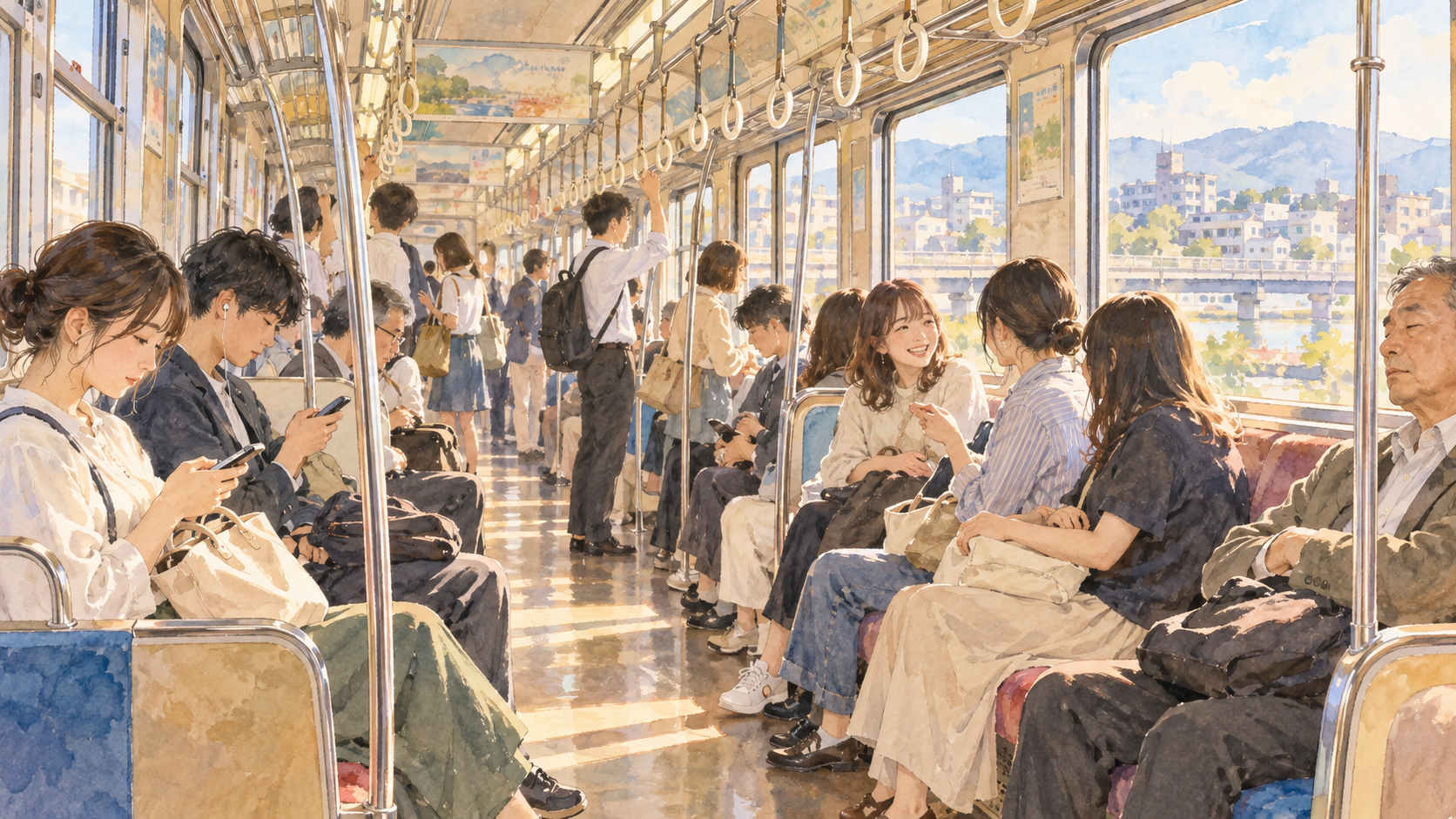
Japan is often described as a quiet country. Visitors notice the orderly queues, the subdued atmosphere on commuter trains, and the way strangers share public spaces without speaking to one another.
But is Japan equally quiet everywhere?
Living in the Kanto region, I had become accustomed to local trains. Some passengers read or look at their phones; others sleep or quietly watch the scenery. Conversations happen, of course, but the overall atmosphere often feels subdued. I hardly thought about it.
Then I traveled to Kansai.
The trains struck me as noticeably livelier. I seemed to hear more conversations and more human voices filling the journey. It was not necessarily unpleasant or chaotic. It simply felt different.
That small experience made me wonder whether the quietness so often associated with Japan is uniform across the country.
When silence becomes the background
One of the curious things about everyday culture is that we rarely notice habits we have grown used to. Travel on relatively quiet trains often enough, and that quietness becomes the default. You stop noticing the absence of conversation.
Only when the atmosphere changes do you recognize what you had taken for granted.
But what exactly changed during my trip? Perhaps more passengers were speaking. Perhaps the conversations were easier to hear. Or perhaps I was so accustomed to the trains of Kanto that an ordinary level of conversation elsewhere felt unusually lively.
A personal observation cannot distinguish these possibilities. Still, it raises a question worth exploring: how much conversation do people expect in a shared public space?
Talking on a Japanese train is not forbidden
The familiar image of a completely silent Japanese train is misleading.
The Japan National Tourism Organization says that conversation in a soft voice is acceptable on trains, while talking on a phone is generally discouraged. West Japan Railway Company similarly asks passengers to refrain from speaking loudly or shouting.
The underlying principle is not absolute silence but consideration for others.
A carriage in which several groups are chatting quietly may respect the same rules as one in which almost nobody speaks. Yet the two can feel completely different.
Written etiquette does not fully describe everyday social atmosphere.
The subtle rhythm of conversation
Research suggests that regional differences in Japanese conversation can involve more than speaking volume.
In a 2021 study, Yuki Ota examined the timing of aizuchi: short listener responses such as un, hai, and sou desu ne that show attention and help the conversation flow.
In the Tokyo conversations analyzed, these responses tended to follow expressions marking the end of a sentence. In the Osaka conversations, they appeared more often at certain points before a sentence was complete, including after connecting expressions.
The study points to subtly different ways of coordinating interaction between speakers and listeners.
This was not a study of conversations on trains. It does not establish that everyone in Tokyo or Osaka speaks in the same way. Rather, it illustrates how the rhythm of interaction can vary within Japan.
A lively atmosphere is shaped by more than decibels.
Does a lively atmosphere mean greater tolerance for noise?
A railway manners survey offers an unexpected perspective.
The Japan Private Railway Association received 5,202 responses to an online survey conducted in October and November 2025. Respondents identified behaviors that bothered them in stations and trains.
For “noisy conversations and boisterous behavior,” the shares selecting that category were:
- Kanto, nine major private railway companies: 28.9%
- Kansai, five major private railway companies: 34.3%
The Kansai group selected this type of behavior more frequently than the Kanto group.
That may sound surprising if the trains in Kansai feel more conversational. But these figures measure reported annoyance, not how much people actually talk. The survey did not record noise levels or count conversations, and participation was voluntary. It cannot establish whether ordinary conversation is more common or more acceptable in either region.
A train can feel lively while its passengers still dislike disruptive noise. Friendly conversation and unwanted noise are not the same thing.
There is no single sound of Japan
Kanto is more than Tokyo, and Kansai is more than Osaka. Neither is culturally uniform.
Even on the same line, a crowded weekday commuter train may sound different from an afternoon local service. Students traveling together, families, commuters, and visitors all affect the atmosphere. Time of day, crowding, and the purpose of a journey may matter as much as geography.
That is why I would not turn one experience into a claim that “Kansai people are noisy” or “Kanto people never talk.” Nor is there any reason to declare one atmosphere more polite.
The more interesting possibility is that the amount of conversation and social distance that feel natural can vary within the same country.
The quietness I had never noticed
Japan is often introduced through broad descriptions: orderly, polite, quiet. Those descriptions can be useful, but they can also make a country seem more uniform than it is.
Before traveling to Kansai, I hardly noticed how quiet the trains around me in Kanto often felt. It was simply part of daily life.
Encountering a different atmosphere made that familiar quietness noticeable for the first time.
Sometimes you do not need to cross a national border to discover a cultural difference. A train ride within your own country may be enough.
Japan may be famous for its quiet trains. But the sounds of everyday Japan are not always the same.
And perhaps that is worth listening to.
Related reading: Japanese Trains Are Quiet, But the Ads Are Always Talking.