Japan’s most familiar instant noodle has always started with boiling water. In the summer of 2026, Nissin changed that rule—and the result sold far faster than expected.
There are some instructions you barely need to read in Japan.
Open a Cup Noodle.
Pour in boiling water.
Wait three minutes.
Eat.
The routine is so familiar that the words almost disappear.
Which is why the large red warning printed on a new Cup Noodle this summer looks so strange:
熱湯禁止 — Do not use boiling water.
Instead, the package tells you to take chilled water from the refrigerator, pour in 330 milliliters, and wait five minutes.
Not hot water followed by ice.
Not noodles cooked first and then chilled.
Cold water from the beginning.
I had already found one and eaten it before I knew how unusual the sales story would become.
A few weeks later, it turned out that Nissin had expected its initial supply to last one to two months.
It sold out in about a week.
- The Cup Noodle that tells you not to use hot water
- Five years to make instant noodles work with cold water
- What it actually looks like
- Nissin expected the supply to last one or two months
- Cup Noodle is 55 years old—and boiling water was part of its identity
- The product was explicitly developed for hotter summers
- Heat changes small habits before it changes entire lifestyles
- The phrase “boiling water prohibited” may be the most interesting part
- Convenience food is really infrastructure in miniature
- This does not automatically make it ideal emergency food
- Why did it sell so quickly?
- The strange thing is that I ate it before realizing it was scarce
- A very small sign of a hotter Japan
The Cup Noodle that tells you not to use hot water
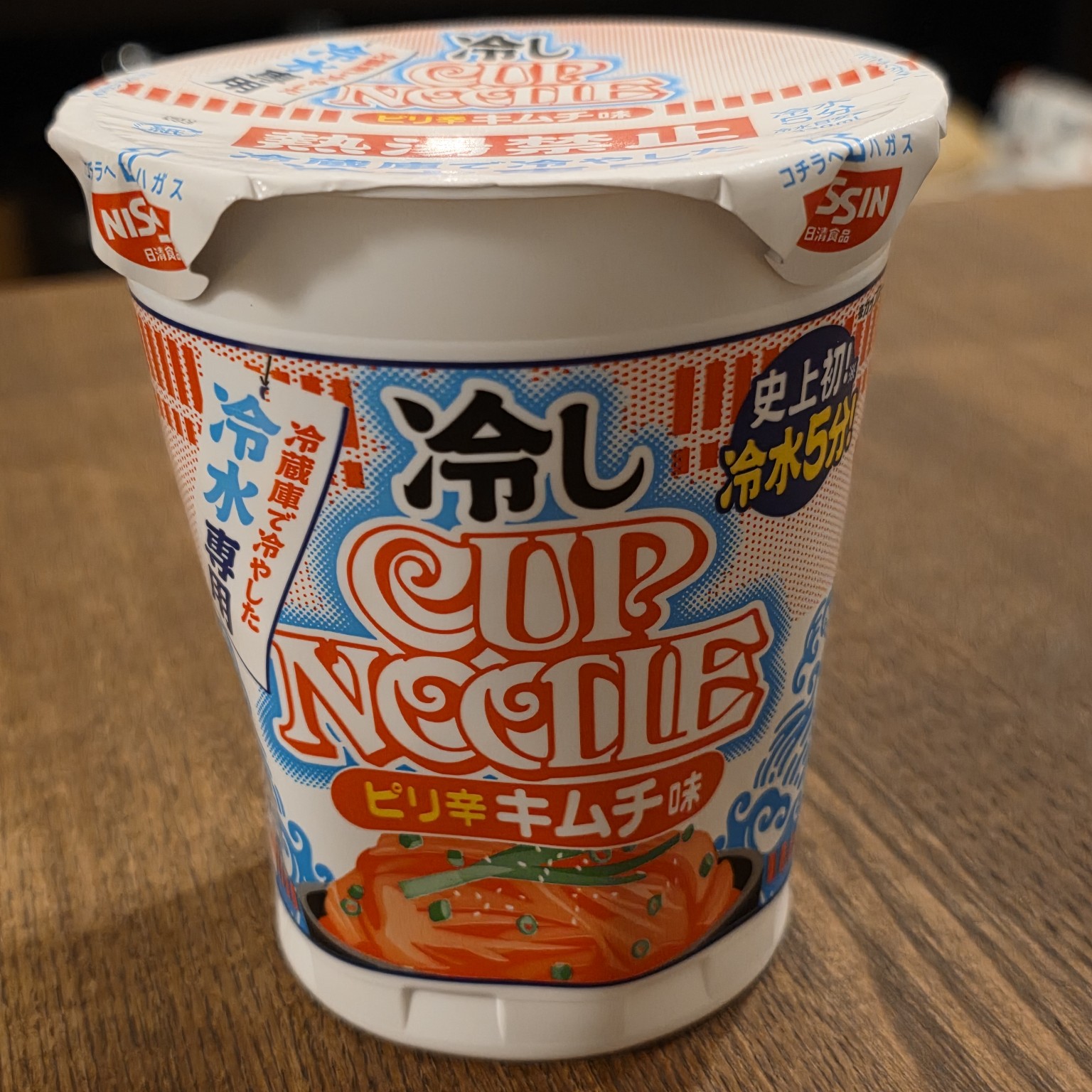
Nissin Foods launched two limited-edition products nationwide on July 20, 2026: Hiyashi Cup Noodle Spicy Kimchi Flavor and Hiyashi Cup Noodle Chicken Salt Lemon Flavor.
The one I tried was the spicy kimchi version.
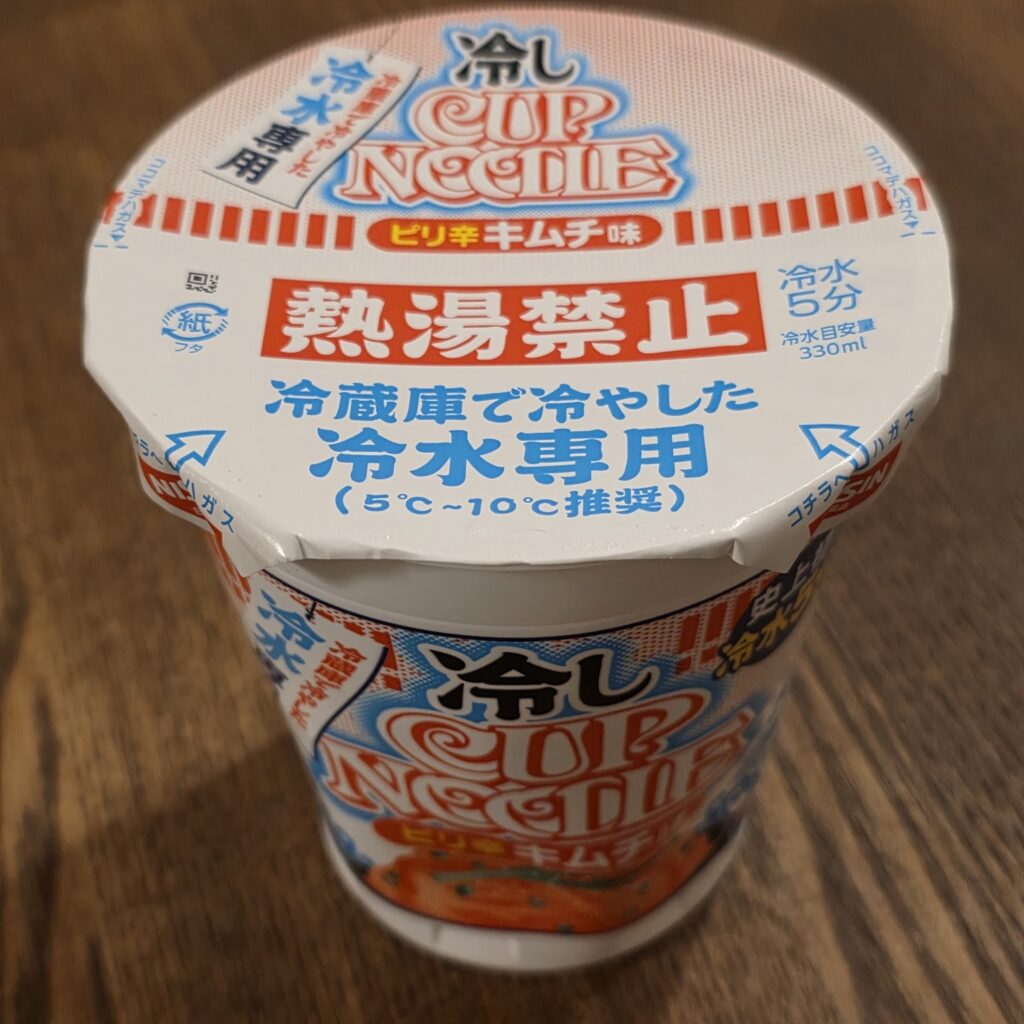
The lid makes very sure that you do not prepare it like an ordinary Cup Noodle.
In large red characters, it says:
熱湯禁止 — boiling water prohibited.
Beside it:
冷水5分 — cold water, five minutes.
And below that, even more specifically:
Use chilled water from the refrigerator. Recommended temperature: 5–10°C.
For a product built around convenience, this is an unusually specific set of instructions.
And that is because the noodles themselves are different.
Five years to make instant noodles work with cold water
Cold-water instant noodles sound simple until you think about what instant noodles actually have to do.
Conventional instant noodles are designed to rehydrate quickly when exposed to very hot water. Heat helps water penetrate the dried noodle structure and restores the texture we associate with instant ramen.
Cold water removes that advantage.
Nissin says it spent five years developing the product and created a patented process called the Cold Rehydrate Method (Cold Rehydrate Seihō).
The noodles are specifically designed to rehydrate in refrigerated water within five minutes while developing the firmness and smoothness expected from a finished noodle.
That technological detail matters.
This is not an ordinary Cup Noodle with different instructions printed on the lid.
The product had to be redesigned around the absence of heat.
What it actually looks like
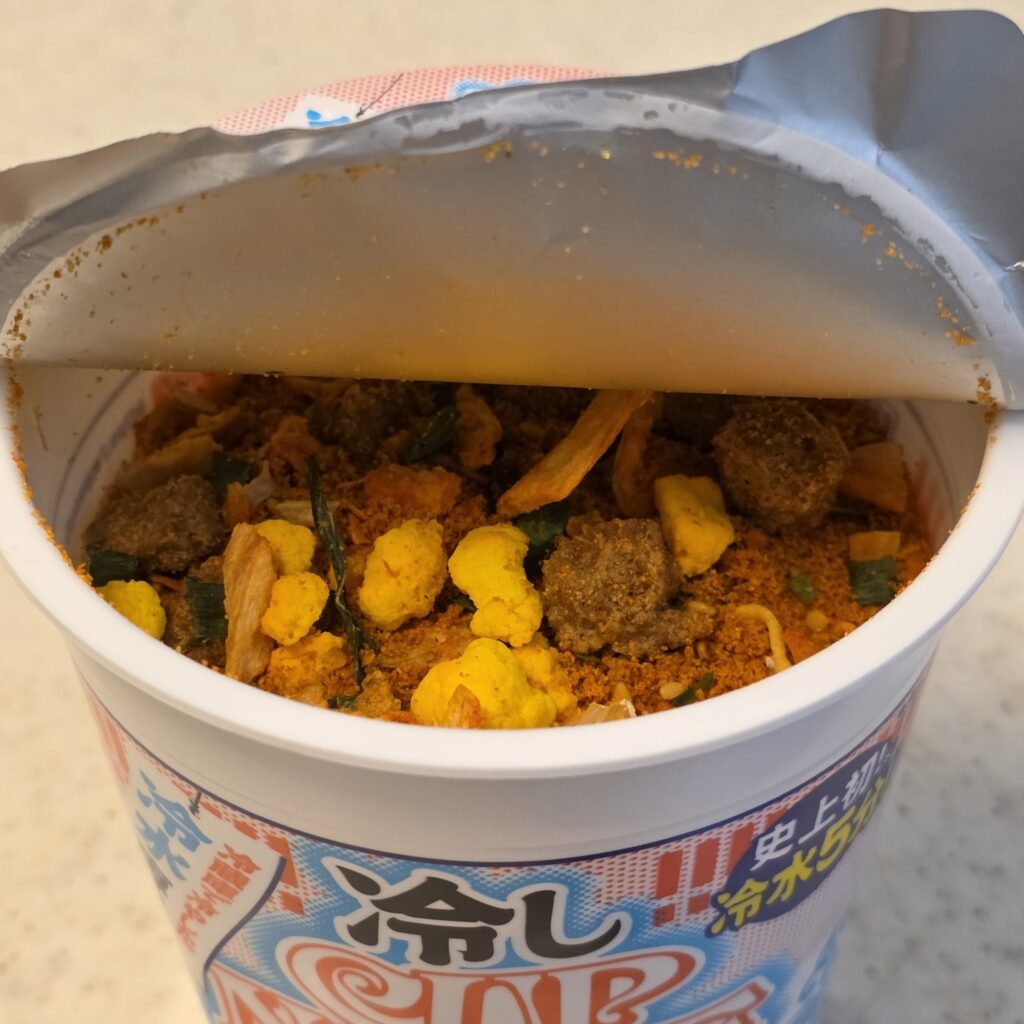
Before adding water, it looks much like any other instant noodle.
There are dried noodles, seasoning powder, green onion and several larger toppings sitting inside the cup.
Then you pour cold water directly over everything.
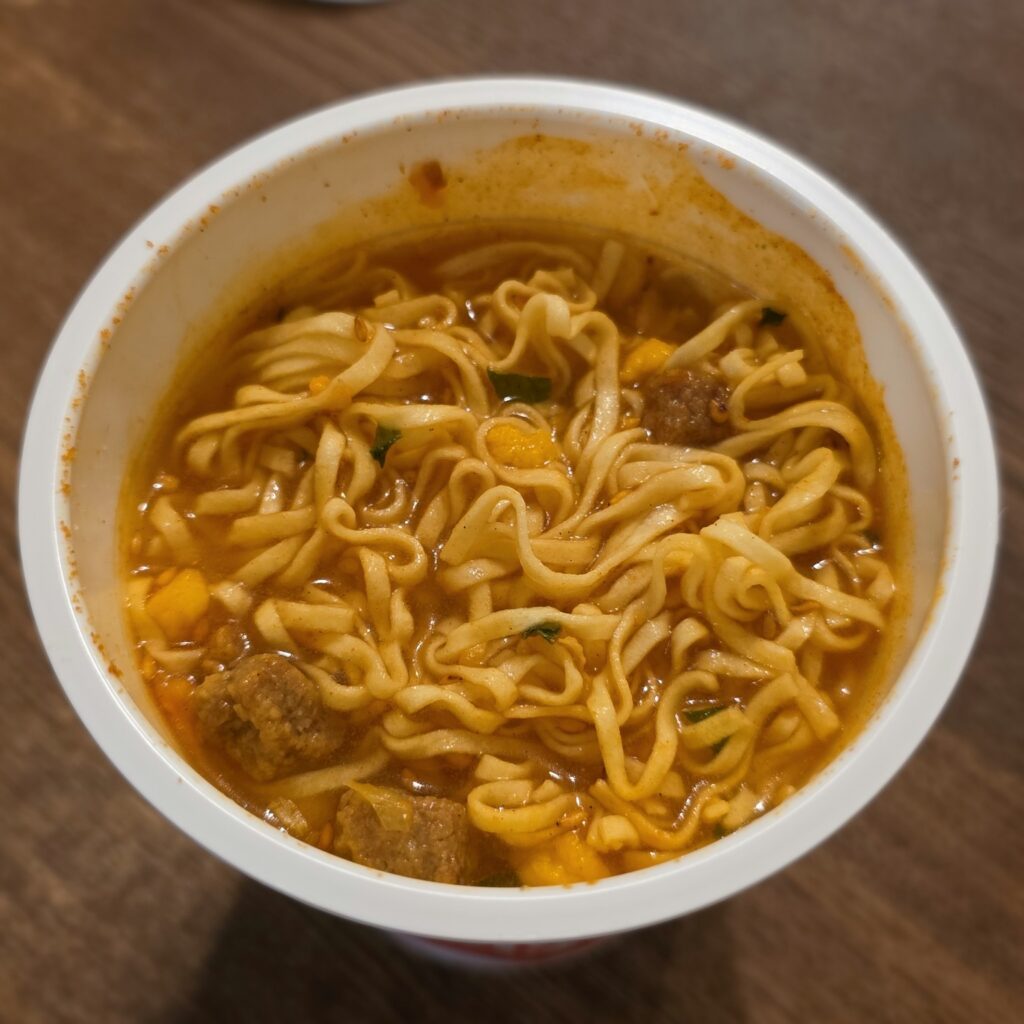
Five minutes later, something surprisingly ordinary has happened.
The noodles have softened.
The toppings have rehydrated.
The seasoning has become an orange-red kimchi soup.
Visually, the finished bowl does not look like a technological experiment.
It looks like Cup Noodle.
That may be one reason the product is interesting.
The innovation largely disappears once it has done its job.
The unusual part is not what you see at the end.
It is what you did not have to do to get there.
You never boiled water.
Nissin expected the supply to last one or two months
The cold Cup Noodles were released as limited products.
But demand moved much faster than expected.
According to reporting published on August 21, Nissin Foods Holdings had prepared an initial supply it expected to last approximately one to two months.
That supply was exhausted in roughly one week.
The company has not disclosed the number of units sold.
That makes it difficult to compare the product directly with other Cup Noodle launches, but the gap between expected and actual sales speed is striking.
A product designed around a very specific summer problem had apparently found its moment.
Cup Noodle is 55 years old—and boiling water was part of its identity
Cup Noodle was launched in Japan on September 18, 1971.
That means 2026 marks its 55th anniversary.
For almost all of that history, hot water has not simply been an instruction.
It has been part of what Cup Noodle is.
Instant ramen itself goes back even further. Nissin founder Momofuku Ando introduced Chicken Ramen in 1958, helping establish the basic idea of dried noodles that could rapidly become a meal with hot water.
That relationship between instant noodles and heat became so obvious that few people had any reason to question it.
Then Japan became hotter.
The product was explicitly developed for hotter summers
Nissin did not describe the cold Cup Noodle merely as a strange anniversary experiment.
In its official announcement, the company explicitly pointed to Japan’s recent record-breaking summer heat and increasing demand for cold foods.
That context changes the meaning of the product.
Japan has always had cold summer noodles.
Sōmen is served chilled.
Hiyashi chūka appears in restaurants when the weather becomes hot.
Cold soba is completely normal.
What is new is that one of Japan’s defining hot convenience foods has been redesigned around cold water.
The distinction is important.
This is not simply the invention of another cold noodle dish.
It is an adaptation of an established everyday system.
Heat changes small habits before it changes entire lifestyles
Climate change is often discussed through large numbers.
Average temperatures.
Heat records.
Electricity consumption.
Crop damage.
Hospital admissions.
Those measurements are important, but they can make environmental change feel abstract.
Daily life reveals something different.
You notice it when people stop going outside at certain hours.
When schools change outdoor activities.
When farmers move work into the night.
When air conditioning becomes something people hesitate to turn off rather than something they occasionally turn on.
And now, apparently, when Cup Noodle no longer assumes you want boiling water.
None of these changes alone represents a transformation of Japanese society.
Together, they show how adaptation actually happens.
Not everything changes at once.
Instead, thousands of small assumptions are revised.
The phrase “boiling water prohibited” may be the most interesting part
There is a subtle difference between saying:
“You can also make this with cold water.”
and saying:
“Do not use boiling water.”
The first keeps the old product and adds another option.
The second creates a product around a new assumption.
Nissin did not merely make conventional Cup Noodle more flexible.
It created noodles specifically for cold-water preparation.
That is why the red warning on the lid is so visually effective.
For anyone familiar with instant noodles, it contradicts decades of learned behavior.
You have to stop yourself from doing the obvious thing.
Convenience food is really infrastructure in miniature
Instant noodles are often treated as trivial food.
Cheap.
Fast.
Ordinary.
But convenience foods contain a surprising amount of engineering.
Their design assumes something about where people live and what resources are available.
A conventional Cup Noodle assumes access to boiling water.
That usually means a kettle, hot-water dispenser, microwave or some other source of heat.
The cold version changes that infrastructure requirement.
You need chilled water instead.
In a Japanese home during summer, that can be an attractive substitution.
Using the refrigerator is already part of daily life. Heating additional water just to produce a steaming meal when the room is hot may feel unnecessary.
The product therefore removes heat from the experience itself.
This does not automatically make it ideal emergency food
One immediate reaction to a cold-water Cup Noodle is to imagine disasters.
Japan stores enormous quantities of instant foods for earthquakes, typhoons and other emergencies. If noodles can rehydrate without boiling water, that sounds useful when electricity or gas is unavailable.
There is some logic to that idea.
But this particular product is specifically designed around refrigerated water, with the package recommending approximately 5–10°C.
A disaster environment in which electricity is unavailable may also be an environment where properly chilled water is difficult to obtain.
So its broader potential should not be exaggerated.
What the product demonstrates more clearly is the underlying technology: fast rehydration no longer necessarily requires hot water.
That could eventually have applications beyond one limited summer product.
Why did it sell so quickly?
There is no single confirmed explanation for the unexpectedly rapid sellout.
Novelty almost certainly matters.
“Cup Noodle that cannot use hot water” is inherently strange enough to make people curious.
The exceptionally hot summer matters too.
Limited availability encourages people to buy a product while they can.
And Cup Noodle already has something most new foods must spend years building: almost universal familiarity in Japan.
A consumer does not have to understand a completely new category.
It is still Cup Noodle.
Only one of its oldest rules has changed.
That combination—familiar object, unexpected behavior—is powerful.
The strange thing is that I ate it before realizing it was scarce
Looking back at the photos now is slightly different.
At the time, it was simply something unusual I had found and wanted to try.
A white Cup Noodle package covered in blue and red text.
A giant warning against boiling water.
Five minutes with cold water.
Then noodles.
That is precisely the kind of ordinary experience that becomes more interesting after the surrounding story appears.
The cup on the table was not just a limited-edition food.
It was part of a five-year engineering project.
It was the first cold-water-only Cup Noodle in the brand’s 55-year history.
And the supply that was supposed to remain on shelves for one or two months had apparently disappeared in about a week.
A very small sign of a hotter Japan
It would be excessive to claim that one successful Cup Noodle proves anything profound about Japan’s future.
Products become popular for all kinds of reasons.
Limited editions sell out.
Food trends disappear.
Nissin itself has not yet established whether this particular experiment will become a permanent part of the Cup Noodle lineup.
But that uncertainty is what makes the product useful as a snapshot.
Adaptation to a hotter climate will not always look dramatic.
Sometimes it will be a new building standard.
Sometimes a different farming schedule.
Sometimes changes to school activities.
And sometimes it will be printed in enormous red characters on the lid of a cup of instant noodles:
DO NOT USE BOILING WATER.
For 55 years, Cup Noodle hardly needed to explain what kind of water you should add.
In the summer of 2026, Japan became hot enough—and food technology advanced enough—that somebody finally rewrote the instruction.
And people bought the result much faster than expected.
Sources: @@INLINE0@@ (July 13, 2026); @@INLINE1@@ published August 21, 2026.
Photos: Original photographs taken in Japan, 2026.