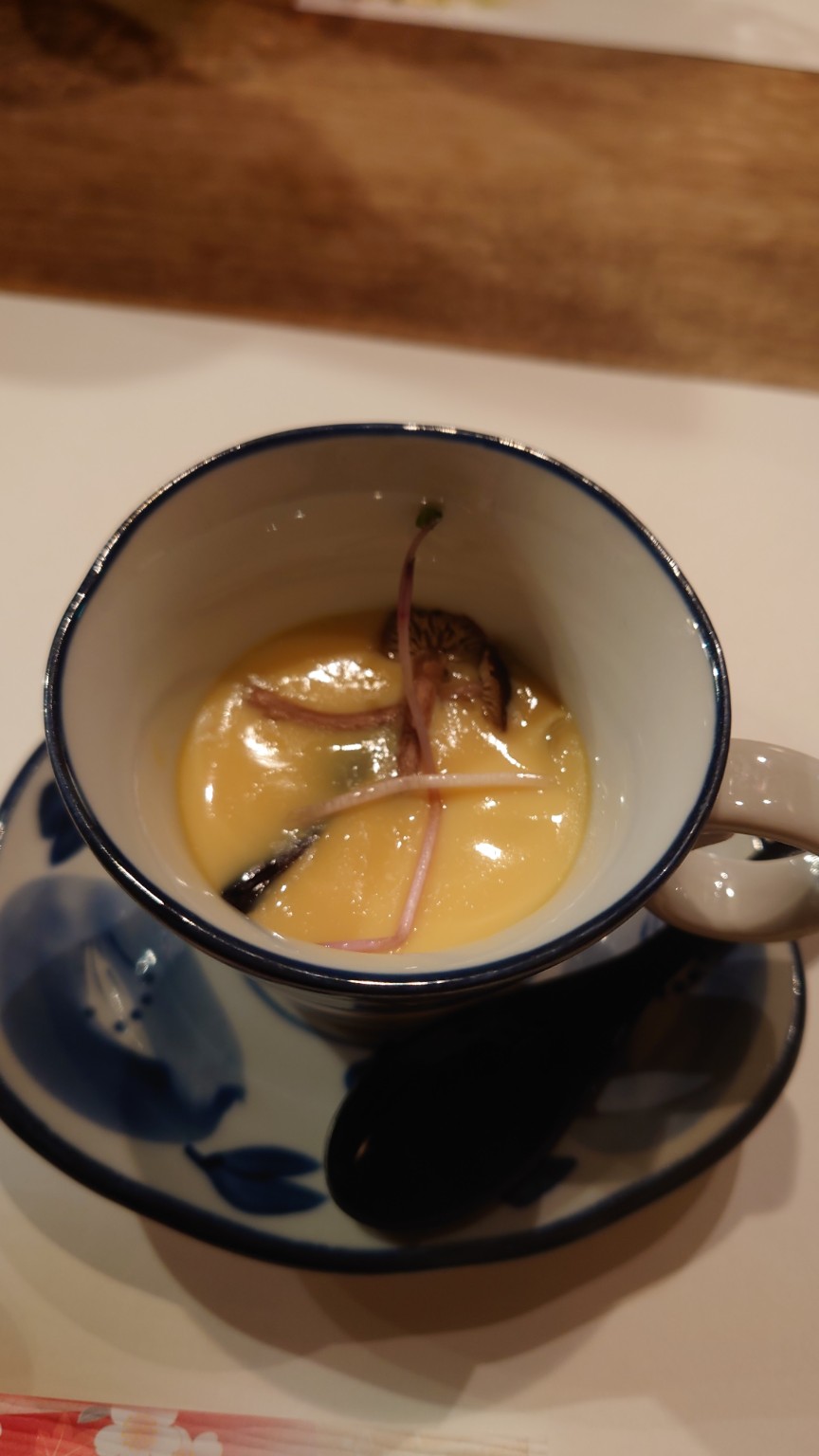
Put this in front of someone without explaining what it is, and there is a good chance they will think they are looking at pudding.
The smooth yellow surface looks like custard. It comes in a small cup. You eat it with a spoon.
Then you take the first bite.
It is not sweet at all.
This is chawanmushi (茶碗蒸し), one of Japan’s most familiar savory egg dishes—and perhaps the closest thing Japan has to a traditional pudding that completely rejects the idea of dessert.
A pudding-shaped savory dish
The easiest English description of chawanmushi is Japanese savory steamed egg custard.
Eggs are mixed with seasoned dashi, Japan’s basic soup stock, and then steamed very gently. The result is much softer than an omelet or scrambled egg. A good chawanmushi is almost trembling: smooth enough to scoop with a spoon, but just firm enough to hold together.
That texture is what makes the pudding comparison so immediate.
Visually, the basic structure is remarkably similar to custard. Both depend on egg proteins setting a liquid into a soft gel. But the flavor direction is completely different.
Where dessert custard usually starts with milk, cream, sugar or vanilla, chawanmushi starts with dashi and savory seasoning.
So the first spoonful produces a small sensory contradiction: your eyes say dessert; your tongue says soup, egg and umami.
What is inside chawanmushi?
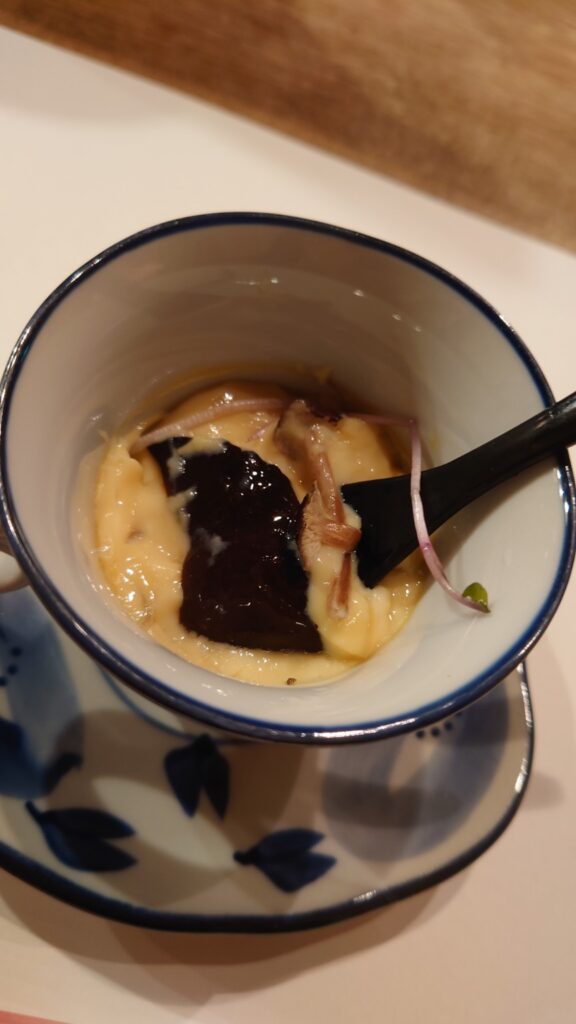
Chawanmushi is also different from most puddings because the custard is often hiding ingredients underneath the surface.
Depending on the restaurant or household, you may find things such as chicken, shrimp, shiitake mushrooms, fish cake, ginkgo nuts or mitsuba. There is no requirement that every cup contain the same combination.
That makes eating it slightly exploratory.
The surface can look almost completely plain, but each spoonful may bring up something different from below.
The cup in these photos shows that clearly. Before eating, the egg custard dominates the view. Once the surface is opened with a spoon, the ingredients and the depth of the custard become much more obvious.
Why is it served in a cup?
The name itself explains the presentation.
Chawan (茶碗) means a bowl or cup used at the table, and mushi (蒸し) refers to steaming.
In other words, chawanmushi is essentially something steamed in a small bowl.
It is commonly served in a lidded ceramic vessel and eaten directly from it with a spoon. That presentation is so strongly associated with the dish that the container is part of the experience.
Open the lid and you usually see a quiet, glossy surface rather than a dramatic plate of food.
It is a very Japanese kind of visual restraint: much of the dish is hidden until you start eating.
The important ingredient is not just egg
It is tempting to think of chawanmushi as simply “steamed egg,” but that misses the role of dashi.
The liquid mixed into the egg is what gives the dish much of its character. Dashi contributes umami while also diluting the egg enough to create the characteristic soft texture.
The mixture is then cooked gently. Too much heat can make the custard rough, porous or watery. Gentle steaming allows it to set while staying smooth.
That is why chawanmushi feels very different from a fried or baked egg dish even though the basic ingredient is familiar.
It is not trying to brown, crisp or become fluffy.
The goal is almost the opposite: a uniform, delicate gel that carries broth-like flavor.
Is chawanmushi a side dish, soup, or appetizer?
The answer depends on where you are eating it.
Chawanmushi can appear as part of a Japanese set meal, a multi-course meal, a sushi restaurant meal, or a seasonal menu. It is not normally treated as dessert.
That can be slightly confusing from an English-language food-category perspective because its texture suggests custard while its role at the table is firmly savory.
Calling it “savory custard” is therefore useful, but it still does not fully capture how ordinary the dish feels in Japan.
It is not generally presented as an experimental fusion of sweet and savory ideas.
It is simply chawanmushi.
Why “Japanese pudding” almost works
Japan also has actual sweet custard pudding: purin (プリン).
Purin is the dessert that most closely corresponds to what many English speakers imagine when they hear “Japanese pudding.” It is sweet, usually caramel-topped, and descended from Western-style custard desserts.
Chawanmushi belongs to a completely different culinary tradition.
And yet, place photographs of purin and chawanmushi side by side without labels and the resemblance becomes difficult to ignore.
Both are soft egg gels. Both can be served in small vessels. Both are eaten with spoons. Both rely on careful control of heat to create a smooth texture.
The crucial difference is the liquid surrounding the egg proteins and the flavors dissolved in it.
One becomes dessert.
The other becomes dinner.
The ordinary surprise of Japanese food
Chawanmushi is a good example of why translating food names is never quite enough.
“Steamed egg custard” is accurate.
“Savory pudding” is understandable.
Neither phrase feels completely natural if you grew up simply knowing the dish as chawanmushi.
That gap is part of what makes everyday food interesting.
Japanese cuisine is often introduced overseas through highly visible dishes such as sushi, ramen and tempura. But a cup of quietly steamed egg can reveal just as much about how ingredients, texture and meal categories are organized differently.
So yes, you could jokingly call chawanmushi Japan’s traditional savory pudding.
Just do not expect caramel.
Photos: Original photographs taken in Japan, 2026.