This morning, I may have watched a tiny piece of language formation happen in real time.
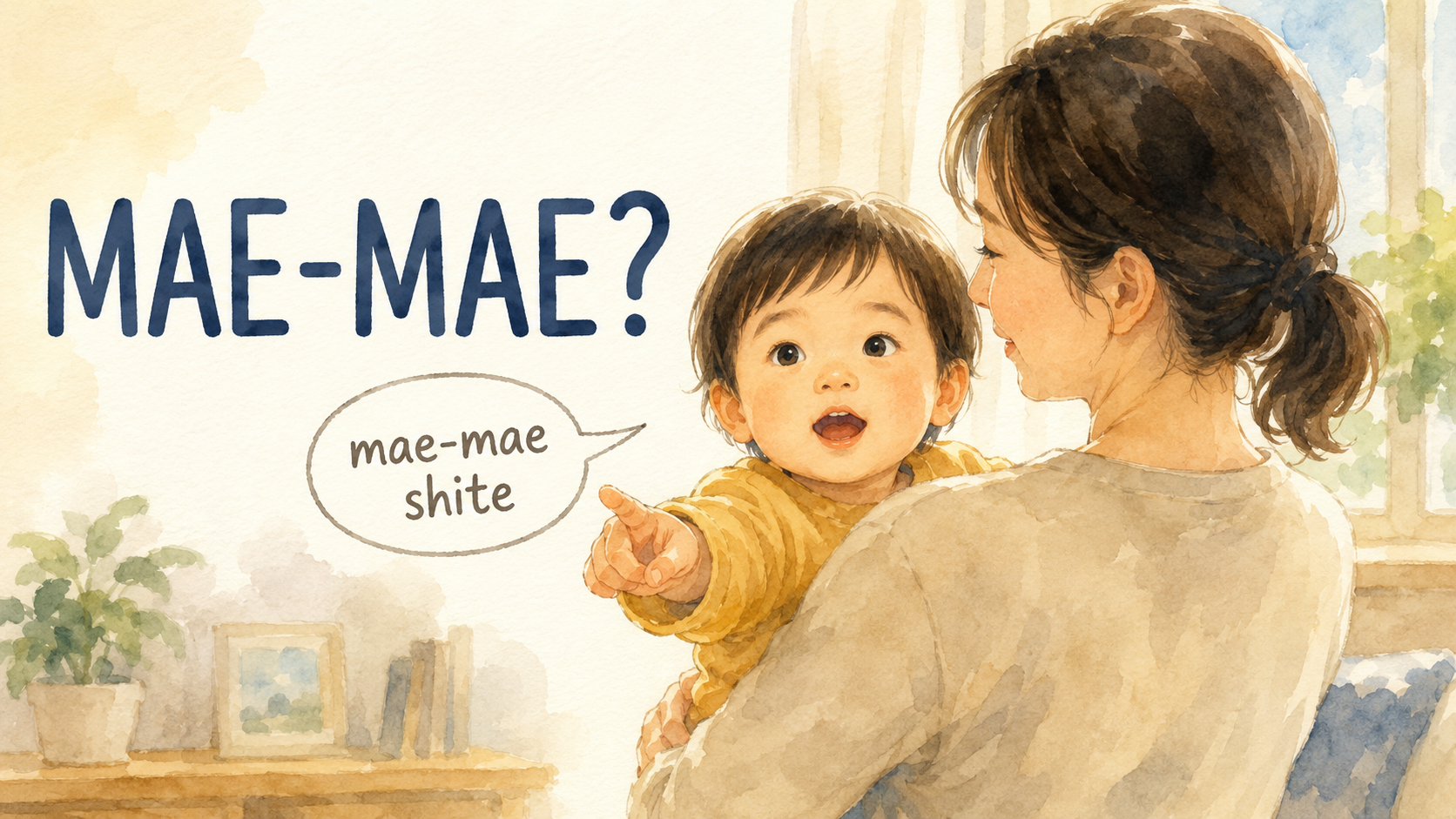
My toddler wanted to be held facing forward. In ordinary Japanese, I might describe that as mae-muki (前向き), “facing forward.” But instead of using that expression, my toddler said:
“Mae-mae shite.”
The literal pieces are simple:
- mae (前) = front
- mae-mae = “front-front”
- shite (して) = “do it” / “make it that way”
In context, the meaning was perfectly clear: “Hold me facing forward.”
“Mae-mae” is not a standard Japanese word. It is also not, strictly speaking, an established example of Japanese onomatopoeia.
But the way it was created feels remarkably Japanese.
Japanese “onomatopoeia” is broader than sound effects
English speakers often learn onomatopoeia as words that imitate sounds: “buzz,” “bang,” “meow.”
Japanese has those too. But the category commonly called onomatopoeia (オノマトペ) in everyday Japanese is much broader. Linguists often discuss Japanese mimetics or ideophones: words that can evoke sounds, movement, texture, visual appearance, bodily sensations, or emotional states.
For example:
- wan-wan — a dog’s bark
- zā-zā — heavy rain
- kira-kira — sparkling
- goro-goro — rolling around, idling, or rumbling depending on context
- sowa-sowa — restless or fidgety
Many of these words use reduplication: repeating a sound pattern twice.
That is why mae-mae caught my attention.
My toddler had taken an ordinary noun, mae, repeated it, and then attached suru (“to do”) in the form shite.
Structurally, it resembles expressions such as kira-kira suru or goro-goro suru, even though mae-mae itself is not a conventional mimetic.
A child did not need a full dictionary entry
This is the part I find most interesting.
A child does not necessarily need the conventional expression “face me forward” if a smaller set of pieces can communicate the idea.
The concept “front” was already available.
So the child seems to have done something like this:
mae → mae-mae → mae-mae shite
A known concept became a repeated form, and the repeated form became something that could function like an action.
Linguists would be cautious about calling this the birth of a new Japanese onomatopoeia. A one-time, spontaneously created expression is closer to what is sometimes called a nonce formation: a word or expression produced for a particular situation.
But nonce formations are one place where new vocabulary can begin.
If the family understands mae-mae, repeats it, and continues using it, the expression has already moved beyond one child’s private invention. It has become a tiny shared convention inside one household.
Language does not need a dictionary before people can use it.
Why repetition matters
Reduplication is not unique to Japanese, but it is highly visible in Japanese mimetic vocabulary.
Research on Japanese sound symbolism has shown that mimetics are not a marginal curiosity. They form a large and productive part of the language and are used for far more than imitating noises.
There is also evidence that sound symbolism can help young children learn words.
In a 2008 study, Mutsumi Imai and colleagues found that Japanese-speaking children were better able to generalize the meanings of novel verbs when the invented verbs had sound-symbolic properties that matched the actions they described.
Later work found similar advantages even in English-speaking children learning novel words based on Japanese sound-symbolic patterns.
A 2014 review by Imai and Sotaro Kita also discusses how Japanese caregivers frequently use sound-symbolic words when speaking to young children, suggesting that mimetics may provide useful scaffolding during early language development.
None of those studies proves that my toddler produced mae-mae because Japanese contains many mimetics.
But they make the observation more interesting: Japanese-speaking children grow up in an environment where repeated, expressive forms are common, meaningful, and often used around them.
Is “mae-mae” really onomatopoeia?
Probably not—at least not yet, and perhaps never.
There is no obvious sound-symbolic relationship between the sound mae-mae and the physical act of facing forward. The expression is transparently derived from the ordinary word mae, “front.”
So the safest description is:
A Japanese toddler spontaneously created a repeated expression using a word-formation pattern that resembles Japanese mimetics.
That is less dramatic than saying “a new onomatopoeia was born.”
But it may actually be more interesting.
It shows that the boundary between “normal vocabulary,” playful repetition, child language, and mimetic expression can be surprisingly fluid in everyday Japanese.
When does an invented expression become a word?
There may not be a single moment.
Imagine the following progression:
- A child says mae-mae once.
- A parent understands it.
- The family starts saying, “Mae-mae suru?”
- The expression is used repeatedly in the same situation.
- Other people begin to understand it without explanation.
- Eventually, in rare cases, a form spreads beyond the original group and becomes conventional.
Most child-created words probably stop at step two or three.
But the mechanism is visible.
Someone produces a form. Someone else understands it. The form is reused. Meaning becomes shared.
That is language operating at a very small scale.
A different way to look at Japanese onomatopoeia
Visitors to Japan are often told that Japanese has “a lot of onomatopoeia.”
That is true in a broad sense, but it can make the language sound as if Japanese speakers simply memorize an enormous list of unusual words.
Watching mae-mae appear suggested a different possibility.
Perhaps part of what matters is not only the number of existing mimetic words, but also the familiarity of the patterns behind them: repetition, rhythm, sound symbolism, and the ease with which expressive forms can be turned into actions with suru.
A toddler saying mae-mae shite is not evidence for a grand theory of Japanese.
It is just one family moment.
But it is the kind of ordinary moment that can reveal something about how a language feels from the inside.
And for a few seconds, I had the strange feeling that I was watching a word being made.
Sources and further reading
- Imai, M., Kita, S., Nagumo, M., & Okada, H. (2008). “Sound symbolism facilitates early verb learning.” Cognition, 109(1), 54–65. https://doi.org/10.1016/j.cognition.2008.07.015
- Kantartzis, K., Imai, M., & Kita, S. (2011). “Japanese Sound-Symbolism Facilitates Word Learning in English-Speaking Children.” Cognitive Science, 35(3), 575–586. https://doi.org/10.1111/j.1551-6709.2010.01169.x
- Imai, M., & Kita, S. (2014). “The sound symbolism bootstrapping hypothesis for language acquisition and language evolution.” Philosophical Transactions of the Royal Society B, 369, 20130298. https://doi.org/10.1098/rstb.2013.0298