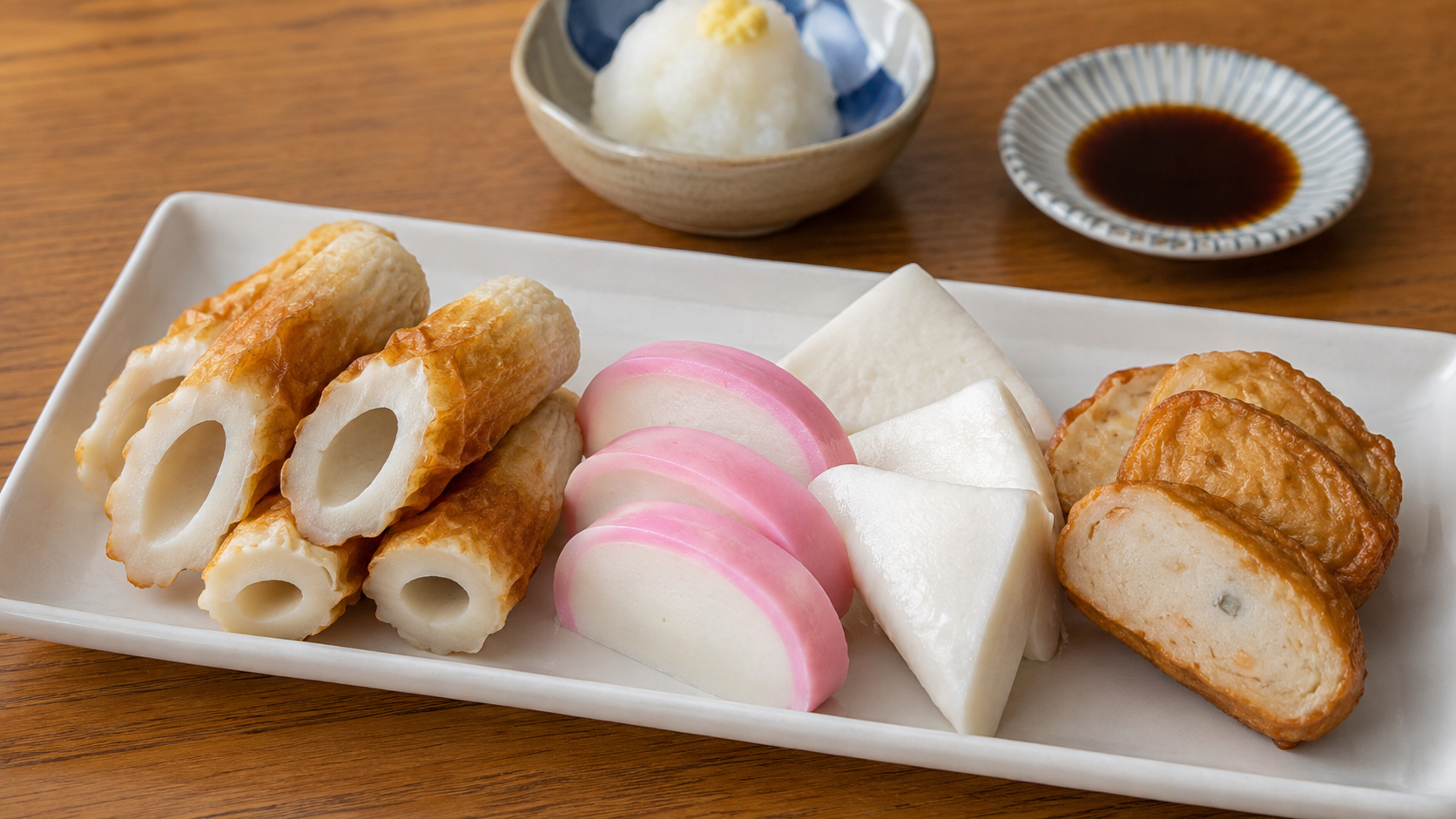
Walk into an ordinary Japanese supermarket and look near the tofu, noodles, and refrigerated foods. You will probably find a section filled with objects of many different shapes.
There are pink-and-white semicircles attached to small wooden boards. Hollow tubes with browned surfaces. Soft white triangles. Flat golden patties. Small balls, imitation crab sticks, and products shaped like leaves, flowers, or cartoon characters.
To most Japanese shoppers, these are not unusual foods. They are simply nerimono: a broad family of foods made mainly from finely ground fish.
They appear in lunch boxes, bowls of noodles, convenience-store snacks, New Year dishes, and winter pots of oden. They are so ordinary that many people in Japan rarely stop to consider how diverse they are.
Seen from outside Japan, however, the nerimono section of a supermarket is a surprisingly complex world.
- One basic idea, many different foods
- Kamaboko: the classic Japanese fish cake
- Chikuwa: a fish cake with a hole
- Hanpen: soft, white, and almost weightless
- Satsuma-age: the fried member of the family
- Different shapes have different places
- Oden: where the family meets
- From local food to global surimi
- An ordinary Japanese food culture
- Further reading
One basic idea, many different foods
The basic method is simple to describe.
Fish meat is finely ground, mixed with salt and other ingredients, shaped, and heated. Salt helps the fish proteins form the springy gel texture associated with many Japanese fish cakes. The final product changes according to the fish, seasoning, shape, and method of heating.
Fish-paste foods are not unique to Japan. Fish balls are common in China, Taiwan, Hong Kong, and Southeast Asia. Korea has eomuk. Northern Europe has fish cakes made from cod, while other regions have their own fish dumplings, puddings, and sausages.
The Japanese Ministry of Agriculture, Forestry and Fisheries also notes that foods resembling Japanese kamaboko developed in several parts of the world using locally available fish.
What is distinctive about Japan is not the invention of fish paste itself. It is the extraordinary number of everyday foods that developed from the same basic idea.
Kamaboko: the classic Japanese fish cake
The word kamaboko can sometimes be used broadly for Japanese fish cakes, but it also describes the familiar loaf of fish paste formed on a small wooden board.
The most recognizable version has a white interior and a pink outer layer. It is steamed, sliced, and eaten as it is, or added to noodles, soups, and ceremonial dishes.
Kamaboko has a long history in Japan. An early form appears in a record of a court banquet held in 1115 during the Heian period. The early product resembled what is now called grilled chikuwa: fish paste formed around a stick and cooked over a fire.
One explanation for the name is that the shape resembled the head of a cattail plant, called gama no ho in Japanese.
Today, board-mounted kamaboko is especially associated with celebrations. Red and white slices are common in osechi, the collection of foods served at the Japanese New Year.
But kamaboko is not limited to ceremonial meals. A few slices may also appear in an ordinary bowl of udon.
Chikuwa: a fish cake with a hole
Chikuwa is among the most familiar and inexpensive forms of nerimono.
Fish paste is wrapped around a bamboo or metal rod and then grilled or steamed. When the rod is removed, a tube-shaped fish cake remains. The name means “bamboo ring,” reflecting its hollow, bamboo-like form.
Chikuwa can be eaten directly from the package, cut into salads, simmered in oden, or filled with cheese or cucumber.
It is also commonly covered in batter containing green seaweed and fried as chikuwa isobe-age, a familiar side dish in lunch boxes, school meals, and inexpensive restaurants.
The hole is not merely decoration. It is a visible record of how the food was made.
Hanpen: soft, white, and almost weightless
At first glance, hanpen looks quite different from firm kamaboko or chewy chikuwa.
It is usually white, soft, and filled with tiny air bubbles. Traditional versions may combine white fish or shark meat with Japanese mountain yam. The mixture is aerated and boiled, producing a texture sometimes compared to a savory marshmallow.
Hanpen is particularly familiar as an ingredient in eastern Japanese oden. It absorbs the flavor of the broth and expands slightly as it cooks.
Even within the category of hanpen, regional differences are considerable.
In Shizuoka Prefecture, kuro hanpen, or black hanpen, is made from fish such as sardines, mackerel, and horse mackerel. The bones and skin may be ground into the mixture, giving it a gray color, stronger flavor, and denser texture. It is eaten grilled, fried, simmered, or added to Shizuoka-style oden. The Ministry of Agriculture describes it as an everyday regional food found in home meals, lunch boxes, supermarkets, and school lunches.
The white hanpen familiar around Tokyo and the darker hanpen of Shizuoka share a name, but they are very different foods.
Satsuma-age: the fried member of the family
When seasoned fish paste is shaped and deep-fried, it becomes a type of age-kamaboko, or fried fish cake.
The best-known variety is satsuma-age, named after the former Satsuma region in present-day Kagoshima Prefecture. It may be plain or mixed with vegetables, ginger, squid, burdock root, or other ingredients.
Satsuma-age can be eaten directly, lightly grilled, or simmered in broth. Similar fried fish cakes are produced throughout Japan, although their names, sweetness, ingredients, and textures differ by region.
In Miyazaki Prefecture, for example, obi-ten is made from local fish ground together with tofu, then seasoned with miso, soy sauce, and brown sugar. It is softer and sweeter than typical satsuma-age. According to the Ministry of Agriculture’s regional food archive, it has long been eaten as an everyday food in the Obi area of Nichinan.
This is one reason the world of nerimono is difficult to summarize. A product that appears simple can carry a strong regional identity.
Different shapes have different places
For Japanese consumers, these products are not merely different shapes of the same food.
Each has an expected place in a meal.
Kamaboko belongs naturally in noodle bowls and New Year dishes. Chikuwa fits into lunch boxes, fried side dishes, and oden. Hanpen is associated with softness and broth. Satsuma-age can be a side dish, a snack with alcohol, or an ingredient in simmered food.
There are also decorative fish cakes for celebrations, grilled specialties such as Miyagi Prefecture’s sasa-kamaboko, and local products made from fish available along particular coastlines. Modern manufacturers have added cheese-filled chikuwa, vegetable fish cakes, character-shaped products for children, and many varieties of imitation seafood.
Japanese supermarkets therefore do not treat fish cake as a single product.
They treat it as an entire food category.
Oden: where the family meets
The easiest place to see the diversity of nerimono is in oden.
Oden is a dish in which ingredients are slowly simmered in a seasoned broth. Daikon radish, eggs, konjac, tofu products, and several kinds of fish cake are cooked together.
A single pot may contain chikuwa, hanpen, satsuma-age, fish balls, and other regional products.
To someone unfamiliar with Japanese food, these ingredients may appear similar. To Japanese diners, each contributes a different texture.
Chikuwa is firm and springy. Hanpen is soft and airy. Fried fish cakes are richer and absorb broth. Fish balls provide a concentrated, elastic bite.
Oden is not simply a collection of ingredients. It is also a collection of textures.
From local food to global surimi
Traditional fish-paste foods existed long before modern refrigeration. Japan also played an important role in turning fish paste into a globally traded industrial ingredient.
In 1960, Nissui and the Hokkaido Fisheries Research Institute developed technology that allowed surimi to retain its useful qualities after freezing. Full-scale production at sea began later in the decade. Frozen surimi could be made near fishing grounds, transported over long distances, and turned into consistent products at factories elsewhere. Nissui’s corporate history describes this as a way of transforming abundant Alaska pollock into a versatile food resource.
This technology helped make products such as imitation crab widely available.
Known in Japan as kani-kama, crab-flavored kamaboko was commercialized by Japanese manufacturers in the early 1970s. It later spread around the world in salads, sandwiches, sushi rolls, and seafood dishes. In many countries, imitation crab may now be more familiar than traditional Japanese kamaboko.
An old method of transforming fish had become part of the modern global food system.
An ordinary Japanese food culture
Nerimono is rarely presented as one of Japan’s grand culinary traditions.
It lacks the international prestige of sushi, the theatrical appeal of teppanyaki, and the meticulous image of kaiseki cuisine.
It is inexpensive, widely manufactured, and sold in plastic packages under supermarket lighting.
That is exactly why it belongs in a portrait of ordinary Japan.
Nerimono shows how Japanese food culture often develops: not through one famous dish, but through countless small distinctions accumulated over time.
One basic mixture of fish and salt became steamed, grilled, boiled, fried, aerated, sweetened, decorated, and adapted to local fish and regional tastes.
The next time you enter a Japanese supermarket, look for the refrigerated fish-cake section.
It may appear to contain a collection of simple processed foods.
In reality, it is a small map of Japanese everyday life.
Further reading
- Fishcakes — Traditional Foods in Japan, Ministry of Agriculture, Forestry and Fisheries
- Kuro hanpen fry — Shizuoka Prefecture, Ministry of Agriculture, Forestry and Fisheries
- Obi-ten — Miyazaki Prefecture, Ministry of Agriculture, Forestry and Fisheries
- A History of Value Creation — Nissui
- The development of kani-kama — Sugiyo
コメント