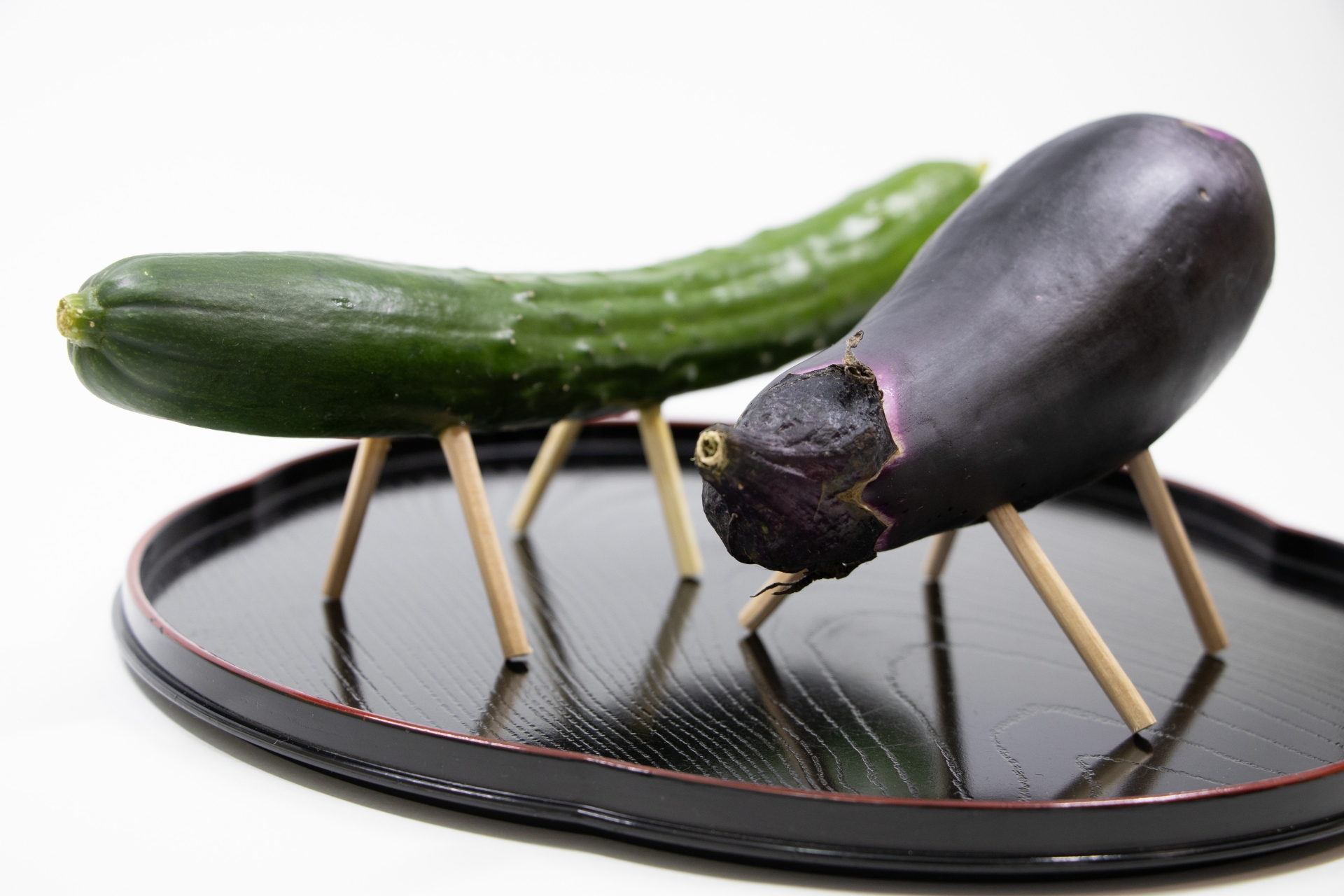
A cucumber lies on a small tray with four thin wooden legs. Beside it stands an eggplant built in the same way.
One is long and slender. The other is round and heavy. Together, they look like something made by a child during a quiet summer afternoon.
But these vegetable animals are not toys.
In many Japanese homes, they are made during Obon, the annual period when families remember and welcome the spirits of their ancestors. The cucumber represents a horse, while the eggplant represents a cow.
They are vehicles for a journey between two worlds.
Ordinary vegetables become special
For most of the year, cucumbers and eggplants are completely ordinary ingredients in Japan.
They appear in salads, pickles, stir-fries, and summer side dishes. They are stacked in supermarket produce sections and sold cheaply when the summer harvest is abundant.
Then Obon arrives.
Four short pieces of wood are pushed into each vegetable to form legs. Traditional materials may include ogara, the peeled stems of hemp plants, while chopsticks, bamboo skewers, and toothpicks are also used today.
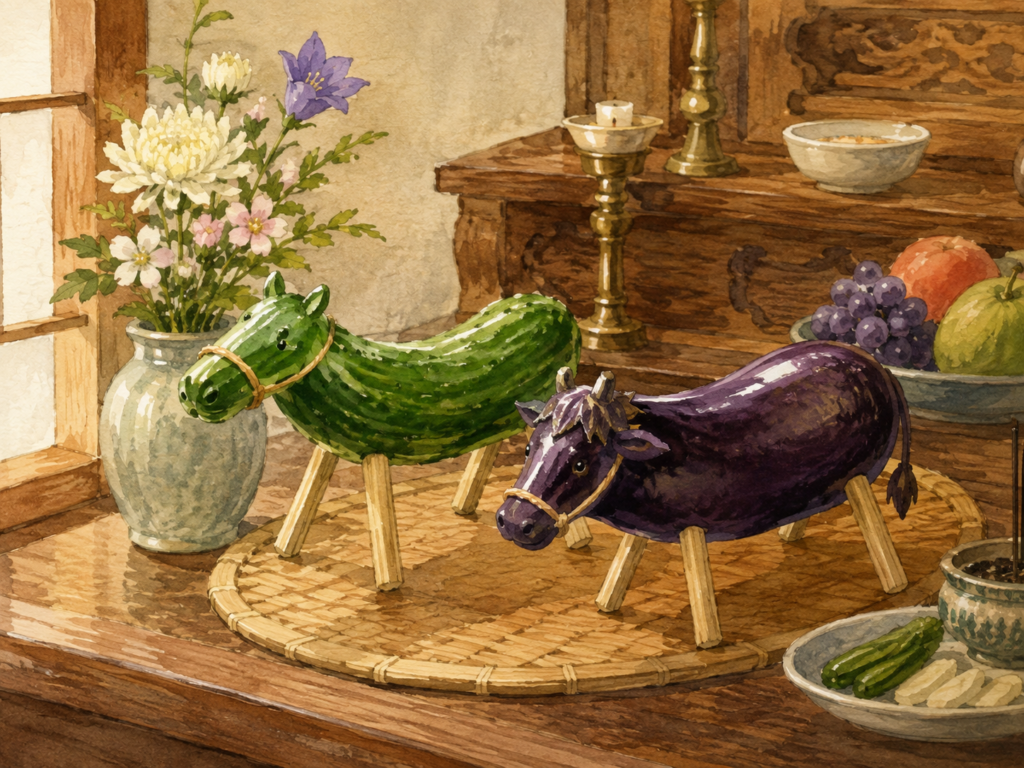
The cucumber becomes a horse. It is called a shōryō-uma—a spirit horse.
The eggplant becomes a cow, sometimes called a shōryō-ushi.
The two may also be referred to together as shōryō-uma or ushi-uma.
The transformation requires almost nothing. There is no complicated carving, expensive material, or specialist craft. A familiar vegetable is simply viewed in a different way.
The long cucumber resembles the body of a horse. The rounded eggplant appears slower and heavier, like a cow.
That difference in shape is also the key to their meaning.
Why a cucumber horse?
In many Obon traditions, ancestral spirits are believed to return to the world of the living for a short period.
Obon is commonly observed around August 13 to 16, although some areas celebrate it in July or follow other local calendars. Families may visit graves, clean household altars, light lanterns, and prepare food for relatives who have passed away.
At the beginning of Obon, the ancestors are invited home.
The cucumber horse is meant to carry them quickly.
A horse is fast, so the message is simple:
Please come home as soon as possible.
It is an unusually direct expression of affection. The family has waited for this brief reunion and does not want the journey to take any longer than necessary.
Why an eggplant cow?
At the end of Obon, the spirits must return.
This time, they are given a cow.
A cow travels more slowly than a horse. It may also be imagined carrying the food and gifts offered by the family during Obon.
The message is the opposite of the cucumber horse:
Please take your time going back.
The family wanted the ancestors to arrive quickly, but they are reluctant to see them leave.
The horse and cow therefore describe more than transportation. Together, they express the emotional shape of a reunion: anticipation at the beginning and hesitation at the end.
Come quickly.
Leave slowly.
That small contrast is what makes the custom so memorable.
Why cucumbers and eggplants?
There is no single, clearly documented origin for the vegetable animals.
One practical explanation is that cucumbers and eggplants are traditional summer vegetables in Japan. They are harvested in large quantities around the Obon season and have long been familiar, accessible foods.
The custom did not require a special purchase. A family could use what was growing nearby or already sitting in the kitchen.
This is an important part of the tradition’s character.
The vegetables are not valuable because they are rare. They become valuable because of the meaning placed upon them.
Japanese seasonal customs often work this way. An everyday material—a plant, a food, a piece of paper, or a small flame—is temporarily given a ceremonial role. When the season ends, it returns to ordinary life.
The boundary between daily life and ritual is not always dramatic.
Sometimes it is only four wooden legs.
Does every Japanese family make them?
No.
Obon customs differ considerably between regions, Buddhist traditions, and individual families. Even the dates of Obon are not uniform across Japan.
Some households carefully prepare a special altar with lanterns, flowers, and offerings. Others mainly visit the family grave. Some attend Bon Odori dances or return to their hometowns, while others do little beyond quietly remembering relatives who have died.
Many Japanese people know what the cucumber horse and eggplant cow are without making them themselves.
The custom may be familiar from a grandparent’s home, a temple, a supermarket display, a school activity, or an illustration seen during childhood.
There are also local differences in how the animals are made, displayed, and interpreted. In some places, other vegetables or materials may be used. Reusable animals made from straw, cloth, glass, or decorative fabric are also available.
There is no single Obon shared identically by every household. Some Buddhist traditions, including Jōdo Shinshū, do not generally treat ancestors as returning from another world during Obon and therefore do not traditionally use welcoming fires or spirit animals in the same way.
That variation does not make the tradition less real. It shows how customs survive: not as fixed museum exhibits, but as practices that families adjust, simplify, or sometimes stop altogether.
A quiet family homecoming
Obon is often visible through large public events.
Bon Odori festivals fill summer evenings with music and dancing. Famous ceremonies such as Kyoto’s Gozan Okuribi send enormous fires into the night. Trains, airports, and highways become crowded as people travel back to their hometowns.
But much of Obon happens quietly inside private homes.
Someone wipes dust from an altar.
A favorite food is placed in front of a photograph.
A lantern is lit.
A cucumber and an eggplant are given four legs.
None of these actions is grand, yet together they create a place for absent family members within the home.
The vegetable animals are especially gentle because they do not try to make death distant or frightening. They imagine the ancestors as travelers—family members who know the way home, need something to ride, and should not be rushed when it is time to leave.
The meaning hidden in ordinary things
A cucumber horse and an eggplant cow can look humorous at first.
They are slightly uneven, clearly homemade, and sometimes barely able to stand. That is part of their charm.
They show how an ordinary object can carry a feeling much larger than itself.
A cucumber becomes the wish to meet someone again as soon as possible.
An eggplant becomes the wish to delay another goodbye.
For a few days in summer, two vegetables from the kitchen are no longer ingredients.
They are waiting at the entrance between this world and the next—one ready to run, the other prepared to walk slowly home.