Every August, something slightly strange happens in Japan.
There is no national holiday called Obon. It does not appear on Japan’s official list of public holidays.
And yet offices become quieter. Trains fill up. Highways become crowded. People disappear from the cities and head back to their hometowns.
For a few days, Japan behaves as if it were on holiday—even though, legally speaking, it is not.
So what exactly is Obon?
And why does a tradition for welcoming the dead have such a powerful effect on the lives of the living?
- Obon Is Not Actually a National Holiday
- What Is Obon?
- The Ancestors Need a Way Home
- Why Does Everyone Travel at the Same Time?
- A Holiday Created by Society, Not the Government
- And Then Everyone Starts Dancing
- Obon Is Not Halloween
- Do Japanese People Still Believe the Spirits Actually Return?
- For a Few Days, Japan Turns Back Toward Home
- Sources and Further Reading
Obon Is Not Actually a National Holiday
This is probably the first thing that surprises people outside Japan.
Japan has 16 legally defined national holidays. Obon is not one of them. The official calendar includes New Year’s Day, Coming of Age Day, Marine Day, Mountain Day and others, but there is no official “Obon Day.”
In 2026, Mountain Day falls on August 11, just before the period when many families observe Obon. The Cabinet Office itself notes that Mountain Day was placed in a season when many people are already taking summer and Obon holidays.
That still does not make Obon a legal holiday.
Companies decide for themselves whether to close. Some employees use paid leave. Schools are already in summer vacation. Yet the combined effect is enormous.
Japan’s expressway operators define August 7–16, 2026 as the Obon travel period for their congestion forecasts, while JR East warns that the same period attracts unusually heavy demand for reserved seats.
The government did not create this holiday.
Society did.
What Is Obon?
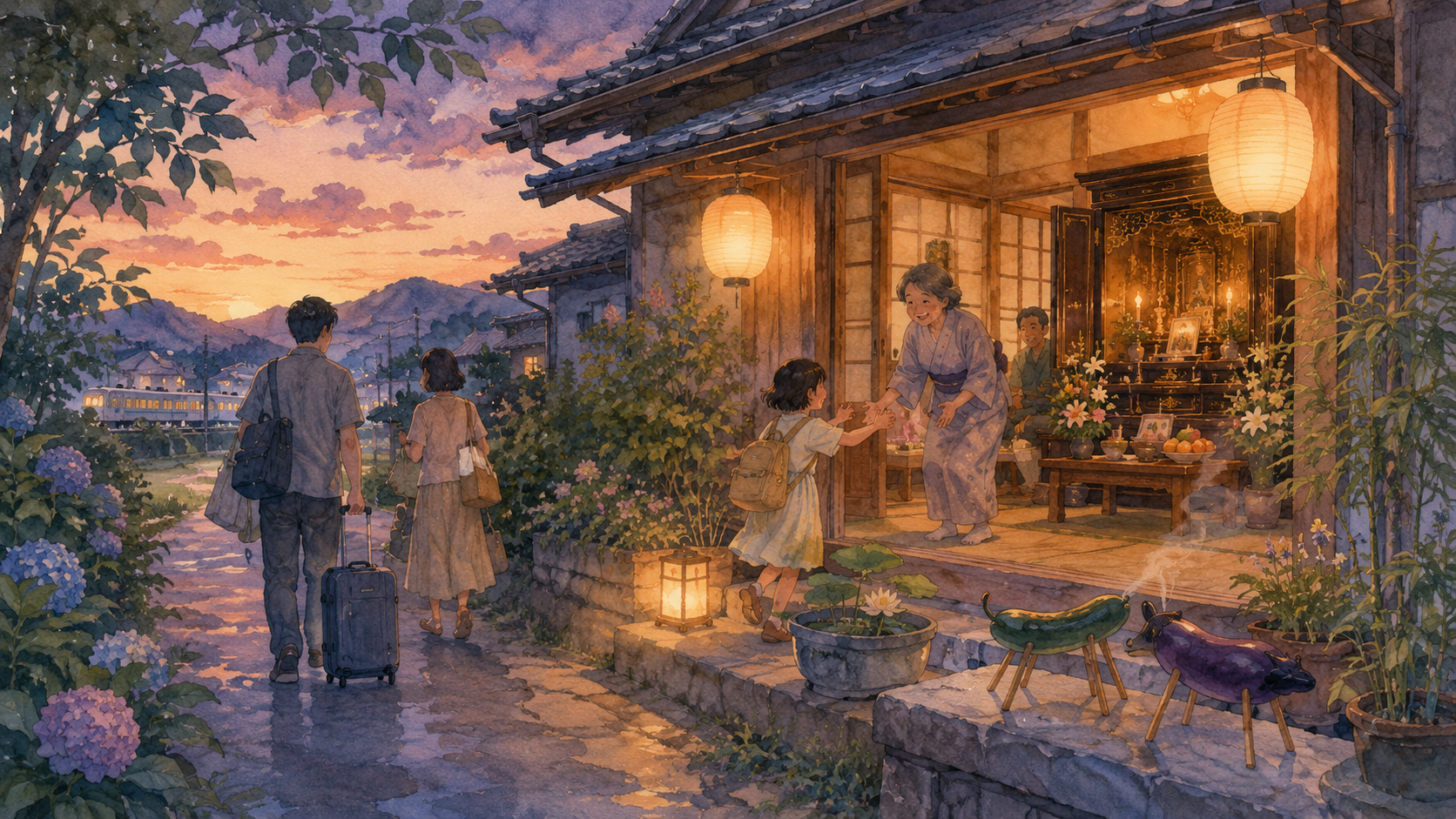
At its heart, Obon is about ancestors coming home.
The customs have been strongly shaped by Buddhism, but Japan’s Agency for Cultural Affairs also describes Bon traditions as preserving an older character of honoring ancestral spirits.
In many parts of Japan, Obon is observed around the middle of August. Dates and rituals vary by region, and some communities preserve older calendars or local customs.
The basic idea, however, is remarkably consistent.
The dead are welcomed back.
Families may clean graves, make offerings, burn incense, gather at the family home and spend time together. At the end of the period, the returning spirits are sent away again.
For some people this remains explicitly religious.
For others it is simply what their family has always done.
And for many modern Japanese people, Obon is simultaneously religious, cultural, familial and seasonal.
The Ancestors Need a Way Home
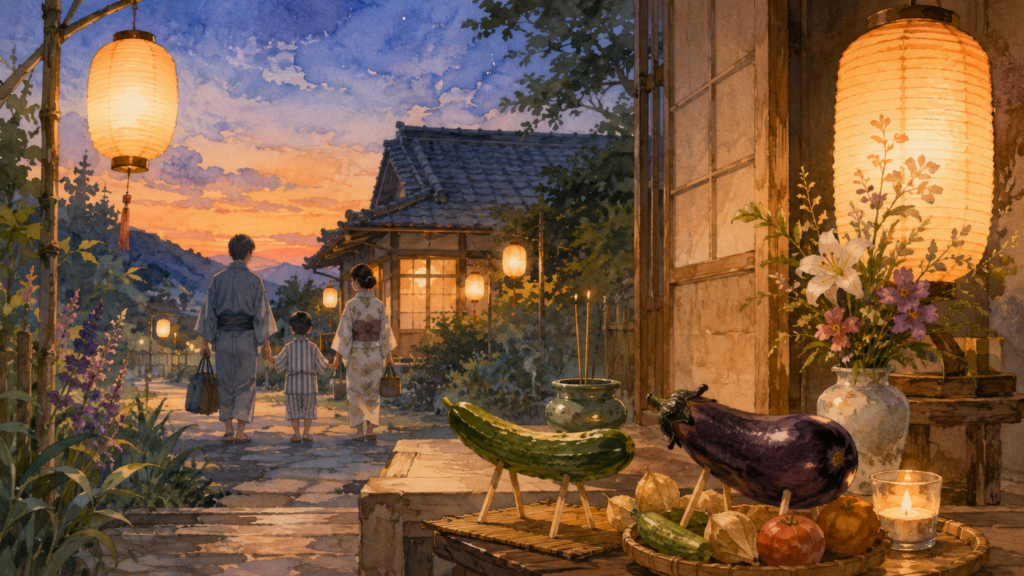
In some regions, families light a mukaebi, or welcoming fire, to guide ancestral spirits home. At the end of Obon, an okuribi, or sending-off fire, may mark their departure.
Then there are the vegetables.
A cucumber with four small legs becomes a horse.
An eggplant becomes a cow.
These are called shōryō-uma, spirit animals associated with the journey of returning ancestors. The familiar explanation is that the cucumber horse lets the spirits arrive quickly, while the slower eggplant cow carries them back more leisurely when Obon ends.
Without context, they can look almost comical: two vegetables standing on wooden legs in a Japanese home.
Within Obon, however, they make perfect sense.
They are vehicles between two worlds.
If you want to see how this small custom works in detail, read our companion article: Cucumber Horses and Eggplant Cows: The Vegetable Animals of Japan’s Obon.
This is part of what makes Obon interesting. Japan’s relationship with death is not expressed only through solemn monuments or formal ceremonies. Sometimes it appears as a cucumber horse made at the kitchen table.
Why Does Everyone Travel at the Same Time?
Obon is about ancestors.
But ancestors are connected to places.
The family grave may be in the town where your parents or grandparents still live. The Buddhist altar may remain in the old family house. Someone who lives and works in Tokyo may still describe a house hundreds of kilometers away as jikka—the parental or family home.
So Obon creates a temporary reversal of Japan’s normal population flow.
For most of the year, work and education pull people toward cities.
During Obon, many people move in the opposite direction.
Railway stations fill with luggage. Children meet grandparents. Highways develop long traffic jams. Regional towns briefly receive family members who normally live elsewhere.
In Japanese summer news, one word appears repeatedly: kisei—returning home.
The transportation system is modern.
The direction of travel is much older.
Back toward the family.
A Holiday Created by Society, Not the Government
This may be the most revealing part of Obon.
Nobody needs a law to tell Japan that the period matters.
Companies know employees may want time off.
Railways prepare for heavy reservations.
Expressway operators publish special congestion forecasts.
Families coordinate schedules months in advance.
People ask one another a simple question:
“Are you going home for Obon?”
The institution exists because millions of individual decisions point in roughly the same direction.
In that sense, Obon reveals something broader about Japanese society.
Some of its strongest rules are not written rules.
And Then Everyone Starts Dancing
For visitors, the most visible expression of Obon may be Bon Odori.
Summer evening.
Paper lanterns.
Music.
People in yukata dancing together.
Today, many Bon dances function as neighborhood festivals. Children buy food from stalls. Friends meet. People with little interest in religion join the circle.
But Bon dancing also retains older connections with memorial rites and ancestral spirits.
The Agency for Cultural Affairs records numerous regional Bon dances as important folk traditions. Some, including dances in the UNESCO-listed Furyu-odori traditions, preserve especially clear links between dancing, local communities and the remembrance of the dead.
Modern Bon Odori can therefore contain two realities at once.
It is entertainment.
And it is remembrance.
Obon Is Not Halloween
There is an obvious temptation to explain Obon to Western readers by comparing it with Halloween or Mexico’s Día de Muertos.
The comparison helps only up to a point.
Obon is not primarily about frightening ghosts.
The returning spirits are usually your own family.
They are welcomed.
Food and flowers may be offered to them.
Their graves are cleaned.
They are invited home.
And when the visit is over, they are respectfully sent away again.
The dead are not necessarily something invading the world of the living.
For several days, they belong there.
Do Japanese People Still Believe the Spirits Actually Return?
That depends entirely on whom you ask.
Some people take the religious meaning seriously.
Others follow the customs because their parents and grandparents did.
Some visit graves because it feels wrong not to.
Some attend Bon Odori because it is fun.
Some do almost nothing.
Modern Japan does not require a declaration of belief before participating in a tradition.
A person can light incense at a grave without explaining exactly what they think happens after death.
Perhaps that ambiguity is one reason Obon has survived so well.
It does not demand an answer.
You can believe.
You can remember.
Or you can simply go home.
For a Few Days, Japan Turns Back Toward Home
Japan is often described through speed.
Bullet trains.
Crowded commuter stations.
Long working days.
Tokyo.
Technology.
Efficiency.
But every summer, Obon pulls in the opposite direction.
Toward old houses.
Family graves.
Grandparents.
Small towns.
Incense.
Lanterns.
And memories of people who are no longer there.
Japan does not officially stop for Obon.
There is no national holiday requiring it to do so.
Yet year after year, a large part of the country slows down anyway.
Perhaps that is the best way to understand Obon.
It is not really a holiday created by the state.
It is a pause created by memory.