Every August, Japan watches teenagers play baseball.
Not professional players. Not college athletes. High school students, many of them 17 or 18 years old.
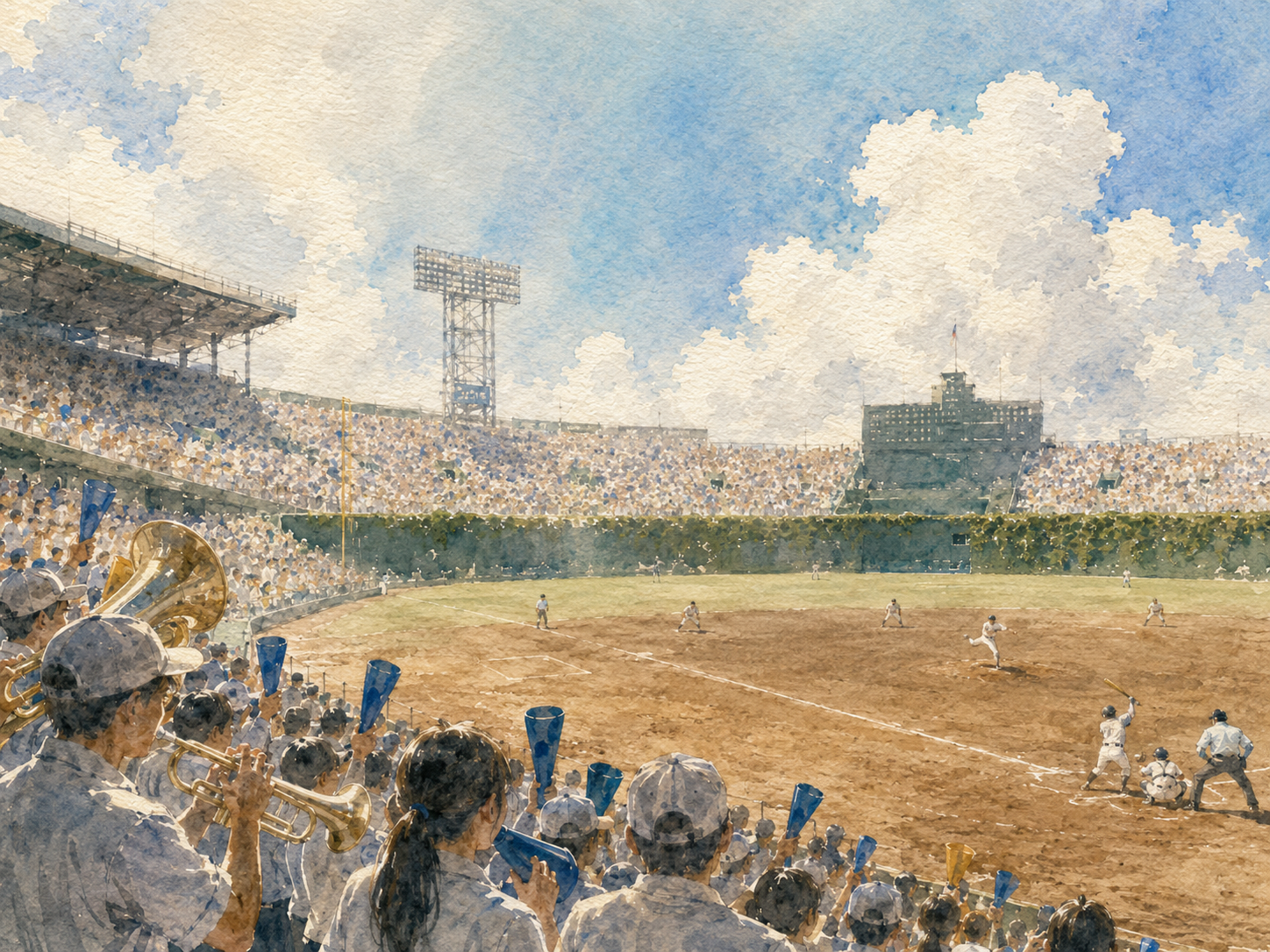
Their games are played at Hanshin Koshien Stadium under the heavy heat of the Japanese summer. Brass bands roar from the stands. Students shout themselves hoarse. Parents watch nervously. Television cameras linger on faces after the final out.
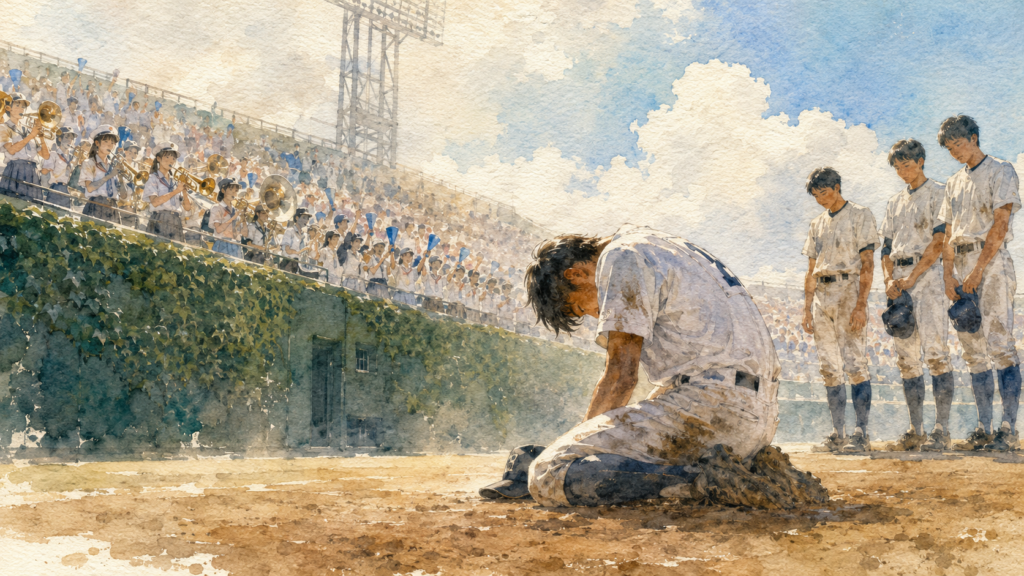
And when a team loses, players sometimes kneel in the dirt and cry.
For many Japanese people, none of this needs explaining.
It is simply summer.
But from outside Japan, there is an obvious question:
Why does an entire country care so much about a baseball tournament played by teenagers?
The answer is partly baseball.
But only partly.
Koshien is also about youth, memory, inequality, regional identity, sacrifice, nostalgia—and perhaps the complicated pleasure adults find in watching someone else’s youth come to an end.
What Is Summer Koshien?
The official name is the National High School Baseball Championship.
The summer tournament dates back to 1915. Koshien Stadium itself opened in 1924, partly because the rapidly growing popularity of student baseball demanded a much larger venue. Professional baseball in Japan did not yet exist in its modern form. Student baseball was already a major spectator sport.
In 2026, the 108th championship runs from August 5 to August 22.
Forty-nine schools reach Koshien through regional tournaments: one representative from each prefectural competition, with Hokkaido and Tokyo divided into two regions. The national championship is a knockout tournament.
That means something very simple.
Forty-nine schools arrive.
One becomes champion.
The other 48 eventually leave.
And for many third-year students, that defeat is not merely the end of a tournament.
It is the end of their high school baseball life.
Japan Does Not Just Watch the Winners
This may be the most important thing to understand about Koshien.
Of course, people celebrate the champion.
But some of the most memorable images come from the teams that lose.
A final strike.
A player staring at the ground.
Teammates bowing toward the stands.
A school song sung for the last time.
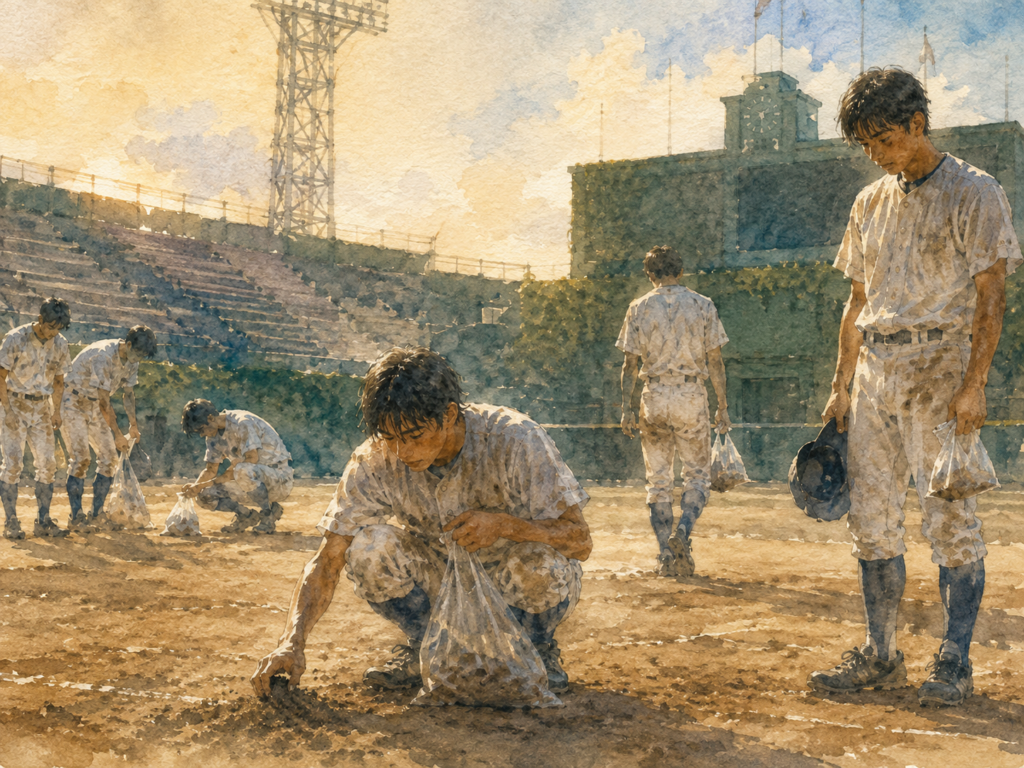
Players gathering dirt from the Koshien field to take home as a keepsake has become one of the tournament’s most recognizable traditions.
In most professional sports, defeat is disappointing because there will be another season.
At Koshien, there is often a much stronger sense of finality.
There will never again be this exact team.
Never again this summer.
Never again these classmates, at this age, playing this game together.
Perhaps that is why Japanese television does not quickly look away when the losing players cry.
The defeat is part of the story.
Maybe it is the story.
Every School Arrives With a Different Life Behind It
Koshien often presents a wonderfully simple picture.
Two schools.
Nine players on each side.
One baseball field.
The same rules.
But life before the first pitch is not nearly so equal.
Some schools have decades of baseball tradition. Some regularly send players to professional baseball. Some return to Koshien again and again.
Others may wait half a century for one opportunity.
In 2026, Yokote High School in Akita returned to the summer championship for the first time in 57 years. Its previous appearance was in 1969.
Hachioji Jissen High School reached Koshien for the first time in its history—during the school’s 100th anniversary year.
Fukuyama Municipal High School, a public school in Hiroshima, qualified for the first time since its baseball club was founded in 1975.
These are irresistible stories.
And Koshien is very good at turning them into stories.
Decades of waiting become a television segment.
A school’s history becomes a few emotional minutes.
Parents, former students, local residents and children suddenly become part of something much larger than a baseball game.
For one school, appearing at Koshien can feel almost routine.
For another, it may happen once in a lifetime.
Then they enter the same tournament.
And the scoreboard does not care.
Life Is Not Fair Before the First Pitch
There is something almost brutally honest about this.
We like sports partly because they create the appearance of fairness.
The bases are the same distance apart.
Three strikes make an out.
Both teams get nine innings under the same rules.
But the people standing on the field did not arrive there through identical lives.
Schools differ.
Training environments differ.
Traditions differ.
Opportunities differ.
Talent differs.
Luck differs.
Even the prefecture in which a team happens to compete changes the path required to reach Koshien.
Sport cannot erase these differences.
It merely gives them a common scoreboard.
And then, eventually, almost everyone loses.
There is something cruel about that.
There is also something strangely close to real life.
Why Do Adults Find This So Moving?
This is where Koshien becomes more than a sports tournament.
A middle-aged office worker can watch a teenager they have never met lose a baseball game and suddenly feel tears coming.
Why?
It cannot only be baseball.
Perhaps adults are watching something they no longer possess.
Youth with a deadline.
When you are 17, three years can feel enormous.
A tournament can feel like everything.
A summer can divide your life into “before” and “after.”
As adults, most of our failures do not come with a brass band, a scoreboard and thousands of people acknowledging that something important has just ended.
Things simply fade.
Friends move away.
Jobs change.
Dreams become less urgent.
Some possibilities disappear so gradually that we never notice the final day on which they were still possible.
Koshien gives us something adulthood rarely does:
a visible ending.
One final pitch.
One final out.
One final bow.
And perhaps when adults watch those teenagers cry, we are not only watching them.
We are remembering ourselves.
Not necessarily as baseball players.
Just as people who were once that young.
We Are Also Consuming Their Youth
There is, however, a less comfortable way to look at all this.
The emotional power of Koshien did not develop outside the media.
It grew together with it.
The tournament attracted enormous crowds early in its history. Radio began reporting results in 1925 and live game broadcasts followed in 1927. For around a century, Koshien and mass media have grown alongside one another.
Today, we know the images.
The crying player.
The worried mother.
The exhausted pitcher.
The school band.
The final summer.
The dirt placed carefully into a bag.
These moments are real.
But they are also filmed.
Selected.
Edited.
Broadcast.
Watched.
The teenage players experience them once.
Millions of adults can experience them from their living rooms.
That does not make the emotion fake.
But it does raise an uncomfortable question.
How much of Koshien is about supporting young people—and how much is about adults consuming a beautifully packaged version of youth?
Perhaps both can be true at the same time.
We can genuinely care about the players.
And we can enjoy the story their joy and suffering create for us.
When the Beautiful Story Breaks
The danger of a powerful story is that reality can become inconvenient.
Japanese high school baseball has long celebrated discipline, hierarchy, endurance and sacrifice.
Those values can create extraordinary teams.
They can also become something else.
In 2025, one of Koshien’s most famous schools, Koryo High School from Hiroshima, withdrew from the national tournament after winning its first game.
The withdrawal followed controversy over violence involving baseball club members. The Japan High School Baseball Federation formally accepted the school’s withdrawal on August 10 and said it would continue efforts to eliminate violence, bullying and “unreasonable hierarchical relationships” from high school baseball.
The affair became uglier in several directions. Media reports described not only the original abuse but also escalating online outrage, harassment of students and even a bomb threat.
It was difficult to fit any of that into the usual Koshien narrative.
Hard work.
Friendship.
Sacrifice.
The final summer.
Dreams coming true.
Those things exist.
But so do teenagers living inside institutions created and supervised by adults.
Koshien can produce beautiful stories about young people.
That is exactly why we should be careful not to let the story become more important than the young people themselves.
And Yet, We Keep Watching
After all of that, it would be easy to become cynical.
Maybe Koshien is simply an old-fashioned institution wrapped in nostalgia.
Maybe the television cameras manipulate emotion.
Maybe adults romanticize suffering because they no longer have to experience it themselves.
There is some truth in all of those criticisms.
And yet.
A school waits 57 years and finally returns.
A public school reaches the tournament for the first time.
A teenager steps onto the field knowing that millions of people may see what happens next.
Two teams play.
One wins.
One loses.
Someone cries.
And despite knowing exactly how the story works, many of us still feel something.
Perhaps understanding the machinery does not destroy the emotion.
Perhaps it makes the emotion more interesting.
Because Koshien is not really a story about perfect fairness.
Life was never fair before the first pitch.
It is not a story in which effort always wins.
It clearly does not.
And it is not simply a celebration of innocent youth.
Adults have been shaping, broadcasting and consuming this image of youth for generations.
Koshien contains all of these contradictions.
That may be why it survives.
Every August, Japan watches teenagers play baseball.
But perhaps what we are really watching is time.
Their time is still intensely finite: three years of high school, one summer, one tournament, one final game.
Ours has already moved on.
And for a few innings, we are allowed to remember what it felt like when one summer could still mean everything.
Sources
- Japan High School Baseball Federation: tournament history and 2026 championship information — https://www.jhbf.or.jp/
- Hachioji Jissen High School: first Koshien appearance in its 100th anniversary year — https://hachioji-jissen.ac.jp/news/3778/
- Fukuyama City: Fukuyama Municipal High School’s first appearance — https://www.city.fukuyama.hiroshima.jp/soshiki/kyoikusomu/409160.html
- Japan High School Baseball Federation statement on Koryo High School’s 2025 withdrawal — https://jhbf.or.jp/topics/detail/533
- The Guardian reporting on the Koryo controversy — https://www.theguardian.com/world/2025/aug/11/japan-baseball-bullying-koryo-high-school-tournament-ntwnfb