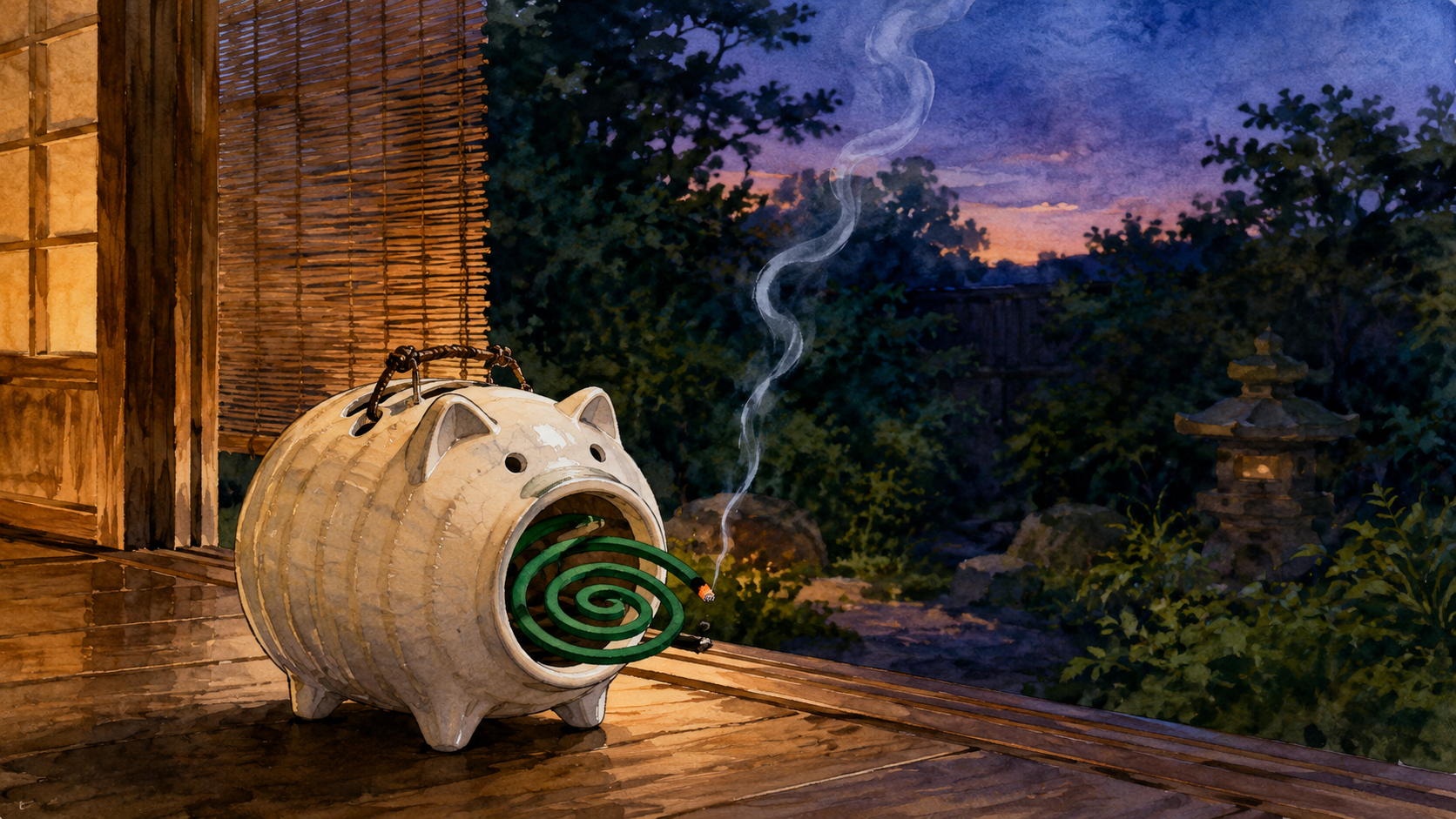
On a humid evening in Japan, a thin ribbon of smoke rises from a green spiral.
It may be sitting in a metal tray beside an open window, under a veranda, or inside a ceramic holder shaped like a pig. Nearby, there might be a glass of cold barley tea, the distant sound of cicadas, and a television murmuring somewhere inside the house.
For many people in Japan, the smell of a mosquito coil is not simply the smell of insect repellent.
It is the smell of summer.
The device itself looks almost too simple to deserve attention: a flat green spiral that slowly turns to ash. Yet its shape was the answer to a real engineering problem, its active ingredient began with a flower, and one of the most important ideas behind it came from the inventor’s wife.
The first mosquito coil, in fact, was not a coil at all.
- The First Mosquito Coil Was a Stick
- A Spiral That Could Last Through the Evening
- The Flower Hidden Inside the Coil
- How Does a Mosquito Coil Work?
- Why Are Japanese Mosquito Coils Green?
- Are Modern Mosquito Coils Still Made from Pyrethrum?
- A Small Note on Safe Use
- A Piece of Summer That Still Burns Slowly
- Sources and Further Reading
The First Mosquito Coil Was a Stick
The story begins with Eiichiro Ueyama, a businessman from Wakayama Prefecture.
In 1886, Ueyama received seeds of a white-flowered plant known as pyrethrum from an American plant dealer. The species, often called Dalmatian pyrethrum, contains natural insecticidal compounds in its flowers.
Ueyama encouraged farmers to grow the plant and began looking for a practical way to use its insect-killing properties.
According to Japan’s National Archives, he eventually mixed pyrethrum powder with dried mandarin-orange peel and a binding material. Inspired by traditional Japanese incense, he formed the mixture into sticks.
In 1890, the early mosquito-repellent incense was born.
But it had problems.
The stick was about 20 centimeters long and burned for only around 40 minutes. It was thin, relatively weak and easy to break during transport. Making it longer would increase the burning time, but an extremely long straight stick would be difficult to manufacture, package and use.
The basic idea worked. The shape did not.
A Spiral That Could Last Through the Evening
The solution appeared in 1895.
KINCHO’s official history credits Ueyama’s wife, Yuki, with the idea of forming the incense into a spiral. Instead of extending the stick across a room, the same length could be curled into a compact circle.
It was an elegant answer to several problems at once.
The spiral could contain much more material without taking up much space. It was easier to store and transport, and it could burn steadily for hours rather than minutes. After years of testing, the spiral version went on sale in 1902.
A later coil measuring about 58 centimeters could burn for approximately six hours. The current standard KINCHO coil is about 75 centimeters long and provides roughly seven hours of use, according to the company’s historical collection.
That is close to the length of a summer evening—or a night’s sleep—packed into a circle small enough to hold in one hand.
The spiral did not make the insecticide chemically stronger. Its achievement was spatial: it transformed a long, fragile stick into a compact and practical time-release device.
The Flower Hidden Inside the Coil
The original mosquito coil began with a plant called shirobana mushiyokegiku in Japanese, literally the “white-flowered insect-repelling chrysanthemum.”
Its scientific name is Tanacetum cinerariifolium, although it was formerly classified in the genus Chrysanthemum. It is native to the Balkan region and resembles a simple white daisy.
Its flowers contain a group of natural insecticidal compounds called pyrethrins.
KINCHO’s historical materials explain that these compounds are concentrated mainly in the flower head, especially around the ovary. When pyrethrins—or the related synthetic compounds called pyrethroids—enter an insect’s body, they interfere with sodium channels in nerve cells. The nerves remain overstimulated, leading to loss of coordination, paralysis and, at a sufficient dose, death.
The US Environmental Protection Agency describes this mechanism for pyrethroids.
In other words, the mosquito coil is not just dried plant material producing an unpleasant smell. It is a method of releasing an insect-active substance into the surrounding air at a controlled rate.
The plant provided the chemistry. The spiral provided the delivery system.
How Does a Mosquito Coil Work?
A mosquito coil is lit at its outer tip. Once a small flame appears, the flame is blown out, leaving the material to smolder slowly.
The glowing section of a KINCHO coil reaches a temperature of roughly 700 to 800°C. However, the insecticidal ingredient is released slightly behind the burning tip, where the temperature is closer to 250°C.
This distinction matters.
The active ingredient does not need to pass directly through the hottest part of the flame. It is heated and dispersed from the section immediately behind it, while the plant-based body of the coil continues to smolder.
The visible smoke helps carry the familiar smell and marks the movement of air, but the effectiveness of the coil comes from the active ingredient being released continuously over several hours.
That slow release is what makes the coil different from a spray. A spray delivers a large amount at once. A coil quietly maintains an insecticidal presence as it burns.
Why Are Japanese Mosquito Coils Green?
The green color looks so natural that it is easy to assume it comes from the pyrethrum plant.
It does not.
According to KINCHO’s factory guide, the mixture used to make a coil is naturally brown. It contains wood powder, plant-based powder, starch and binding materials. Green dye is added during production.
The company gives several reasons for the choice.
Green could be applied evenly to the brown base. It also appeared cool and refreshing during Japan’s hot summers. Finally, it recalled an older Japanese practice called kayari, in which people burned grasses and leaves—including mugwort—to drive away mosquitoes.
The color therefore connects a modern manufactured product with an older image of smoldering green plants.
Even the color of the coil was designed to feel like summer.
Are Modern Mosquito Coils Still Made from Pyrethrum?
The historical mosquito coil relied on natural pyrethrins from pyrethrum flowers. Modern products are more complicated.
Many contemporary mosquito coils use synthetic pyrethroids: compounds developed by studying and modifying the chemical structures of natural pyrethrins. These synthetic versions can provide more stable and predictable performance.
For example, the standard KINCHO Uzumaki currently lists allethrin, a synthetic pyrethroid, as its active ingredient. The company also sells a separate coil made with natural pyrethrum as its insecticidal ingredient.
Therefore, “inspired by a flower” does not necessarily mean that every mosquito coil sold today contains only flower-derived insecticide.
The distinction is important. Natural pyrethrins and synthetic pyrethroids belong to the same broader chemical family, but they are not identical.
A Small Note on Safe Use
A mosquito coil is both an insecticide and a burning object. “Plant-inspired” does not mean that it can be used without care.
The manufacturer instructs users to place the coil upwind in a well-ventilated area. In a closed room, accumulated smoke may irritate the eyes, nose or throat. The coil should be kept away from flammable materials and used only with a suitable holder or tray.
It should also not be burned in rooms containing pet insects, aquarium fish, amphibians or reptiles, because pyrethroids can be highly toxic to many non-mammalian animals.
As with any household insecticide, the directions on the specific product should take priority.
A Piece of Summer That Still Burns Slowly
Japan now has electric mosquito vaporizers, battery-powered repellents, window screens, air conditioning and sprays that work with a single push.
The mosquito coil is no longer the only answer to a summer night.
Yet it has never completely disappeared.
It remains useful outdoors, in gardens, at campsites and around older homes with open windows. More than that, it survives as a cultural image: the green spiral, the falling ash and the smoke drifting through heavy evening air.
Its history also contains something larger than nostalgia.
A flower evolved a chemical defense against insects. A Japanese inventor recognized its usefulness. His first design worked, but only for 40 minutes. His wife saw that the problem could be solved not by changing the material, but by changing its shape.
That shape extended 40 minutes into an entire evening.
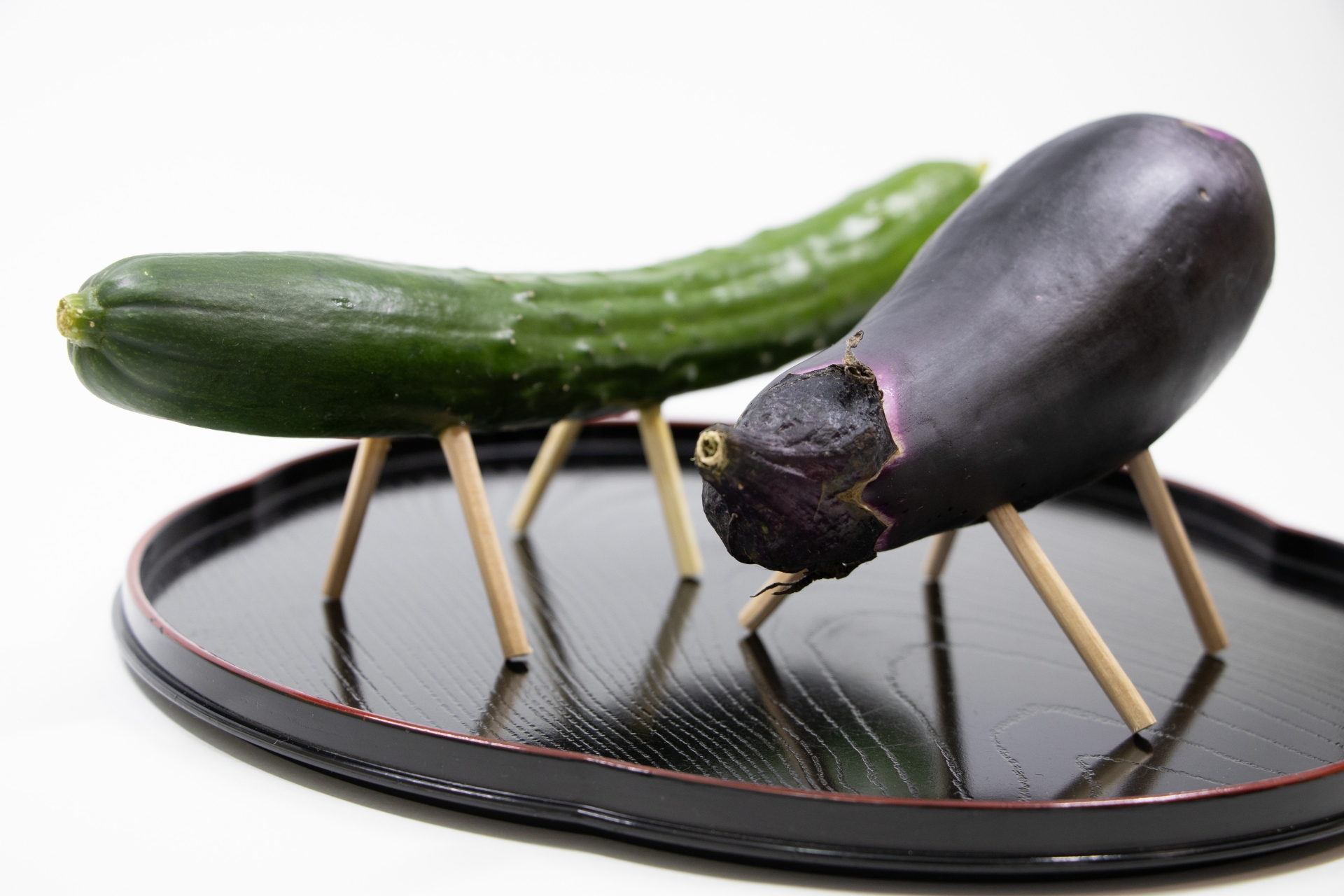
During the same season, ordinary objects take on other quiet roles in Japanese homes—from cucumber horses and eggplant cows made for Obon to a glass of cold barley tea.
Today, more than a century later, the spiral continues to burn—slowly, quietly and with the unmistakable smell of a Japanese summer.
Sources and Further Reading
- KINCHO: Company History—Meiji Era
- National Archives of Japan: The Invention of the Mosquito Coil
- KINCHO Factory Guide: Why Is the Coil Spiral-Shaped and Green?
- KINCHO Historical Product Collection
- KINCHO: Current Mosquito Coil Products
- US Environmental Protection Agency: Insecticides and Their Modes of Action