Japan’s traditional calendar calls this short stretch of September 鶺鴒鳴 (sekirei naku)—“wagtails begin to call.” But the 72 microseasons are more useful today as prompts to look closely than as literal weather reports.
For this microseason in 2026, the clearest seasonal signal is not a claim that wagtails across Japan have suddenly started calling. It is the overlap visible in ordinary life: sweet potatoes are entering harvest season, autumn-coded foods are appearing on convenience-store shelves, and summer heat is still hanging on.
- When is 鶺鴒鳴 in 2026?
- The strongest seasonal clue is on the table
- A convenience-store bento can be a seasonal document
- The produce market still looks like a season in transition
- The air can still say summer
- What “shun” means in this microseason
- How to notice 鶺鴒鳴 in Japan today
- Where this fits in Japan’s seasonal calendar
- Calendar source
When is 鶺鴒鳴 in 2026?
Ordinary Japan treats 鶺鴒鳴 as September 12–17, 2026.
The date window used here is derived from the official 24-solar-term anchors published by the National Astronomical Observatory of Japan. NAOJ publishes the solar terms, not a modern official national schedule for all 72 microseasons, so the five-day window should be read as a calendar framework rather than a government observation of nature.
And the name itself is historical seasonal language. It does not mean that Ordinary Japan has verified a nationwide change in wagtail behavior during these exact dates.
The strongest seasonal clue is on the table
In mid-September, sweet potato is one of the clearest food signals of the season beginning to turn.
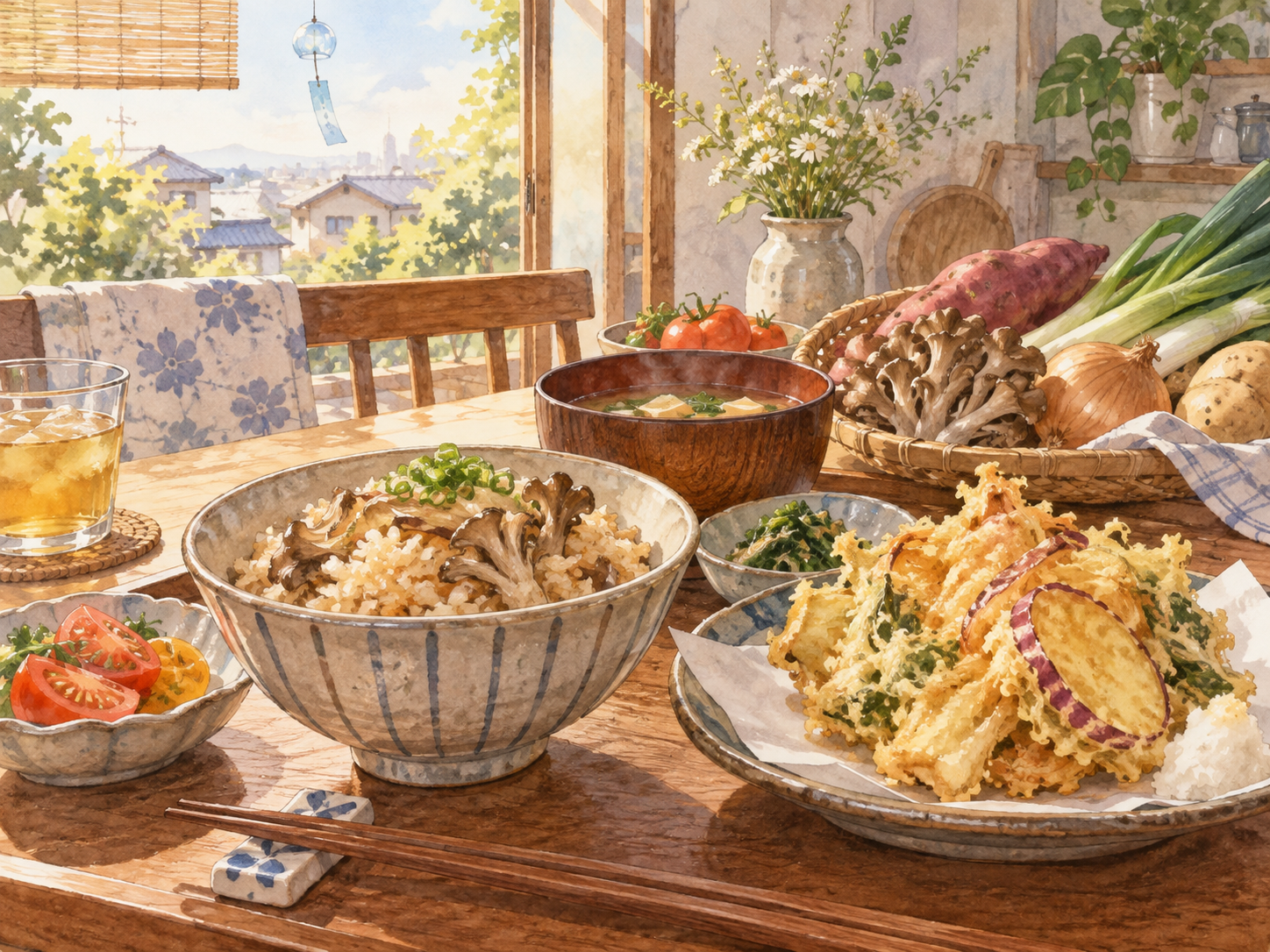
The Ministry of Agriculture, Forestry and Fisheries’ Chugoku-Shikoku Regional Agricultural Administration Office gives the general sweet-potato harvest period as September through November. MAFF’s traditional-food database also notes that Kagoshima-style karaimo gohan—rice cooked with sweet potato—is commonly made around September to November, when sweet potatoes are harvested and circulate more widely.
That makes sweet potato a particularly useful example of shun: not merely a food associated with “autumn” in the abstract, but something whose harvest and everyday use are actually moving into season.
Source: MAFF — Sweet potato cultivation and harvest
Source: MAFF — Karaimo gohan, Kagoshima
A convenience-store bento can be a seasonal document
Seasonality in modern Japan does not appear only in gardens, shrines, or traditional meals. It also turns up in extremely ordinary retail spaces.
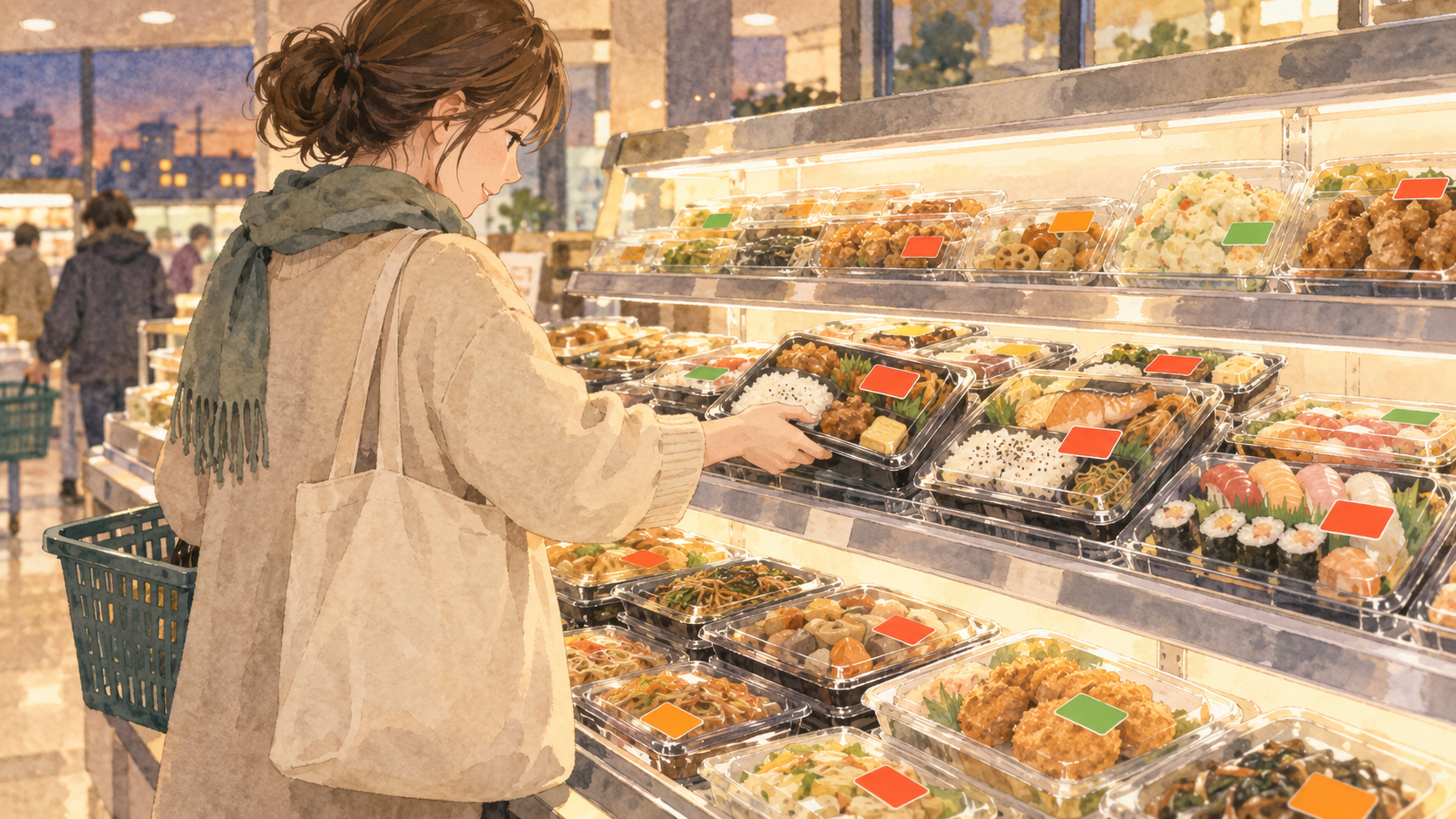
Seven-Eleven Japan’s official weekly product listing shows a “舞茸御飯幕の内 さつまいもかき揚げ” — maitake-rice makunouchi bento with sweet-potato kakiage — released from September 15, 2026, across a wide range of regions.
That does not prove that maitake or sweet potato reached exactly the same biological seasonal stage everywhere in Japan, and a retail launch is partly a commercial calendar. Still, it is a useful observation of how contemporary Japanese everyday life communicates “autumn”: mushroom rice and sweet potato appear together in a mass-market meal while the weather can still feel like summer.
Source: Seven-Eleven Japan — This week’s new products
The produce market still looks like a season in transition
The national vegetable outlook for September 2026 also shows why it is too simple to say that autumn has fully arrived.
MAFF’s August 28 outlook for vegetables shipped to the Tokyo Central Wholesale Market describes a mixed September picture. For example, tomatoes and cucumbers were expected to run somewhat above normal prices in the first half of the month before moving closer to normal later, while potatoes and onions were expected to have above-normal shipment volumes and below-normal prices. Other vegetables were forecast closer to normal conditions.
This is not a list of “autumn foods.” It is evidence of a market still shaped by summer weather, regional production shifts, and the gradual handoff between producing areas.
Source: MAFF — Vegetable growth and price outlook for September 2026
The air can still say summer
The calendar’s autumn language also collides with present-day temperatures.
A Japan Meteorological Agency forecast issued on September 15 included a maximum temperature of 32°C for Osaka within the forecast period and 28°C for Tokyo. Even inside a traditional early-autumn microseason, much of daily life can therefore still feel distinctly warm.
This mismatch is not a reason to dismiss the old calendar. It is one of the most interesting things about using it today.
The name 鶺鴒鳴 gives us an inherited seasonal expectation. Modern observations then show which parts still resonate, which arrive at different times, and which signals have moved from the field into shops, kitchens, and urban routines.
Source: JMA forecast — Osaka
Source: JMA forecast — Tokyo
What “shun” means in this microseason
The Japanese idea of shun (旬) is more useful than a fixed label such as “autumn food.” A seasonal ingredient can be:
- hashiri — just arriving or entering its season
- sakari — at its peak
- nagori — lingering at the end of its season
Around 鶺鴒鳴 in 2026, sweet potato is a good example of the hashiri side of autumn: harvest is beginning in parts of Japan, it is appearing more visibly in seasonal meals, yet the surrounding weather has not necessarily caught up.
That overlap may be the most recognizably modern-Japanese expression of this microseason.
Autumn can reach the table before it reaches the air.
How to notice 鶺鴒鳴 in Japan today
You do not need to find a wagtail at exactly the right moment to experience this five-day season.
Look instead for small changes in ordinary surroundings. Sweet potato begins to move from “future autumn” into actual food. Mushroom rice and other autumn-coded dishes become easier to find. Supermarket produce changes gradually rather than all at once. Meanwhile, cold drinks, air-conditioning, and high daytime temperatures may still belong to everyday life.
The old calendar and modern Japan are not perfectly synchronized—and that is precisely why comparing them is useful.
鶺鴒鳴 is less a command to observe one bird than an invitation to notice how many different clocks a season follows at once: wildlife, crops, markets, retail, weather, and human habit.
Where this fits in Japan’s seasonal calendar
鶺鴒鳴 belongs to 白露 (Hakuro, White Dew), one of Japan’s 24 solar terms. It is followed by 玄鳥去 (Tsubame saru, Swallows depart).
See the full guide: Japan’s 24 Solar Terms and 72 Microseasons
Calendar source
The 24-solar-term anchors used by Ordinary Japan are based on the National Astronomical Observatory of Japan’s 2026 almanac: NAOJ — 2026 solar terms
The 72-microseason date interval used here is derived from those official anchors and should not be interpreted as a separate official NAOJ publication of the 72 microseasons.