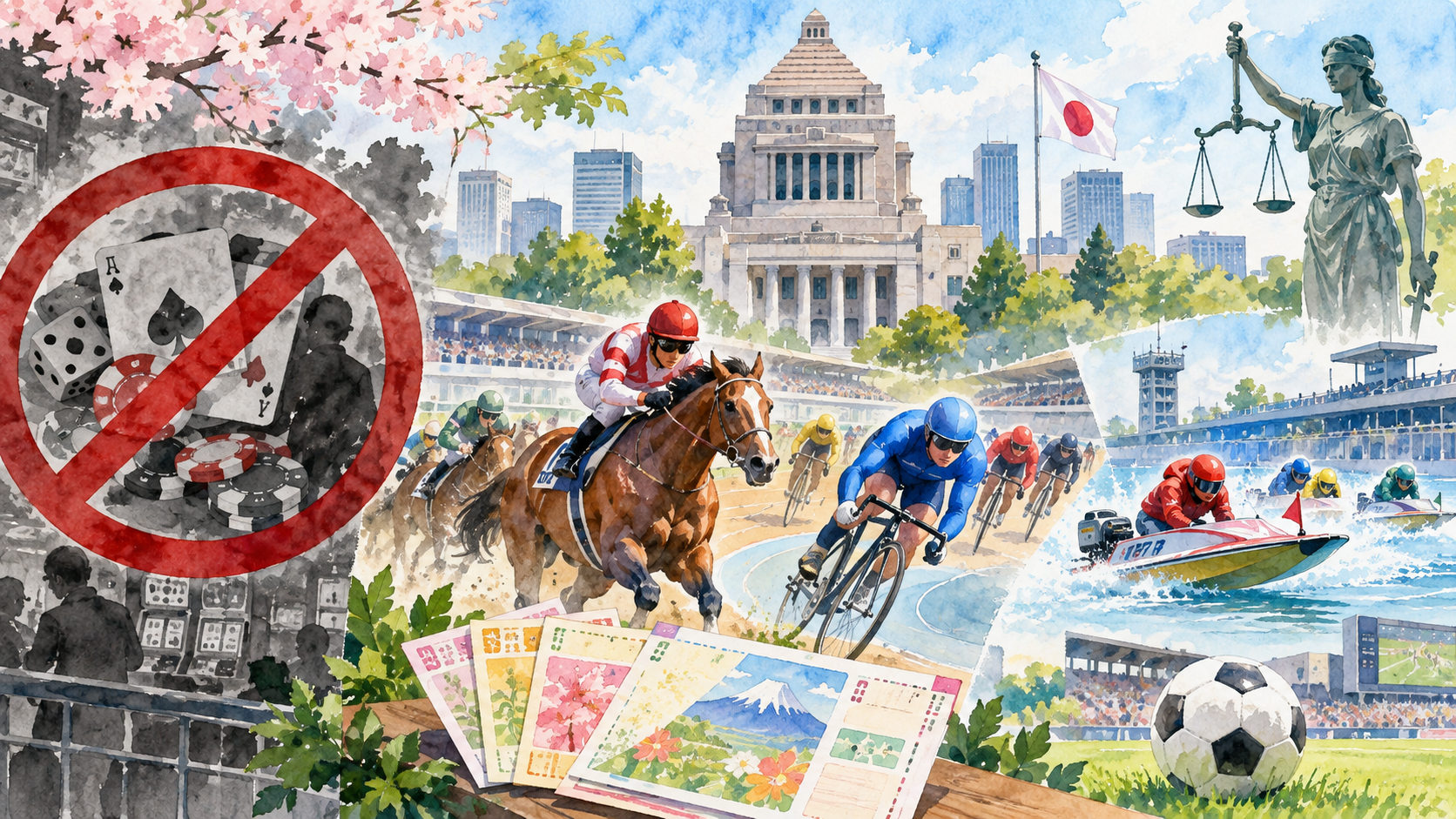
In Japan, you can legally place a bet on a horse race.
You can also bet on a bicycle race, a motorboat race, or a motorcycle race.
You can buy official lottery tickets, and you can buy sports lotteries such as toto, BIG, WINNER, and DUNK.
But if a private company simply opens a betting business and starts taking wagers, that does not make the activity legal.
This is one of the most important things to understand about gambling in Japan:
Japan does not generally legalize gambling and then regulate the industry. It generally prohibits gambling, and then creates specific legal exceptions through individual laws.
That difference explains why Japan has such a fragmented collection of legal betting systems.
- The basic rule comes from the Penal Code
- So why is horse racing legal?
- The same logic created Keirin
- Boat Race follows the same pattern
- Auto Race also has a special law
- Why were so many of these laws created after World War II?
- Takarakuji is not just a private lottery
- The money is part of the legal design
- This does not mean gambling becomes harmless
- Why can’t the same logic make an online casino legal?
- Why not simply legalize and tax gambling?
- Regulation also limits who can run the game
- Japan therefore has two layers of law
- The distinction also explains pachinko
- Legal gambling in Japan is better understood as a set of exceptions
- The result is a very Japanese institutional landscape
- Sources and further reading
- Gambling in Japan — Series
The basic rule comes from the Penal Code
Japan’s Penal Code establishes the starting point.
Article 185 prohibits gambling, apart from a narrow exception involving things provided merely for temporary entertainment. Article 186 addresses habitual gambling and operating gambling places for profit. Article 187 separately addresses unauthorized lotteries.
So the default position is not:
Gambling is legal unless the government bans it.
It is much closer to:
Gambling is prohibited unless a specific legal framework authorizes it.
That distinction is fundamental.
So why is horse racing legal?
Because horse racing has its own statutory framework.
Japan’s Horse Racing Act dates from 1948 and establishes who may conduct races, how betting is organized, how the system is supervised, and how money is handled.
The important point is that horse racing is not treated as an ordinary private gambling market. It is a specially authorized institution operating inside a legal framework created by the state.
This same pattern appears again and again in Japan’s legal betting systems.
The same logic created Keirin
Keirin may be an even clearer example.
Japan’s Bicycle Racing Act was enacted in 1948. Its first article explicitly connects bicycle racing with public purposes: improving bicycles and other machinery, promoting exports, rationalizing the machinery industry, supporting sports and other public-interest activities, and helping improve local government finances.
In other words, the law did not create Keirin purely because people wanted to gamble on bicycles.
The betting system was embedded inside a wider industrial and fiscal policy.
This helps explain something that can seem unusual to visitors:
Why would a country have a government-authorized gambling system based specifically on bicycle racing?
Because the system was historically designed to do more than provide entertainment.
The race, the betting, industrial policy, public funding, and local-government finance were connected.
Boat Race follows the same pattern
Japan’s motorboat racing system was established under the Motorboat Racing Act in 1951.
Again, the law explicitly describes broader purposes.
These include promoting ships, marine engines and related industries, supporting maritime safety and other maritime activities, contributing to tourism and sports, supporting other public-interest activities, and improving local government finances.
So Boat Race is not simply:
Japan happens to allow people to bet on speedboats.
Legally and historically, it belongs to a system in which wagering generates money that can support designated industries and public purposes.
Auto Race also has a special law
Japan’s Auto Race uses motorcycles, despite the English name sometimes suggesting automobile racing.
It is governed by the Small Motor Vehicle Racing Act, enacted in 1950.
Like the Bicycle Racing Act, the law connects the racing system to machinery-related industries, public-interest projects, sports, and local public finance.
By this point, the pattern becomes clear.
Japan’s four major public racing systems are not exceptions created through one general “Gambling Act.”
Each has its own legal history.
Each has its own institutions.
And each has historically been connected to public-policy objectives beyond gambling itself.
Why were so many of these laws created after World War II?
The dates matter.
The modern legal frameworks for Takarakuji, horse racing, and Keirin all date from 1948.
Auto Race followed in 1950.
Boat Race followed in 1951.
Postwar Japan faced enormous fiscal and economic reconstruction challenges.
The language written into these laws reflects that environment.
The Lottery Ticket Act, for example, originally stated that its purpose was to absorb excess purchasing power and help secure funds for local government finances.
The Bicycle Racing Act referred to machinery industries, public-interest projects, and local finances.
The Small Motor Vehicle Racing Act used a similar logic.
The Motorboat Racing Act connected racing with maritime industries, tourism, sport, public-interest activities, and local finances.
One useful way to understand Japan’s legal gambling structure is therefore to see part of it as a postwar funding architecture.
Activities involving wagering were permitted, but only inside tightly specified institutional systems that redirected part of the money toward public purposes.
Takarakuji is not just a private lottery
The same distinction is especially clear with Takarakuji, Japan’s official lottery.
The Penal Code prohibits unauthorized lotteries.
Yet Takarakuji is legal because another law — the Lottery Ticket Act — establishes an authorized lottery system.
The issuers are not ordinary private companies.
Under the law, prefectures and designated cities may issue lottery tickets under the statutory framework.
Banks and other organizations can carry out operational work, but the issuing structure itself is public.
That distinction matters.
If a company simply decided to create its own nationwide cash lottery, it could not argue:
Takarakuji exists, therefore private lotteries are legal.
Takarakuji exists because the law creates a particular authorized system.
The money is part of the legal design
This also explains why discussions of Japanese gambling so often lead to the question:
Where does the money go?
The destination of the money is not an incidental side effect.
It is often built into the institutional justification for the system.
In Takarakuji, part of the proceeds becomes revenue for prefectures and designated cities.
Horse racing produces public revenue through its statutory structure.
Keirin and Auto Race have historically funded machinery-related and public-interest activities.
Boat Race revenue is connected with local government and maritime or public-interest purposes.
Sports lottery revenue supports sports promotion.
The details differ significantly between systems, but the broad structure is similar:
betting is permitted inside a controlled framework, and part of the economic value is redirected toward designated public purposes.
This does not mean gambling becomes harmless
The fact that a system has a public purpose does not eliminate the risks associated with gambling.
Japan maintains policies addressing gambling addiction and gambling-related harm.
So the legal reasoning is not simply:
Gambling generates public revenue, therefore gambling is good.
Instead, the system represents a policy balance.
Certain forms of wagering are authorized.
They are restricted to defined institutional frameworks.
Revenue is directed through regulated channels.
And governments simultaneously regulate participation and address gambling-related harm.
Why can’t the same logic make an online casino legal?
This is where the special-law structure becomes particularly important.
An overseas online casino may be legally licensed in the country where its operator is located.
But that does not place it inside one of Japan’s legal exceptions.
From Japan’s perspective, the question is not simply whether the company is licensed somewhere.
The relevant question is:
Does Japanese law authorize this particular form of gambling in Japan?
For overseas online casinos accessed from Japan, the answer is no.
The National Police Agency states that gambling through an overseas online casino from within Japan is a criminal offense even when the operator itself is legal overseas.
The existence of JRA, Keirin, Boat Race, or Takarakuji does not create a general right to offer gambling.
They are exceptions, not precedents for an unrestricted market.
Why not simply legalize and tax gambling?
Some countries use a regulatory model in which private gambling businesses can receive licenses and operate within a broad legal market.
Japan historically developed differently.
Rather than opening one large gambling market, Japan built several narrow systems around particular activities.
That resulted in an unusual landscape:
- horse racing under one legal framework
- bicycle racing under another
- motorboat racing under another
- motorcycle racing under another
- government-authorized lotteries under another
- sports lotteries under another
- pachinko under amusement-business regulation
- IR casinos under yet another framework
To outsiders, this can appear inefficient or contradictory.
But from a legal perspective, the fragmentation is exactly what makes the system possible.
Each exception is bounded.
Regulation also limits who can run the game
Another important feature is that the government does not merely regulate how bets are accepted.
The laws also restrict who may organize the underlying gambling system.
Local public entities play central roles in public racing.
JRA operates central horse racing under its statutory structure.
Takarakuji is issued within a local-government lottery framework.
The Japan Sport Council operates the sports promotion lottery system.
This prevents legal gambling from becoming an ordinary market where any company can simply launch a competing product.
Institutional gatekeeping is part of the legal exception.
Japan therefore has two layers of law
A useful way to think about the system is as two layers.
Layer 1: the general prohibition
The Penal Code establishes that gambling and unauthorized lotteries are generally prohibited.
Layer 2: specific statutory systems
Individual laws then create narrow authorized systems.
Examples include:
- Horse Racing Act
- Bicycle Racing Act
- Small Motor Vehicle Racing Act
- Motorboat Racing Act
- Lottery Ticket Act
- Act governing the Sports Promotion Lottery
This is why asking simply,
“Is gambling legal in Japan?”
does not produce a very useful answer.
The more useful question is:
“Which specific gambling system does Japanese law authorize?”
The distinction also explains pachinko
Pachinko appears to complicate the picture further.
It resembles gambling economically, but it is not organized under the same public-racing laws.
Instead, pachinko parlors operate within Japan’s regulated amusement-business framework.
That does not make pachinko the same legal category as horse racing or Keirin.
It means Japan has developed yet another regulatory route for an activity with gambling-like characteristics.
We will examine that system separately later in this series.
Legal gambling in Japan is better understood as a set of exceptions
This is the central idea.
Japan does not really have one legal gambling industry.
It has multiple authorized systems sitting inside a broader prohibition.
The logic looks something like this:
General gambling prohibition
↓
Specific law creates a limited exception
↓
Only designated organizations can operate it
↓
Rules determine how betting works
↓
Government bodies supervise the system
↓
Part of the proceeds is directed toward specified public purposes
That structure explains why horse racing can be legal while an unlicensed betting business is illegal.
It explains why Takarakuji can be sold while an unauthorized private lottery cannot.
And it explains why a foreign online casino license does not automatically have legal effect inside Japan.
The result is a very Japanese institutional landscape
Japan’s legal gambling systems are therefore not merely entertainment businesses.
They also reflect postwar industrial policy, local government finance, sports policy, maritime policy, agriculture, and administrative history.
This is why the ministries involved are so varied.
Horse racing connects to agricultural administration.
Keirin and Auto Race connect to industrial administration.
Boat Race connects to transport and maritime administration.
Takarakuji connects to local governments and internal-affairs administration.
Sports lotteries connect to sports policy.
What looks like a collection of unrelated betting products is actually a collection of policy systems built at different points in modern Japanese history.
And that leads directly to the next question:
Why did Japan end up with exactly four public racing sports — horse racing, Keirin, Boat Race, and Auto Race?
That is the subject of the next article.
Sources and further reading
- e-Gov, Penal Code: https://laws.e-gov.go.jp/law/140AC0000000045/
- e-Gov, Bicycle Racing Act: https://laws.e-gov.go.jp/law/323AC1000000209/
- e-Gov, Small Motor Vehicle Racing Act: https://laws.e-gov.go.jp/law/325AC1000000208/
- e-Gov, Motorboat Racing Act: https://laws.e-gov.go.jp/law/326AC1000000242/
- e-Gov, Lottery Ticket Act: https://laws.e-gov.go.jp/law/323AC0000000144/
- National Police Agency, online casinos: https://www.npa.go.jp/bureau/safetylife/hoan/onlinecasino/onlinecasino.html
Gambling in Japan — Series
- Gambling in Japan: What Is Legal and How Does It Work?
- Why Is Gambling Mostly Illegal in Japan — Yet Horse Racing and Lotteries Are Legal? — You are here
- Why Does Japan Have Four Public Racing Sports?
- Horse Racing in Japan: JRA, Betting and the Money Behind It — Coming soon
- Keirin: How Bicycle Racing Became a Japanese Betting Sport — Coming soon
- Boat Race: Why Japan Bets on Motorboat Racing — Coming soon
- Auto Race: Japan’s Lesser-Known Motorcycle Betting Sport — Coming soon
- Takarakuji: How Japan’s Government-Authorized Lottery Works — Coming soon
- toto, BIG, WINNER and DUNK: Japan’s Sports Lottery Explained — Coming soon
- Pachinko Explained: Is It Gambling in Japan? — Coming soon
- Casinos in Japan: How the IR System Is Different — Coming soon
- Online Casinos in Japan: Why Overseas Websites Are Still Illegal to Use — Coming soon
- Where Does Japan’s Gambling Money Go? — Coming soon
- Who Regulates Gambling in Japan? The Ministries Behind Each System — Coming soon
- What Are the Odds? Comparing Payout Rates Across Japan’s Lotteries and Public Racing — Coming soon
- Why Japan Treats Gambling, Lotteries and Pachinko Differently — Coming soon
Information in this article is current as of September 26, 2026.