Japan can be confusing when it comes to gambling.
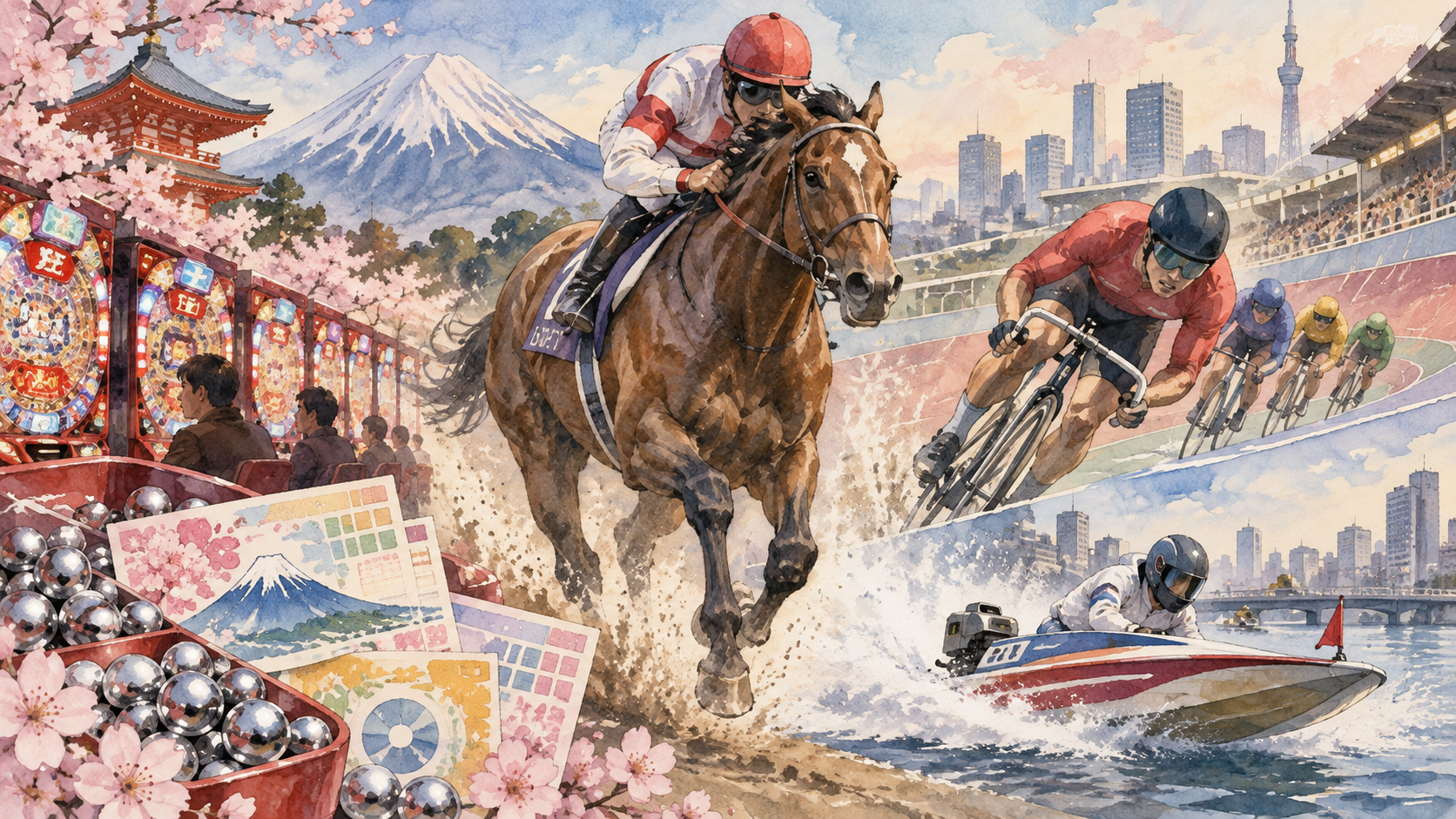
Walk through a Japanese city and you may see brightly lit pachinko parlors. Turn on the television and you may see advertisements for horse racing or lotteries. Convenience stores sell sports lottery tickets. Bicycle races, motorboat races, and motorcycle races can all be legally bet on.
And in September 2026, Japan added something new: DUNK, a prediction-free sports lottery based on basketball.
Yet at the same time, Japanese police repeatedly warn that using an overseas online casino from inside Japan is a crime.
So is gambling legal in Japan or not?
The short answer is:
Gambling is generally prohibited, but Japan has created several specific legal systems that allow certain forms of betting or lotteries under special laws and government supervision.
That distinction explains much of Japan’s unusual gambling landscape.
- The starting point: gambling is generally prohibited
- What can people legally bet on in Japan?
- Japan has four major public racing systems
- Horse racing is also a public-finance system
- Lotteries form another branch of the system
- And then there are the sports lotteries
- Pachinko is the strange case
- What about casinos?
- Why does Japan use such a complicated system?
- The money does not all go to the same place
- Gambling in Japan is not one system
- Sources and further reading
- Gambling in Japan — Series
The starting point: gambling is generally prohibited
Japan does not begin from the assumption that gambling is a normal commercial activity.
Article 185 of the Penal Code prohibits gambling, with a limited exception for things used for temporary amusement. More serious provisions cover habitual gambling and operating gambling establishments.
Japan’s legal public racing systems therefore do not exist because gambling is generally legal. They exist because special legislation creates specific exceptions to the general prohibition.
Lotteries are also legally distinct. Japanese criminal law separately addresses gambling and unauthorized lotteries, while authorized lotteries operate under their own legislation.
This produces a system that can look contradictory from the outside but is relatively structured once the categories are separated.
What can people legally bet on in Japan?
| System | Status in Japan | Basic structure |
|---|---|---|
| Horse racing | Legal under special laws | Publicly regulated racing |
| Keirin bicycle racing | Legal under special law | Public racing |
| Boat Race | Legal under special law | Public racing |
| Auto Race | Legal under special law | Public racing |
| Takarakuji | Legal | Government-authorized lottery |
| toto / BIG / WINNER / DUNK | Legal | Sports promotion lotteries |
| Pachinko | Legal as a regulated amusement business | Not legally structured as public racing or a lottery |
| IR casino | Legal framework established, but not yet open | Casino permitted only within licensed integrated resorts |
| Overseas online casino used from Japan | Illegal | Ordinary gambling prohibition applies |
That last distinction is particularly important.
An online casino does not become legal in Japan merely because the company operating it is licensed in another country.
The National Police Agency states explicitly that accessing an overseas online casino from Japan and gambling on it is a criminal offense. This applies regardless of whether the overseas operator itself is legal where it is based. Japan also strengthened restrictions on advertising and directing users toward illegal online gambling from September 25, 2025.
Japan has four major public racing systems
One of the most distinctive parts of the Japanese system is kōei kyōgi, usually translated as public racing.
There are four major types:
- horse racing
- Keirin bicycle racing
- Boat Race
- Auto Race
They are not all controlled by one gambling authority.
Horse racing falls under the agricultural administration, Keirin and Auto Race under the economic and industrial administration, and Boat Race under the transport administration.
Japan’s Ministry of Land, Infrastructure, Transport and Tourism describes this division: horse racing is overseen by the Ministry of Agriculture, Forestry and Fisheries; Keirin and Auto Race by the Ministry of Economy, Trade and Industry; and Boat Race by the Ministry of Land, Infrastructure, Transport and Tourism.
That administrative split reflects the history of how these industries developed after the war.
It also means that Japanese gambling cannot really be understood as one unified industry. It is a collection of systems created at different times, under different laws, for different policy purposes.
Horse racing is also a public-finance system
Japan Racing Association races are not simply commercial entertainment.
Under the Japan Racing Association Act, part of betting-ticket sales and part of JRA’s profits are paid to the national treasury.
JRA explains that these payments ultimately contribute to areas including livestock promotion and social welfare.
This pattern — betting combined with public revenue — appears repeatedly across Japan’s legal gambling systems.
That does not mean every yen lost by a bettor goes directly to a government project. Prize payouts, operating costs and other expenses come first.
But the important point is that the legal justification and institutional design are closely connected to public administration.
Lotteries form another branch of the system
Japan also has the familiar Takarakuji lottery.
But even this is not simply a private lottery company selling tickets for profit.
In fiscal 2024, Takarakuji sales totaled ¥759.8 billion.
Of that amount, 46.5% was paid as prizes, while 36.2% — ¥275.0 billion — went to the prefectures and designated cities that issue the lottery, where the money is used for public projects and services.
The remainder covered areas such as sales expenses and public-interest promotion.
So buying a Japanese lottery ticket is also, indirectly, participating in a local-government financing mechanism.
And then there are the sports lotteries
Japan’s sports lotteries form another separate system.
Many people know toto and BIG, which historically focused mainly on football. The system later expanded to products such as WINNER.
Then, on September 15, 2026, Japan launched DUNK, a new prediction-free sports lottery based on basketball.
It was the first Japanese prediction-free sports lottery to use basketball as its target sport.
Revenue from Japan’s sports lotteries is used as a funding source for sports-promotion grants administered through the Japan Sport Council. These grants support activities including regional sports development and other sports-related programs.
So Japan now has a system in which professional sporting events can generate lottery revenue that is then recycled into the broader sports ecosystem.
DUNK is therefore not simply “betting on basketball.”
It is part of a larger Japanese policy structure linking sports, lotteries and public funding.
Pachinko is the strange case
And then there is pachinko.
To many visitors, pachinko looks obviously like gambling.
Players put money into machines, win metal balls or medals, and can receive prizes.
Yet pachinko parlors are legally regulated as amusement businesses, not as public betting operators equivalent to horse racing or Boat Race.
The National Police Agency regulates these businesses under Japan’s amusement-business framework.
This legal separation is one reason discussions about “gambling in Japan” quickly become complicated.
From an everyday economic perspective, pachinko can resemble gambling. From the perspective of Japanese law and administration, however, it belongs to a different system.
What about casinos?
Japan has also created a legal framework for casino gambling inside Integrated Resorts, usually called IRs.
But as of September 2026, Japan does not yet have an operating legal IR casino.
The Casino Regulatory Commission exists and the legal and regulatory framework is already in place. Japan’s approved Osaka IR is currently expected to open around autumn 2030.
This is another important distinction.
Saying “casinos are legal in Japan” is technically incomplete.
Japan has legalized casino operations within a tightly defined licensed IR framework. That does not legalize ordinary private casinos elsewhere in the country.
Nor does it make overseas online casinos legal for residents accessing them from Japan.
Why does Japan use such a complicated system?
Look at these systems together and a pattern emerges.
Japan did not simply decide that gambling was legal or illegal.
Instead, it repeatedly created narrow exceptions for specific activities and surrounded each with its own regulation, supervisory body and public-policy rationale.
Public racing can provide revenue to governments and related industries.
Takarakuji provides revenue to local governments.
Sports lotteries finance sports promotion.
Pachinko operates through amusement-business regulation.
IR casinos are being introduced under an entirely new framework with a dedicated Casino Regulatory Commission.
The result is fragmented, but that fragmentation is part of the story.
Different ministries, local governments and public organizations have accumulated responsibility for different forms of betting over decades.
In other words, Japan’s gambling landscape is also a map of Japanese administrative history.
The money does not all go to the same place
When somebody loses ¥1,000 on a horse race, a Boat Race ticket, a lottery or a sports lottery, the money does not follow the same path.
Different systems have different payout rates, operating costs and public beneficiaries.
A Takarakuji ticket, for example, returns less than half of total sales to winners overall. Public racing generally returns a considerably larger proportion to bettors.
That raises two obvious questions:
If these are all legal forms of betting, which one gives players the best statistical return?
And:
Which parts of the Japanese government benefit from each system?
We will come back to both later in this series.
Gambling in Japan is not one system
So the simplest answer to “Is gambling legal in Japan?” is not yes or no.
It is:
Ordinary gambling is generally prohibited, but Japan has built a collection of specially authorized systems around public racing, lotteries, sports, amusement businesses and, soon, integrated-resort casinos.
Each developed for different historical reasons.
Each is regulated differently.
Each moves money through a different institutional route.
And each tells us something about modern Japan.
That is what this series will explore.
Sources and further reading
- Ministry of Justice, Penal Code and government materials on gambling: https://www.moj.go.jp/
- National Police Agency, online casino information: https://www.npa.go.jp/bureau/safetylife/hoan/onlinecasino/onlinecasino.html
- Ministry of Land, Infrastructure, Transport and Tourism, public racing overview: https://www.mlit.go.jp/maritime/maritimetk1000031.html
- Japan Racing Association, national treasury contributions: https://www.jra.go.jp/company/social/society/national-treasury/
- Takarakuji Official, use of lottery proceeds: https://www.takarakuji-official.jp/about/proceeds/top.html
- Japan Sport Council, sports lottery and grants: https://www.jpnsport.go.jp/sinko/
- Casino Regulatory Commission: https://www.jcrc.go.jp/
Gambling in Japan — Series
- Gambling in Japan: What Is Legal and How Does It Work? — You are here
- Why Is Gambling Mostly Illegal in Japan — Yet Horse Racing and Lotteries Are Legal? — Coming soon
- Why Does Japan Have Four Public Racing Sports? — Coming soon
- Horse Racing in Japan: JRA, Betting and the Money Behind It — Coming soon
- Keirin: How Bicycle Racing Became a Japanese Betting Sport — Coming soon
- Boat Race: Why Japan Bets on Motorboat Racing — Coming soon
- Auto Race: Japan’s Lesser-Known Motorcycle Betting Sport — Coming soon
- Takarakuji: How Japan’s Government-Authorized Lottery Works — Coming soon
- toto, BIG, WINNER and DUNK: Japan’s Sports Lottery Explained — Coming soon
- Pachinko Explained: Is It Gambling in Japan? — Coming soon
- Casinos in Japan: How the IR System Is Different — Coming soon
- Online Casinos in Japan: Why Overseas Websites Are Still Illegal to Use — Coming soon
- Where Does Japan’s Gambling Money Go? — Coming soon
- Who Regulates Gambling in Japan? The Ministries Behind Each System — Coming soon
- What Are the Odds? Comparing Payout Rates Across Japan’s Lotteries and Public Racing — Coming soon
- Why Japan Treats Gambling, Lotteries and Pachinko Differently — Coming soon
Information in this article is current as of September 25, 2026.