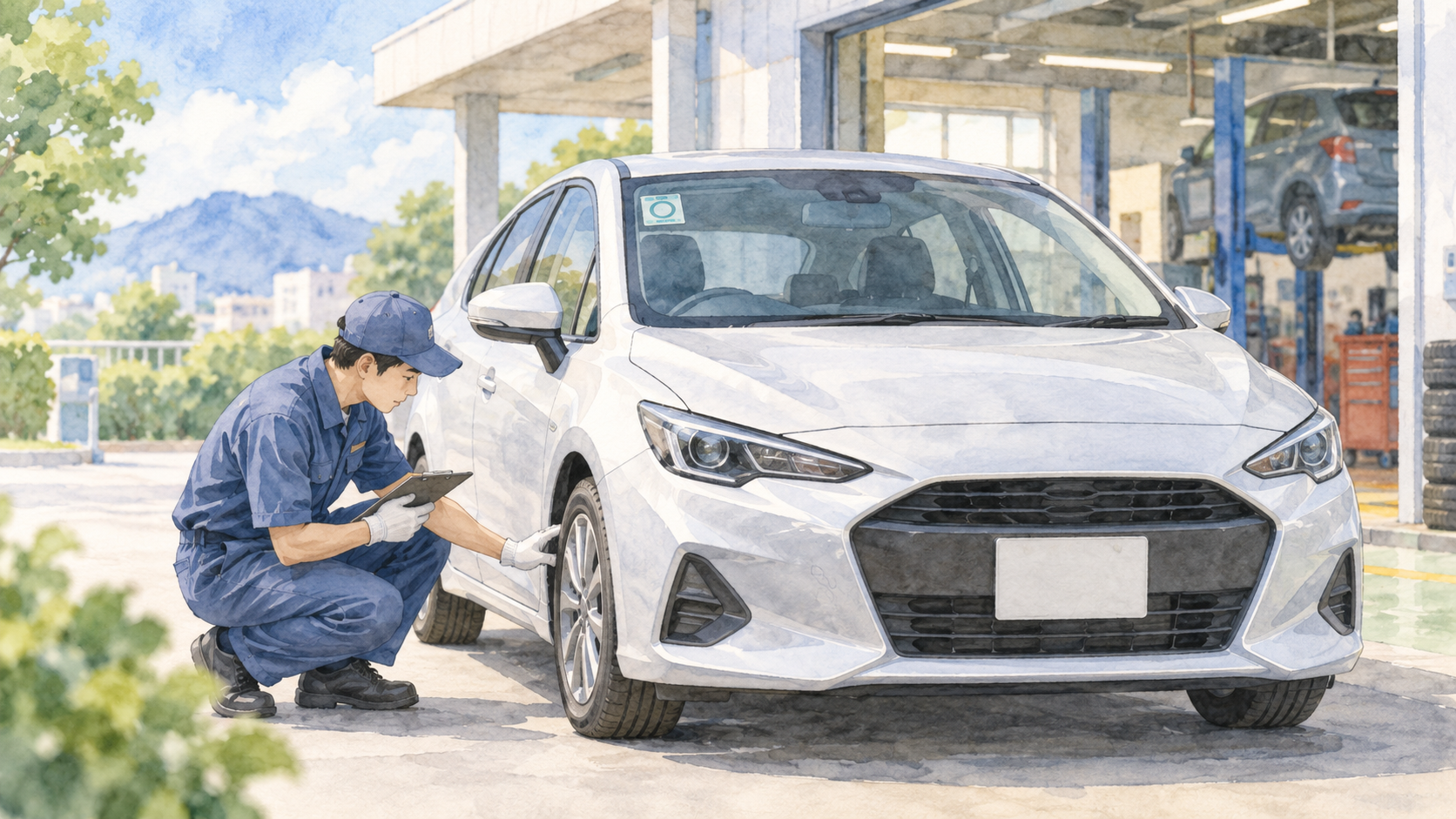
On many cars in Japan, there is a small square sticker near the upper edge of the windshield. It is easy to treat it as a simple sign that the car has “passed shaken,” Japan’s famous vehicle inspection.
But the sticker does not mean the car is guaranteed to remain safe until the date printed on it.
That distinction is especially timely in September and October 2026. Japan’s Ministry of Land, Infrastructure, Transport and Tourism (MLIT) designates these two months as the intensive period of its annual vehicle inspection and maintenance campaign. The ministry’s message is straightforward: cars deteriorate with time and mileage, so inspection and maintenance must continue throughout their use.
For overseas residents, shaken is often introduced as one of Japan’s strict rules of car ownership. That is true to a point. But the more useful way to understand the system is as two separate layers:
Shaken checks whether the vehicle meets required standards at the time of inspection. Maintenance is what keeps it in good condition after that.
- What shaken actually means
- What is the small sticker on the windshield?
- Shaken and maintenance are separate responsibilities
- Is Japan’s vehicle inspection unusually strict compared with other countries?
- Even Britain separates passing the test from remaining roadworthy
- Why does shaken feel so expensive in Japan?
- The important date is not a maintenance deadline
- What overseas residents in Japan should remember
- Sources
What shaken actually means
The Japanese word shaken (車検) is short for the periodic vehicle inspection system. For a normal privately owned passenger car, the first inspection is generally due three years after the vehicle is first registered, and subsequent inspections are generally every two years.
At shaken, the vehicle is checked against legally required safety and environmental standards.
This is important, but MLIT makes an equally important point that is sometimes missed: the inspection confirms compliance at the time of the test. It does not guarantee safety throughout the entire validity period of the vehicle inspection certificate.
A car can pass shaken today and still develop a problem months later. Tires continue to wear. Brake components wear. Rubber parts age. Lights fail. Fluids leak. Batteries weaken. A stone can damage a windshield. None of these processes stop because the vehicle passed an inspection.
So the next shaken date is a legal inspection deadline, not a promise that nothing needs attention until then.
What is the small sticker on the windshield?
The square sticker on the windshield is the inspection sticker, or kensa hyosho (検査標章).
Its purpose is to show the expiry timing of the vehicle inspection certificate. In other words, it tells you when the vehicle’s shaken validity ends.
It does not certify that the vehicle will remain mechanically safe until that date.
This is a useful visual way to understand the entire system:
The sticker shows the inspection expiry date. It is not a two-year safety warranty.
The sticker’s position also changed recently. Since July 3, 2023, the general rule is to place it near the top of the windshield on the driver’s side, as far from the center of the vehicle as practical, unless that position would obstruct the driver’s view. On a typical right-hand-drive Japanese car, that usually means the upper-right area from the driver’s perspective.
The change was intended in part to make the expiry easier for the driver to notice and help prevent vehicles from being driven after their inspection validity has expired.
Shaken and maintenance are separate responsibilities
Japan’s vehicle system makes a formal distinction between inspection and inspection/maintenance.
MLIT explicitly warns users not to confuse the two.
For ordinary private passenger cars, periodic maintenance standards include a 12-month inspection and a more extensive 24-month inspection. Under the current standard schedule, MLIT lists 29 items for the one-year inspection and 60 items for the two-year inspection, including the one-year items.
There are also routine checks that owners are expected to perform according to the vehicle’s condition and use.
This is why the common mental model—“I passed shaken, so I do not need to think about the car for two years”—is wrong.
The legal inspection and ongoing maintenance serve different purposes:
| System | Main purpose |
|---|---|
| Shaken | Confirms that the vehicle meets required safety and environmental standards at the time of inspection |
| Periodic maintenance | Finds wear and deterioration and helps keep the vehicle in proper condition between inspections |
| Routine checks | Helps the user notice changing conditions during everyday use |
In practice, these activities are often performed together at a dealer or maintenance shop. That is one reason they can feel like a single event to the owner. Legally and technically, however, they are not the same thing.
Is Japan’s vehicle inspection unusually strict compared with other countries?
Sometimes—but not always.
The answer depends heavily on the country, and in the United States, even on the state.
A simple comparison for ordinary passenger cars looks like this:
| Place | Typical periodic roadworthiness/safety inspection schedule |
|---|---|
| Japan | First after 3 years, then every 2 years |
| United Kingdom | First after 3 years, then every year (MOT) |
| Germany | First after 3 years, then every 2 years (Hauptuntersuchung) |
| EU minimum framework | First after 4 years, then every 2 years for standard passenger cars; member states may require more frequent testing |
| Texas, USA | Since January 1, 2025, most non-commercial vehicles no longer require a periodic safety inspection; emissions testing remains in specified areas |
This comparison changes the usual stereotype.
Japan is not simply “the country with the strictest vehicle inspection.” Britain tests ordinary older cars more frequently than Japan. Germany’s schedule is very similar to Japan’s. The EU sets a minimum framework, while member states can go further.
On the other hand, some parts of the United States are dramatically less inspection-oriented. Texas is a particularly clear example: most non-commercial vehicles no longer need a periodic safety inspection before registration, although emissions requirements continue in designated counties.
So if someone says “vehicle inspections overseas are much looser,” the most accurate answer is: some are, and some are not.
Even Britain separates passing the test from remaining roadworthy
The Japanese distinction is not unique.
Britain’s MOT system is a useful comparison because it tests most cars annually after their third year. Yet a vehicle that passes an MOT can still receive “minor” or “advisory” items that should be monitored or repaired. UK guidance also makes clear that a vehicle must continue to meet minimum roadworthiness standards when it is used.
In other words, even a country with more frequent testing does not treat a successful periodic inspection as a guarantee of future condition.
That principle is common sense once it is stated clearly: an inspection can assess a car now; it cannot freeze the car’s condition in time.
Why does shaken feel so expensive in Japan?
Another source of confusion is the phrase “shaken cost.”
When someone says their shaken cost tens of thousands of yen or more, that amount usually does not represent the inspection test fee alone.
The overall bill can combine several different things. NALTEC, Japan’s National Agency for Automobile and Land Transport Technology, separates the statutory costs from other expenses. Statutory costs include the inspection fee, automobile weight tax and compulsory automobile liability insurance. Depending on how the owner handles the process, there can also be maintenance labor, replacement parts, administrative service fees and other costs.
This helps explain why shaken can feel much larger than an MOT-style “test fee” comparison suggests.
The owner may experience one large payment event, but economically it can contain inspection, tax, compulsory insurance, maintenance and repairs at the same time.
That bundled experience is one of the reasons shaken has such a strong reputation among foreign residents.
The important date is not a maintenance deadline
There is a subtle but useful way to read the windshield sticker.
Suppose the sticker shows that the shaken validity continues for many more months. That tells you something important: the vehicle’s legally required periodic inspection has not yet expired.
But it does not answer questions such as:
- Are the tires still in good condition?
- Has a brake problem developed?
- Is a warning light appearing?
- Are the wipers still effective?
- Is a fluid level dropping?
- Has the vehicle developed an unusual sound or vibration?
Those are maintenance questions, not shaken-expiry questions.
This is exactly why MLIT’s 2026 campaign focuses on continued inspection and maintenance rather than simply reminding people to renew shaken.
What overseas residents in Japan should remember
If you own or use a car in Japan, the simplest way to understand shaken is not “the government guarantees my car for two years.”
It is:
“At the inspection date, the car was confirmed to meet the required standards. I still have to maintain it afterward.”
The small windshield sticker is useful precisely because it gives a clear inspection deadline. But the condition of the vehicle changes every time it is driven.
Japan’s system may look unusually strict from places with little or no periodic safety inspection. Compared with Britain or Germany, however, the inspection interval itself is not exceptionally severe.
What is more characteristically Japanese is the way shaken sits inside a broader ownership system of vehicle inspection, statutory maintenance, compulsory insurance, taxes and administrative procedures.
And the most important misconception is also the simplest one to correct:
Passing shaken means the car passed an inspection. It does not mean the car is guaranteed safe until the next one.
Sources
- Japan Ministry of Land, Infrastructure, Transport and Tourism (MLIT), Why vehicle inspection and maintenance are necessary
- MLIT, Types of vehicle inspection and maintenance
- MLIT, 2026 Vehicle Inspection and Maintenance Promotion Campaign
- MLIT Kanto District Transport Bureau, Inspection sticker placement
- NALTEC, Types of vehicle inspection and validity periods
- NALTEC, Vehicle inspection costs
- UK Government, When to get an MOT
- UK Government, MOT test results and roadworthiness
- Germany, StVZO Annex VIII inspection intervals
- European Union, Directive 2014/45/EU on periodic roadworthiness tests
- Texas Department of Public Safety, Vehicle safety inspection changes effective January 2025