For many people in Japan, rice planting is one of the clearest signs that spring has arrived.
Rice seedlings are carried to flooded paddies, loaded onto a rice transplanter, and planted in neat green rows across the water. Even if you have never worked on a farm, the scene is familiar from school activities, television, local festivals, and drives through the countryside.
It is such a familiar image that rice farming and rice transplanting can feel almost inseparable.
But in some parts of Japan, farmers are increasingly growing rice without transplanting seedlings at all.
Instead, they sow rice seed directly into the field.
This method is called direct-seeded rice cultivation, and one form in particular—dry direct seeding—has been expanding in Japan.
It still represents only a small share of Japanese rice production. But the change is interesting because it is not simply about removing one step from farming.
It is beginning to change the machinery, labor, crop rotations, and even the kinds of rice plants farmers need.
- Direct seeding is still small, but it is growing
- “Dry” direct seeding does not mean growing rice like wheat
- The biggest difference may be all the work before the rice transplanter arrives
- Rice farming starts to look surprisingly similar to upland farming
- But removing human work gives more work back to the rice plant
- Will Japan stop transplanting rice?
- A small change that alters a familiar Japanese landscape
- Sources
Direct seeding is still small, but it is growing
According to Japan’s Ministry of Agriculture, Forestry and Fisheries, direct-seeded rice covered about 41,657 hectares in 2024, equivalent to roughly 2.8% of Japan’s rice-growing area.
So transplanting remains overwhelmingly dominant.
But the trend inside that small share is notable.
In 2020, dry direct seeding covered about 14,631 hectares. By 2024, it had grown to about 23,042 hectares—an increase of roughly 58%.
Meanwhile, the area using another form known as wet direct seeding has not grown in the same way.
In other words, the recent change is not simply “Japan is switching to direct-seeded rice.”
More specifically, dry direct seeding is becoming more common in some regions and farming systems.
There is an important caveat: the Ministry itself notes that these figures come from voluntary prefectural surveys and should not be treated as a perfectly complete national census.
Still, they clearly show the direction of change.
“Dry” direct seeding does not mean growing rice like wheat
The name can be misleading.
Dry direct seeding does not usually mean that rice is grown in a dry field all the way until harvest.
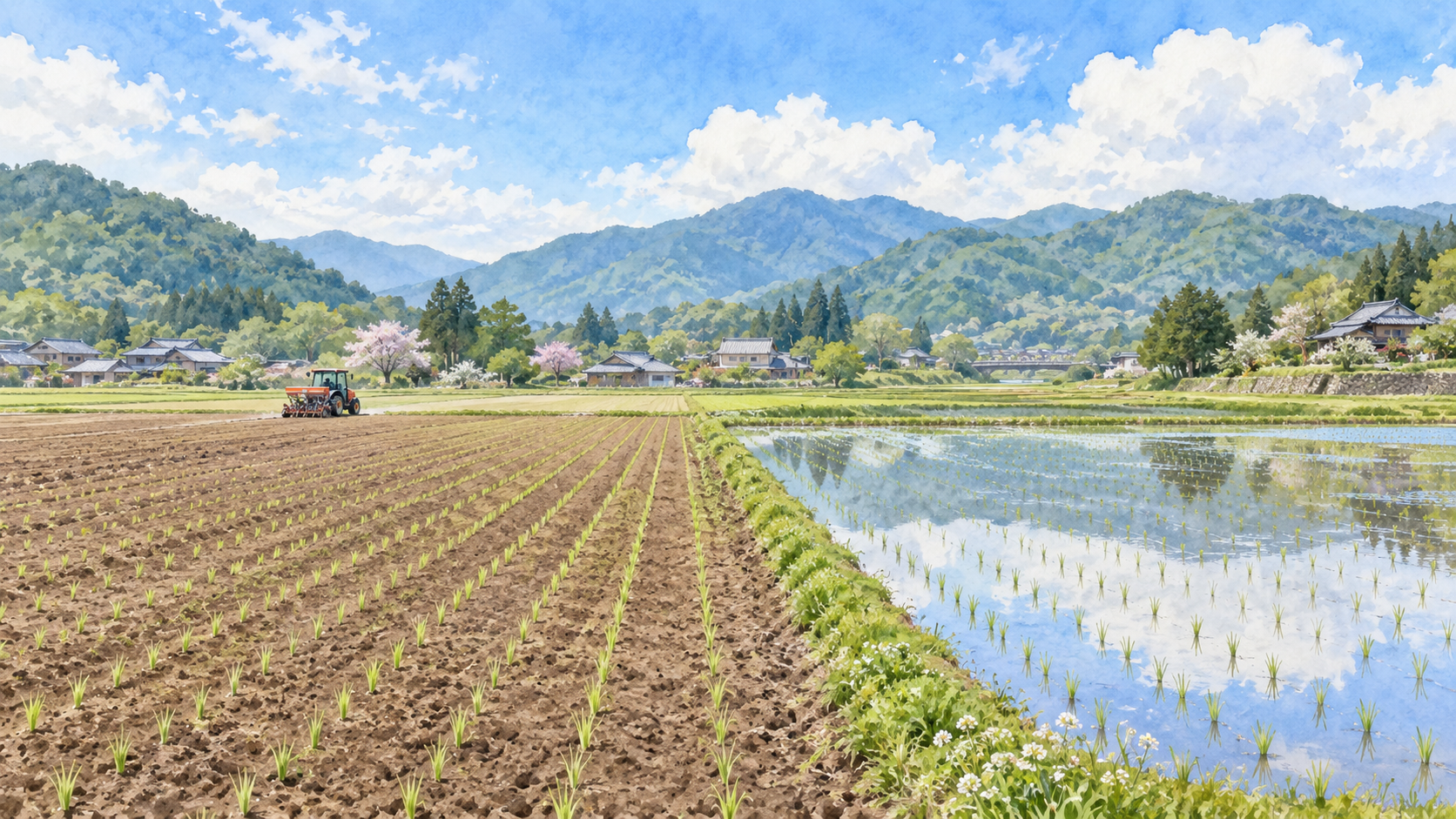
Instead, the field is dry when the seed is planted.
Farmers prepare and level the soil, sow the rice seed directly into it, and allow the seedlings to emerge. Water is then introduced later, and the field is generally managed as a paddy.
So the difference is mainly at the beginning of the season.
Traditional transplanting works like this:
Rice seeds are germinated and raised separately as seedlings. Those seedlings are then transported to the field and transplanted into the paddy.
Dry direct seeding removes that entire nursery-and-transplanting stage.
That may sound like a small technical change, but it has surprisingly large consequences.
The biggest difference may be all the work before the rice transplanter arrives
Modern rice transplanters are highly efficient machines.
But rice transplanting involves much more than driving one machine through a field.
Before planting day, farmers must prepare nursery trays, sow seed into them, manage thousands of young seedlings, transport the trays to the fields, and continuously load them onto the transplanter.
For a small farm, this is simply part of the annual rhythm.
For a farm managing dozens of hectares, it becomes a serious logistical operation.
Japan’s farming population is shrinking and aging, while many remaining farms and agricultural companies are managing larger areas.
This changes the question.
The goal is no longer only:
“How much rice can we produce from one hectare?”
It is increasingly also:
“How much land can one person realistically manage during the short spring planting season?”
Direct seeding addresses that bottleneck in the most straightforward way possible.
Do not grow transplant seedlings in the first place.
Rice farming starts to look surprisingly similar to upland farming
This is where dry direct seeding becomes especially interesting.
Some modern systems use machinery that is also used for wheat, soybeans, and other field crops.
A large tractor prepares the field.
A leveler makes the surface extremely flat.
A grain drill places rice seed into rows.
Other machines handle spraying and field management.
At harvest, farmers can use existing combines.
There is no special “direct-seeded rice harvester” required simply because the rice was not transplanted.
In Hokkaido, the National Agriculture and Food Research Organization has documented farms that combine dry direct-seeded rice with wheat, soybeans, corn, rapeseed, and sugar beet. Some of the same agricultural machinery can be shared across several crops, while large combines are used for harvesting.
This is quite different from the classic image of Japanese rice farming built around specialized rice machinery.
Dry direct seeding can connect rice production to a broader, more flexible machinery system.
That matters because agricultural machinery is expensive.
If the same tractor, seeder, or combine can be used across several crops instead of being used for only a short rice-growing operation each year, the economics of the entire farm can change.
But removing human work gives more work back to the rice plant
There is another side to this.
Transplanting does not simply move rice plants from one place to another.
It gives them a protected childhood.
Rice seedlings spend their weakest early stage in a nursery. By the time they enter the paddy, they already have leaves and roots and are much larger than many competing weeds.
Direct-seeded rice gets no such advantage.
The seed must germinate in the field.
The young shoot must push through the soil.
Roots must establish quickly.
The plant must compete with weeds from an early stage.
And it must remain upright enough to be harvested efficiently by machinery.
That means a variety that performs well under transplanting is not automatically the ideal variety for direct seeding.
Traits such as strong early growth, emergence under cool conditions, root development, weed competitiveness, and lodging resistance become more important.
Hokkaido provides a good example.
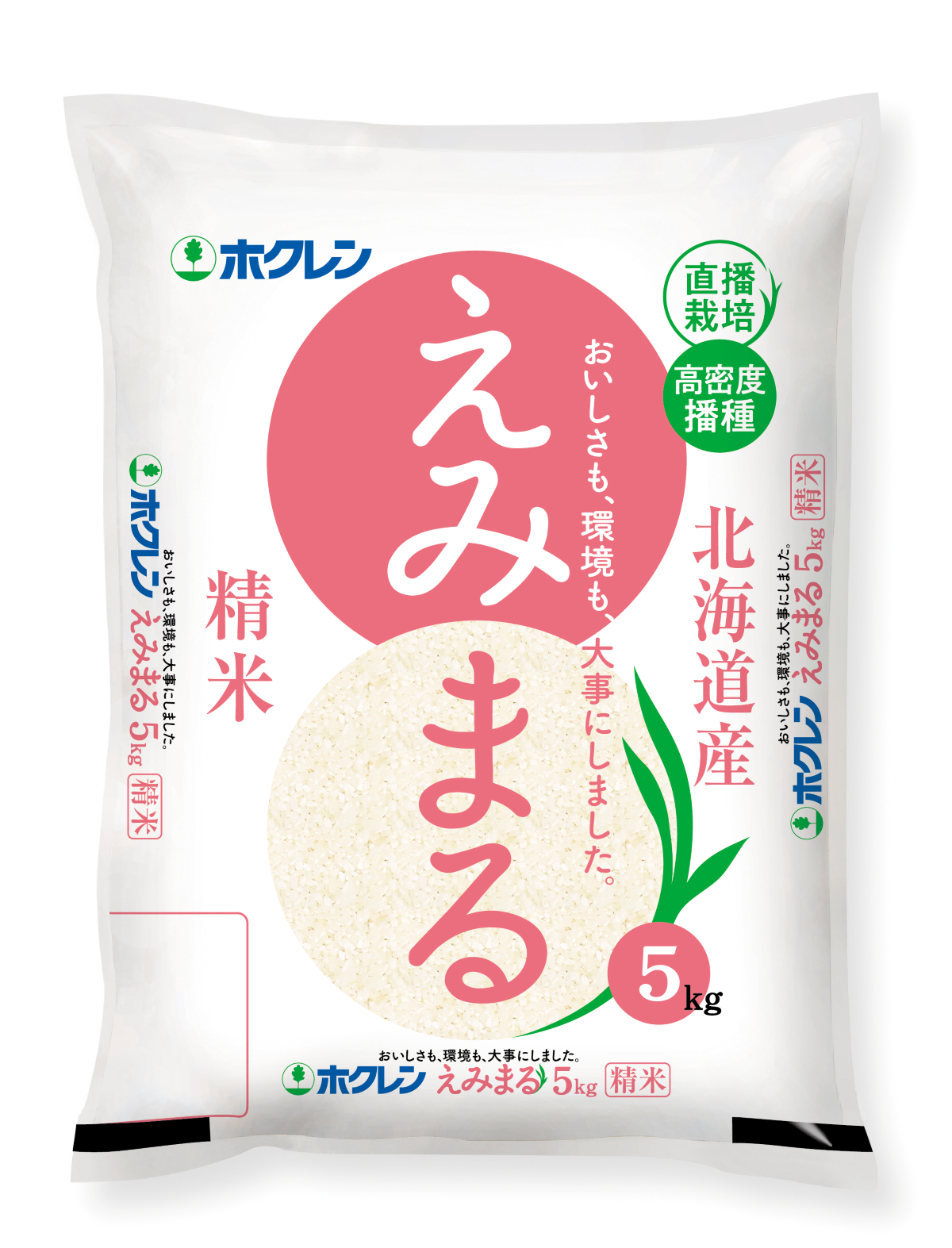
The rice variety Emimaru was developed with strong establishment under cool conditions, a useful trait for direct seeding in northern Japan. NARO notes that the variety has been widely used for direct-seeded production as its cultivated area expanded.
Changing the farming system can therefore change what farmers want from the plant itself.
Will Japan stop transplanting rice?
No.
At least not anytime soon.
Direct seeding accounted for only 2.8% of Japan’s rice area in 2024.
Japan also has enormous variation in field size, soil, irrigation infrastructure, climate, and local farming practices. Transplanting remains reliable and well suited to many regions.
Direct seeding also creates its own problems.
Weed control can become more difficult.
Seedlings can emerge unevenly.
Field leveling becomes extremely important.
Yields can be less stable under some conditions.
For many farmers, transplanting is still the better system.
What seems more likely is that Japanese rice farming will become more diverse.
A large farm may transplant rice in some fields, use wet direct seeding in others, and use dry direct seeding where the field and machinery system make it practical.
That combination can spread the spring workload over a longer period.
A small change that alters a familiar Japanese landscape
Rice planting is more than an agricultural operation in Japan.
It is part of the seasonal landscape.
Rows of newly transplanted seedlings standing in shallow water are one of those ordinary scenes that quietly mark the movement from spring toward summer.
That scene is not disappearing.
But it may no longer represent every modern rice farm.
In some fields, the first stage of rice production may increasingly resemble wheat or soybean farming: a tractor crossing dry soil, a drill placing seed directly into rows, and water entering the field only later.
To someone passing by, it may not even look like a rice field yet.
That is what makes this change interesting.
Japanese rice farming is not abandoning tradition overnight. Instead, labor shortages, larger farms, new machinery, and new rice varieties are gradually changing the practical meaning of “growing rice.”
For decades, the central question of mechanized rice farming was:
How can we transplant rice more efficiently?
Some farmers are now asking a more fundamental question:
Do we need to transplant it at all?
The answer will differ from field to field.
But even one of Japan’s most familiar seasonal landscapes is not as fixed as it looks.
Sources
Japan Ministry of Agriculture, Forestry and Fisheries, “Direct-seeded rice cultivation” and prefectural direct-seeding data for the 2020 and 2024 crop years. MAFF notes that the figures are based on voluntary prefectural surveys and are not a complete statistical census.

https://www.maff.go.jp/j/syouan/keikaku/soukatu/attach/pdf/chokuha-37.pdf
https://www.maff.go.jp/j/syouan/keikaku/soukatu/attach/pdf/chokuha-40.pdf
National Agriculture and Food Research Organization (NARO), dry direct-seeded rice cultivation in Hokkaido and the direct-seeding rice variety Emimaru.