If someone throws away food that is still edible, discards an object that still works, or lets a good opportunity go unused, a very natural Japanese reaction is:
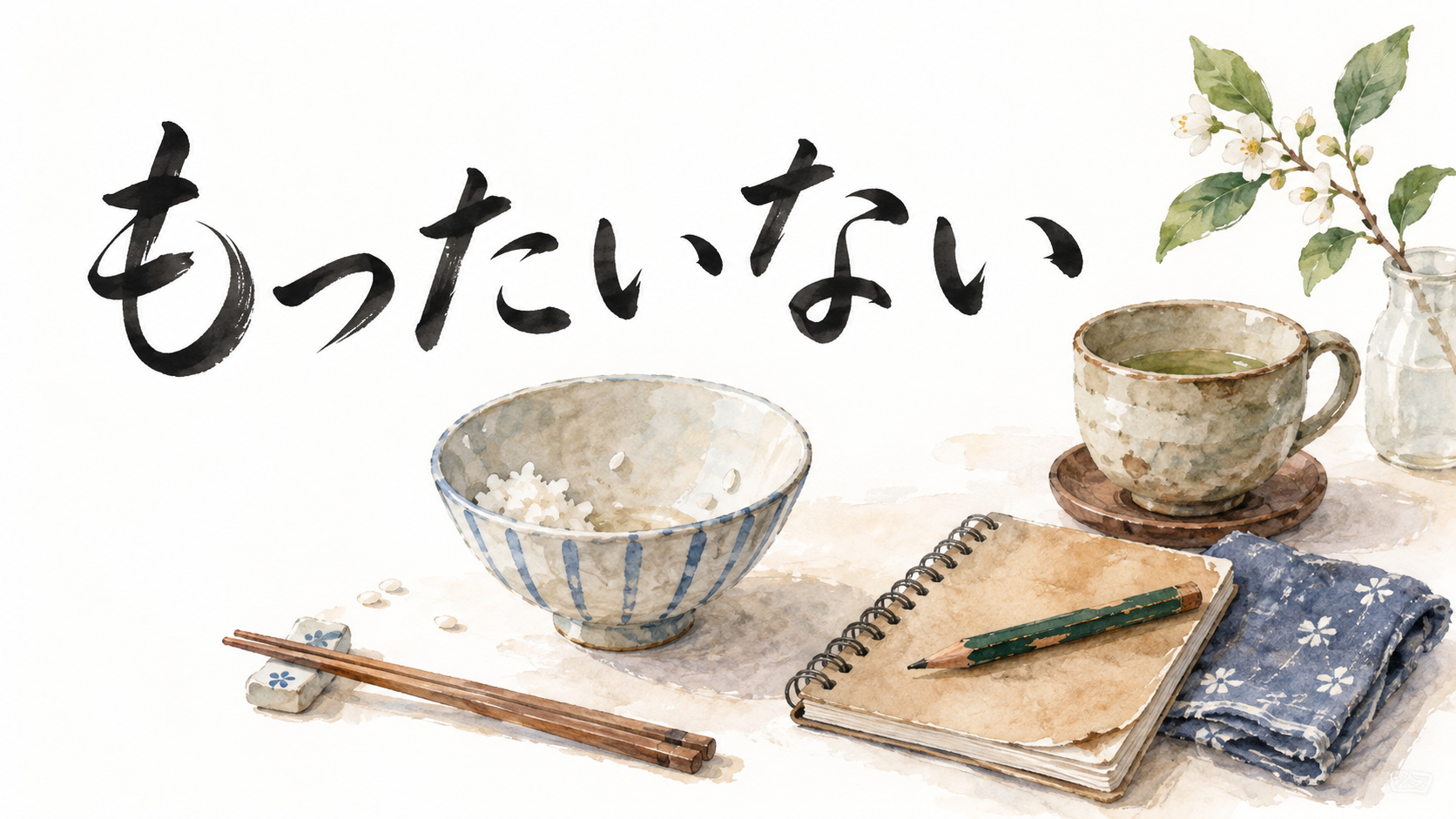
Mottainai (もったいない).
It is often translated as “what a waste.” That is useful—but incomplete.
In everyday Japanese, mottainai often expresses the feeling that something with value is not being used, appreciated, or treated as fully as it could be. That value might belong to food or money, but it can also belong to time, talent, an opportunity, a gift, or even praise.
That makes mottainai a strong example of Japanese Beyond Translation: not an impossible word to translate, but one whose natural translation changes with the kind of value at stake.
- The short answer
- Why “what a waste” is only part of it
- The common thread is value
- How it is actually used
- “Mottainai” and “muda” are not the same
- Why “too good for me” belongs to the same word
- From an everyday Japanese word to an environmental slogan
- So how should you translate “mottainai”?
- What “mottainai” reveals about everyday Japan
- Sources and further reading
The short answer
Mottainai describes the regret felt when something valuable is wasted, underused, discarded too soon, or treated as less valuable than it really is.
Common English translations include:
- what a waste
- wasteful
- don’t let it go to waste
- it would be a shame
- too good for me
- more than I deserve
The last two may seem surprising, but they are important.
Why “what a waste” is only part of it
If food is thrown away while it is still perfectly edible, mottainai maps neatly onto “what a waste.”
Mada taberareru noni, suteru no? Mottainai. You’re throwing it away even though it’s still edible? What a waste.
But consider another use:
Konna rippa na purezento, watashi ni wa mottainai desu. This is such a wonderful gift—it’s too good for me.
Here the word is not about trash, efficiency, or conservation. It expresses humility: the gift feels more generous than the speaker deserves.
Japanese dictionaries explicitly include both senses. The same word can therefore move between wasted value and value that feels beyond one’s due.
The common thread is value
A useful way to understand mottainai is not “waste,” but:
Something has value, and the current situation does not do justice to that value.
That “something” might be:
- food that could still be eaten
- clothes that could still be worn
- time that could be used better
- a person’s ability
- an opportunity
- a gift
- generous praise
This is why mottainai often feels more personal than the English word “wasteful.”
A broken object that truly cannot be used again may simply be finished. A perfectly usable object thrown away after one use is much more likely to invite mottainai.
How it is actually used
Food
Mada nokotteru noni. Mottainai. There’s still food left. What a waste.
Objects
Mada tsukaeru noni suteru nante, mottainai. Throwing it away even though it still works is such a waste.
Time
Sekkaku no yasumi na noni, nete bakari ja mottainai yo. It’s your day off—sleeping the whole day would be a waste.
Talent
Sonna sainō ga aru noni tsukawanai no wa mottainai. It would be a shame not to use talent like that.
Opportunity
Kono kikai o nogasu no wa mottainai. It would be a shame to let this opportunity pass.
Praise
Sonna ohome no kotoba, mottainai desu. That is more praise than I deserve. / You’re too kind.
The English changes because the thing being “wasted” changes.
“Mottainai” and “muda” are not the same
Another Japanese word associated with waste is muda (無駄).
Muda often describes:
- uselessness
- inefficiency
- unnecessary effort
- pointless expenditure
A meeting can be muda because it accomplishes nothing.
Mottainai is different. It usually assumes that something does have value, but that value is being lost or left unrealized.
A talented person doing work far below their abilities can be described as mottainai. The person is not “useless.” The opposite is true: there is value there, and that is exactly why failing to use it feels regrettable.
Why “too good for me” belongs to the same word
The older and still-current sense of mottainai includes something being beyond one’s station or more than one deserves.
That can sound far removed from environmental waste, but the logic is related.
If someone gives you extraordinary praise, you might say:
Watashi ni wa mottainai kotoba desu. Those words are more than I deserve.
The value is not being thrown away. Instead, the speaker feels the value is too great in relation to themselves.
That is why a single English word cannot cover every use.
From an everyday Japanese word to an environmental slogan
Outside Japan, mottainai is often associated with environmentalism.
That connection became especially visible after Kenyan environmentalist and 2004 Nobel Peace Prize laureate Wangari Maathai encountered the word in Japan. The Green Belt Movement describes mottainai as an important inspiration for Maathai and notes that she helped re-popularize it internationally after a 2005 visit to Japan.
Environmental campaigns often linked it with reduce, reuse, recycle, and respect.
That interpretation fits one important part of the word—but it should not replace its much broader everyday use in Japanese.
A parent can say mottainai about leftover food. A colleague can say it about unused talent. A friend can say it about wasting a day off. A recipient can say it about excessive praise.
The environmental slogan grew from an existing word. It did not define the word from the beginning.
So how should you translate “mottainai”?
Translate the kind of value being lost.
| Situation | Natural English |
|---|---|
| Mada tsukaeru noni, mottainai. | It still works—what a waste. |
| Tabenai nara mottainai yo. | Don’t let it go to waste. |
| Sainō o tsukawanai no wa mottainai. | It would be a shame to waste that talent. |
| Kono kikai o nogasu no wa mottainai. | It would be a shame to miss this opportunity. |
| Watashi ni wa mottainai okurimono desu. | This gift is too generous for me. |
| Ohome no kotoba, mottainai desu. | You’re too kind. / I don’t deserve such praise. |
“What a waste” belongs in the toolbox.
It simply should not be the only tool.
What “mottainai” reveals about everyday Japan
It would be too simple to claim that Japan uniquely values thrift, gratitude, or careful use. These ideas exist in many cultures.
What is linguistically interesting is how much Japanese packs into one ordinary adjective.
Mottainai can connect:
- waste
- regret
- value
- unused potential
- restraint
- humility
The unifying idea is not merely “do not throw things away.”
It is closer to:
If something has value, do not treat that value lightly.
That is why mottainai can describe a half-eaten meal, an unused talent, a missed opportunity, or praise that feels too generous.
The object changes. The underlying feeling remains surprisingly consistent.
Sources and further reading
- Shogakukan, Digital Daijisen and Nihon Kokugo Daijiten entries for 勿体無い, via Kotobank: https://kotobank.jp/word/%E5%8B%BF%E4%BD%93%E7%84%A1%E3%81%84-645881
- Shogakukan, Progressive Japanese-English Dictionary, entry for 勿体ない, via Kotobank: https://kotobank.jp/jeword/%E5%8B%BF%E4%BD%93%E3%81%AA%E3%81%84
- The Green Belt Movement, Wangari Maathai House Concept Note: the role of mottainai in Maathai’s environmental thinking.