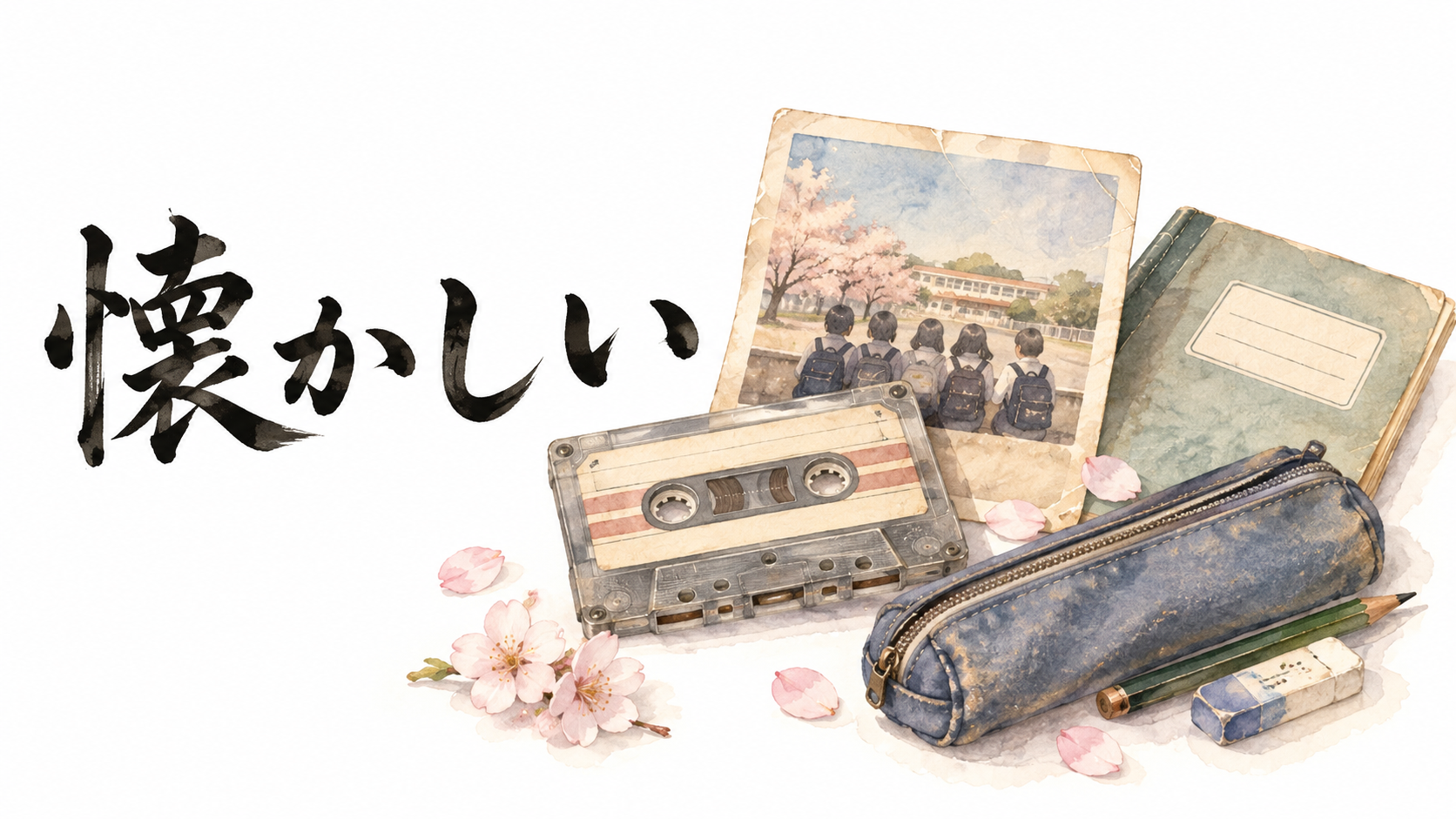
If you find an old school photo, hear a song you loved as a teenager, or taste a snack you have not eaten in twenty years, a very natural Japanese reaction is:
Natsukashii! (懐かしい)
Dictionaries often translate natsukashii as “nostalgic.” That is not wrong. But it is only part of the picture.
In everyday Japanese, natsukashii can be a quick, almost reflexive response to something familiar from the past. It does not always mean that you are sad, that you wish you could go back, or even that you have been consciously thinking about the past. Something appears, a memory opens, and the word fits.
That small difference is why natsukashii is a useful example of what this series calls Japanese beyond translation: not a word that cannot be translated, but a word whose most natural translation changes with the situation.
- The short answer
- What does the dictionary say?
- Why “nostalgic” is close—but not identical
- Japanese can attach “natsukashii” directly to the thing
- How Japanese people actually use it
- “Natsukashii” is not the same as “I miss it”
- So how should you translate “natsukashii”?
- What “natsukashii” reveals about everyday Japan
The short answer
Natsukashii (懐かしい) describes the feeling of encountering or remembering something familiar from the past with affection or emotional warmth.
“Nostalgic” is often a good translation, especially when talking about a person’s emotional state:
Mukashi no shashin o miru to natsukashii kimochi ni naru. Looking at old photos makes me feel nostalgic.
But Japanese also commonly says things like:
Kono kyoku, natsukashii! This song brings back memories!
The second example shows where a simple one-word translation becomes awkward. English can certainly call a song “nostalgic,” but in ordinary conversation “This takes me back” or “This brings back memories” often expresses what the Japanese speaker is actually doing: reacting to a trigger that suddenly reconnects the present with a remembered past.
What does the dictionary say?
Modern Japanese dictionaries give the familiar present-day meaning: remembering a person, thing, or time that one once knew well and feeling as though the past has returned.
But natsukashii has an older history.
Major Japanese dictionaries derive it from 懐く (natsuku), a verb associated with becoming attached or familiar. Earlier uses of natsukashii could describe something attractive, dear, or emotionally drawing—something or someone you wanted to be close to. The strongly past-oriented sense developed later.
That history is useful because it reminds us that the emotional center of natsukashii is not simply “oldness.” It is affective familiarity: the past matters because the person, place, sound, taste, or object once felt close.
An old object is not automatically natsukashii. A 200-year-old chair in a museum may simply be old. But the cheap plastic chair that was in your grandparents’ kitchen may be intensely natsukashii.
Why “nostalgic” is close—but not identical
English nostalgia is commonly defined as a feeling that combines pleasure with some sadness when thinking about the past. That bittersweet element is important in a great deal of English-language research on nostalgia.
Japanese natsukashisa can also be bittersweet. Research with Japanese participants has found that nostalgic recollection can contain both positive and negative affect. So it would be wrong to say that natsukashii is always cheerful.
At the same time, Japanese psychological research has also found that autobiographical memory and positive emotion are central features of natsukashisa, while negative and mixed emotions can be more peripheral.
That fits ordinary conversation well. Someone can pick up an old game cartridge and say:
Wā, natsukashii! Wow, this takes me back!
There may be no sadness at all. The main event is recognition: I know this. This belonged to another part of my life. And seeing it now feels good.
Japanese can attach “natsukashii” directly to the thing
One of the most useful differences is grammatical and conversational.
Japanese comfortably says:
- natsukashii kyoku — a song that brings back memories
- natsukashii aji — a familiar taste from the past
- natsukashii kao — a familiar face from long ago
- natsukashii basho — a place full of old memories
- natsukashii shashin — an old photo that brings the past back
English can use “nostalgic” in some of these positions, but the focus may shift. A “nostalgic song” can sound like a song designed to evoke nostalgia, or one with a nostalgic mood. Japanese natsukashii kyoku can simply mean: I know this song from my past, and hearing it again gives me that feeling.
That is why translations based on the actual event are often better than translations based on a dictionary label.
How Japanese people actually use it
Imagine finding a box while cleaning your parents’ house.
Inside is a pencil case you used in elementary school.
Kore, mada attan da. Natsukashii. I can’t believe this is still here. This takes me back.
Or you visit a neighborhood where you lived years ago:
Kono michi, natsukashii na. Mainichi koko o tōtteta. This street brings back memories. I used to walk here every day.
Or you taste a home-style dish:
Kono aji, natsukashii. Kodomo no koro, sobo ga yoku tsukutte kureta. This taste takes me back. My grandmother used to make this for me when I was a child.
Notice that none of these English translations has to contain the word “nostalgic.”
The translation changes because English often prefers to say what the thing does to your memory, while Japanese can simply label the resulting quality as natsukashii.
“Natsukashii” is not the same as “I miss it”
Another common overtranslation is “I miss…”
Sometimes it works:
I miss my school days.
But natsukashii does not necessarily contain the ache of absence that “I miss…” often carries.
Compare it with koishii (恋しい).
If someone says:
Nihon no kazoku ga koishii. I miss my family in Japan.
the focus is longing for people who are absent.
With natsukashii, the focus is more often on the emotional return of something already known:
Looking at old family photos brings back memories.
The two feelings can overlap, but they are not interchangeable.
So how should you translate “natsukashii”?
There is no need to search for one permanent English replacement. Translate the situation.
| Japanese situation | Natural English |
|---|---|
| Kono kyoku, natsukashii! | This song takes me back! / This brings back memories! |
| Mukashi no shashin o miru to natsukashii kimochi ni naru. | Old photos make me feel nostalgic. |
| Kono aji, natsukashii. | This tastes just like I remember. / This taste brings back memories. |
| Gakusei jidai ga natsukashii. | I miss my school days. / I feel nostalgic for my school days. |
| Natsukashii kao ni atta. | I ran into a familiar face from the old days. |
“Nostalgic” belongs in the toolbox. It simply should not be the only tool.
What “natsukashii” reveals about everyday Japan
It is tempting to present natsukashii as evidence of a uniquely Japanese relationship with memory. That goes too far. People everywhere experience memories triggered by music, smells, foods, places, and familiar objects.
What is interesting is the linguistic packaging.
Japanese gives speakers an extremely compact adjective that can be used immediately when the past suddenly becomes present again. The word works on a song, a face, a taste, a street, a TV commercial, a toy, a photograph, or an entire period of life.
That makes natsukashii not an untranslatable emotion, but an unusually convenient everyday label for a very human one.
And that is exactly why the best translation is sometimes not a word at all.
Sometimes:
Natsukashii!
simply means:
“This takes me back.”
Sources and further reading
- Shogakukan, Digital Daijisen and Nihon Kokugo Daijiten entries for 懐かしい, via Kotobank: https://kotobank.jp/word/%E6%87%90%E3%81%8B%E3%81%97%E3%81%84-588916
- Cambridge Dictionary, “nostalgia” and “nostalgic”: https://dictionary.cambridge.org/dictionary/english/nostalgia
- Masato Nagamine & Miki Toyama (2016), “Do Japanese people experience nostalgia? Focus on the side of ‘bitter sweetness’ of nostalgia,” Japanese Journal of Research on Emotions, 24(1), 22–32. https://doi.org/10.4092/jsre.24.1_22
- Takashi Kusumi (2021), “Cognitive-affective aspects and functions of nostalgia: Individual differences and age-related changes,” Japanese Psychological Review, 64(1), 5–28. https://doi.org/10.24602/sjpr.64.1_5