Japan’s 72 microseasons are most interesting when they do not behave like a weather app.
天地始粛 (tenchi hajimete samushi) is usually understood as the moment when the heat begins to lose its force. It sounds beautifully autumnal. Yet in modern Japan, late August can still feel unmistakably like summer.
That tension is exactly what makes this microseason worth noticing.
- A five-day season between summer and autumn
- In 2026, the heat is easing — but it is not gone
- Autumn may arrive on the table before it arrives in the air
- Even the convenience store starts whispering “autumn”
- How to notice 天地始粛 in present-day Japan
- Old calendar vs modern Japan
- What “shun” means here
- Where this fits in the Japanese Seasonal Calendar
- Calendar source
A five-day season between summer and autumn
For 2026, Ordinary Japan treats 天地始粛 as August 28 to September 1.
It falls within 処暑 (Shosho), the solar term traditionally associated with the easing of summer heat. The National Astronomical Observatory of Japan places Shosho at 11:19 JST on August 23, 2026.
Ordinary Japan derives the dates of the 72 microseasons from the official solar-term anchors. The National Astronomical Observatory publishes the 24 solar terms, not an official modern set of dates for all 72 microseasons.
So what should “the heat begins to subside” mean today?
Not that summer suddenly switches off.
It is better understood as a turning point.
In 2026, the heat is easing — but it is not gone
The latest Japan Meteorological Agency forecast issued at 5:00 a.m. on August 27 gives Tokyo a forecast high of 31°C on August 28 and Osaka 32°C. Both areas are also expecting unsettled weather and rain.
That is cooler than the mid-30s heat seen only days earlier, but the weekly forecast makes the transition look anything but smooth. Tokyo is forecast to return to around 34°C on August 31, while Osaka may reach around 35°C on August 31 and September 1.
In other words, the old calendar and the modern forecast are not really contradicting each other.
The season is changing. The heat is simply refusing to leave in a straight line.
Source: @@INLINE0@@ and @@INLINE1@@.
Autumn may arrive on the table before it arrives in the air
If the thermometer still says summer, the fruit aisle tells a different story.
Chiba Prefecture describes late August as the beginning of pear season in Kamagaya, with pear picking running from late August into early October. Grapes are already in season there from mid-August.
Source: Chiba Prefecture — seasonal fruit picking in Kamagaya.
Aichi Prefecture offers another clue. Its 2026 fruit events were timed around produce described as being in season: a grape competition was held on August 18, followed by a fig competition on August 25. The prefecture explicitly describes grapes and figs as fruits reaching their seasonal moment at this time of year.
Source: Aichi Prefecture — 2026 grape and fig events.
This is one of the pleasures of late summer in Japan: autumn can become visible in food before it becomes obvious in the weather.
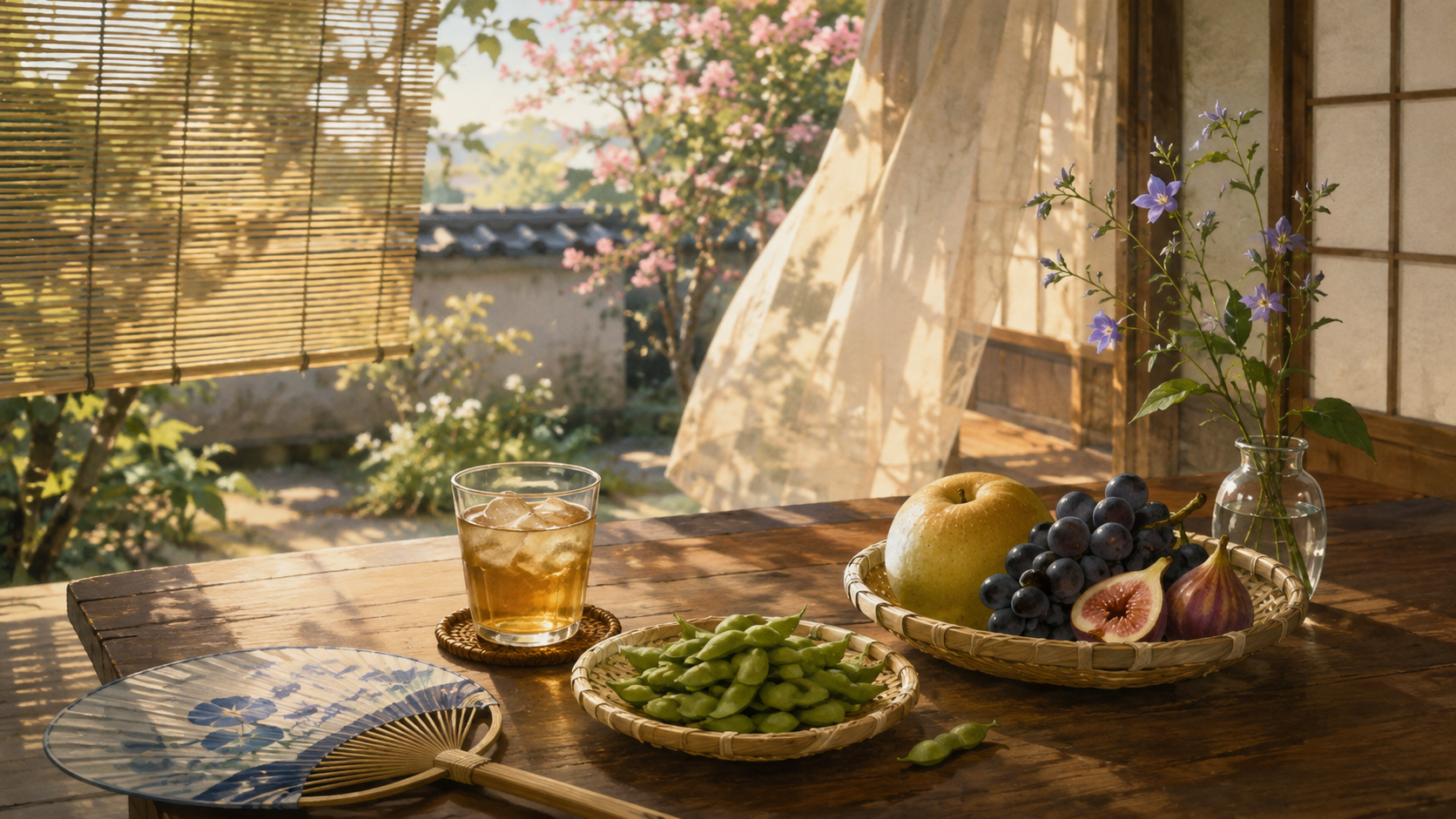
A cold glass of barley tea and an uchiwa fan may still belong on the table, but beside them you begin to see pears, grapes and figs.
Summer and autumn overlap.
Even the convenience store starts whispering “autumn”
Japan’s convenience stores are surprisingly useful places to watch the seasons change.
Seven-Eleven’s weekly lineup for products released from August 25 includes a maitake mushroom rice ball (舞茸ご飯おむすび) across many parts of Japan.
Maitake on a convenience-store shelf does not prove that autumn weather has arrived. Retail calendars move early, and product availability differs by region.
But that is precisely why it is interesting.
Japanese seasonal culture is not expressed only through temples, gardens or traditional festivals. It also appears in extremely ordinary places: the supermarket fruit section, a convenience-store rice ball, a dessert package, or the ingredients someone chooses for dinner.
Source: Seven-Eleven Japan — this week’s products.
How to notice 天地始粛 in present-day Japan
You do not need to find a dramatic sign of autumn.
This microseason is better suited to small contrasts.
Step outside at midday and it may still feel like August. Then notice what happens around the edges of the day. Rain temporarily breaks the heat. Evening light softens. A pear or fig appears on the table. Fans and cold drinks are still part of daily life while autumn ingredients begin to appear beside them.
That overlap is the point.
天地始粛 is not the first cool day. It is the moment when summer starts to feel slightly less permanent.
Old calendar vs modern Japan
Traditional seasonal language can sound strangely precise: frogs begin to sing, cotton bolls open, the heat begins to subside.
Real ecosystems and real cities are not synchronized that neatly.
Japan stretches from Hokkaido to Okinawa. Weather varies from year to year, urban heat changes the experience of summer, and retail seasons often move ahead of the climate.
Rather than treating the 72 microseasons as a checklist of things that “should” be happening, Ordinary Japan uses them as questions:
Does this old seasonal description still fit modern Japan? If not, what is happening instead?
For 天地始粛 in 2026, the answer is especially clear.
The weather still says summer.
The food is beginning to say autumn.
What “shun” means here
The Japanese idea of shun (旬) is not just “in season.” It can include the movement of a season itself:
- hashiri — the first arrivals
- sakari — the seasonal peak
- nagori — the lingering end
Late August is a good time to see these stages overlap. Summer foods have not disappeared, while pears, grapes, figs and other early-autumn signals are arriving or reaching their best period depending on region and variety.
That is why a seasonal table can sometimes tell you more than a calendar date.
Where this fits in the Japanese Seasonal Calendar
- Full calendar: Japan’s 24 Solar Terms and 72 Microseasons
- Parent solar term: 処暑 (Shosho)
- Previous microseason: 綿柎開
Calendar source
The 24 solar-term anchor dates are based on the National Astronomical Observatory of Japan’s 2026 almanac:
National Astronomical Observatory of Japan — 2026 solar terms
The 72-microseason date window used by Ordinary Japan is derived from those official solar-term anchors and should not be read as an official NAOJ publication of the 72 microseasons.