When countries become centralized, the story usually has a recognizable shape.
A king defeats powerful nobles. A capital sends officials into the provinces. Or one dominant regional state absorbs its neighbors and turns its own ruler, army, and bureaucracy into the institutions of a larger nation.
Japan’s transformation in the late nineteenth century followed a stranger path.
The Tokugawa shogunate was overthrown largely by samurai from powerful western domains, especially Satsuma and Chōshū. Yet these victors did not simply replace the Tokugawa house with the Shimazu house of Satsuma or the Mōri house of Chōshū.
Instead, leaders who had risen through the domains created a new central government—and then abolished the domain system itself.
The political units that made their victory possible disappeared only a few years after the revolution.
That reversal is one of the most distinctive features of the Meiji Restoration.
- One country, but not one unitary administration
- The more familiar paths to centralization
- The regions defeated the center
- The victors abolished the structure that produced them
- Why did the domain lords accept it?
- The emperor made the reversal possible
- The samurai state then abolished the samurai
- Centralization came before democracy
- A revolution by insiders at the edge
- Further reading
One country, but not one unitary administration
Tokugawa Japan was not a collection of fully independent countries in the modern sense. The shogunate controlled foreign relations, imposed a national political hierarchy, regulated the great lords, and maintained supremacy across the archipelago.
But it was also not a modern centralized state.
Japan was divided into hundreds of domains, or han, ruled by hereditary daimyō. Each domain maintained its own administration, finances, retainers, and local military power. The shogunate stood above this structure, while the emperor in Kyoto retained ancient legitimacy but little direct governing power.
This arrangement is often called the bakuhan system: bakufu, the shogunate, combined with han, the domains.
By the 1850s and 1860s, foreign pressure exposed its weaknesses. When American warships arrived and demanded the opening of Japanese ports, the country faced questions that could not easily be solved by a fragmented military and fiscal system.
Who spoke for Japan? Who could negotiate with foreign powers? Who could build a national army, collect national taxes, or coordinate industrial development?
The problem was not merely that the Tokugawa government was unpopular. The structure of government itself was becoming difficult to defend.
The more familiar paths to centralization
The contrast with Europe helps reveal what was unusual.
In France, centralization was driven over centuries by the monarchy. Royal officials extended the authority of the center into the provinces, while the crown restricted or absorbed the independent power of regional nobles.
Germany was unified in 1871 under the leadership of Prussia, one of the strongest German states. The king of Prussia became the German emperor, and Prussia remained the dominant force inside the new empire. The old states were not simply erased; they entered a federal structure led from Berlin. The U.S. State Department’s historical summary describes modern Germany as taking shape under the leadership of Prussia, with the Prussian king elevated to emperor.
Italy followed a related pattern. The Kingdom of Piedmont-Sardinia led the unification process, and its ruler, Victor Emmanuel II, became king of the new Kingdom of Italy in 1861. The central institutions of the expanding state were, to a large extent, Piedmontese institutions operating on a larger map.
Japan did not follow either model exactly.
The Tokugawa shogunate did not centralize the country by defeating the domains. Nor did Satsuma annex the rest of Japan and turn its lord into a national king. Chōshū did not become the Japanese equivalent of Prussia.
Instead, activists from several domains overthrew the existing center, governed in the name of the emperor, and then destroyed the legal and political independence of every domain—including their own.
The regions defeated the center
The men who led the Restoration were not ordinary peasants rising directly against a ruling class. Most were samurai, frequently from the lower and middle levels of the warrior hierarchy.
They belonged to the old order, but they were not at its national center.
Satsuma, Chōshū, Tosa, and Hizen had developed capable local administrations, military organizations, commercial networks, and reform movements. Their activists gained experience inside domain governments before carrying those ambitions to the national level.
A Cambridge study describes them as “peripheral elites”: people whose abilities and political influence were increasing, but who remained constrained by the hierarchy of shogun, daimyō, and senior retainers.
This helps explain both their strength and their radicalism.
They were experienced enough to build a government, but insufficiently invested in preserving the highest levels of the existing system.
After the collapse of the shogunate and the Boshin Civil War, these men entered the center of national power. The imperial court supplied a legitimacy that no single domain could claim for itself.
The new order could therefore be presented not as the conquest of Japan by Satsuma or Chōshū, but as the restoration of national authority to the emperor.
That language concealed how revolutionary the change would become.
The victors abolished the structure that produced them
The crucial steps came quickly.
In 1869, the leading domains formally returned their lands and population registers to the emperor in a process called hanseki hōkan. Other domains followed. At first, many former daimyō were simply reappointed as governors of their old territories, so the practical change was incomplete.
Then, in 1871, the government abolished the domains altogether through haihan chiken, the abolition of domains and establishment of prefectures.
Former domain lords were removed from their local power bases. Prefectural governors became officials of the central state. Regional armies, taxation systems, and administrations were progressively absorbed or replaced by national institutions.
The National Archives of Japan presents the return of lands and the abolition of the domains as foundational steps in the emergence of the modern Japanese state.
The political paradox is easy to miss because the winners remained influential.
Satsuma and Chōshū personnel dominated important parts of the early Meiji government. Their personal networks did not vanish. But their domains ceased to exist as hereditary political units.
The leaders transferred power from regional institutions into a national state that they controlled.
They did not surrender power in a purely selfless act. They changed its form.
Why did the domain lords accept it?
The abolition of the domains was not simply a peaceful national consensus.
The new government assembled military forces before announcing the reform. It understood that the daimyō might resist. It also reduced opposition by assuming domain debts, protecting some private assets, providing pensions, and incorporating former lords into a new peerage.
For many daimyō, the old system had also become financially difficult to sustain. A guaranteed position and income under the new state could be safer than an indebted domain in an unstable country.
This combination of coercion, compensation, and reassignment is important.
A study in the Journal of Institutional Economics calls the process elite redeployment. The Meiji government stripped traditional elites of their inherited political bases, but selectively reused their education, administrative experience, and wealth in new institutions such as government, education, finance, and business.
The old ruling class was neither preserved intact nor eliminated completely.
Its members were separated from the organizations that had allowed them to act collectively. Some became officials, officers, teachers, bankers, entrepreneurs, or members of the new nobility. Others lost income and status.
This allowed Japan to dismantle feudal institutions while retaining a large share of the human capital that had operated them.
The emperor made the reversal possible
The emperor’s role was central, even though real policy was often made by a small group of Restoration leaders.
Japan possessed an ancient source of legitimacy that stood above the domains but had not recently exercised strong direct rule. That made the imperial institution unusually useful.
In Germany, the king of Prussia became emperor because Prussia led the new state. In Italy, the king of Piedmont-Sardinia became king of Italy because his kingdom expanded into the national kingdom.
In Japan, no victorious daimyō became the new sovereign.
The Restoration leaders could place the emperor above Satsuma, Chōshū, the Tokugawa house, and every other regional authority. They used an old institution to justify an unprecedented concentration of modern power.
This is why the word “Restoration” can be misleading.
The government claimed to restore ancient imperial rule, but it created institutions that had never existed in that form: a national conscript army, centralized taxation, prefectural administration, compulsory education, modern ministries, and eventually a constitution and national parliament.
Japan carried out a revolution while describing it as a return to legitimate tradition.
The samurai state then abolished the samurai
The same pattern continued after the domains disappeared.
The Restoration had been led by samurai, but the new government progressively dismantled the hereditary privileges of the samurai class. Stipends were converted into bonds, the public wearing of swords was restricted, and military service became a national obligation rather than the monopoly of hereditary warriors.
Resistance followed.
The largest conflict was the Satsuma Rebellion of 1877, led by Saigō Takamori, one of the best-known figures of the Restoration. Former samurai from the domain that had helped build the new government fought against that government’s conscript army.
Their defeat carried enormous symbolic weight.
A state created largely by samurai from powerful domains proved that it no longer depended on either the domains or the samurai as a class.
The institutions that had produced the revolutionaries had become obstacles to the state they were constructing.
Centralization came before democracy
It is tempting to describe the Meiji Restoration as Japan’s democratic revolution, but that is not quite accurate.
The 1868 Charter Oath promised deliberative assemblies and government influenced by public discussion. The language of public opinion became politically important, and later movements demanded representative government, civil rights, and a national assembly. The National Diet Library traces how these arguments developed from the final years of the shogunate into the early constitutional period.
But the immediate achievement of the Restoration was not popular sovereignty.
It was the construction of a powerful centralized state.
Democratic participation expanded later, within institutions created by an initially oligarchic and authoritarian government. Japan built the state first and democratized it gradually—and incompletely—afterward.
A revolution by insiders at the edge
The Meiji Restoration was not unique in every respect. Revolutions often recruit dissatisfied elites. New regimes frequently reuse the officials and skills of old ones. Central governments commonly weaken regional institutions.
What makes Japan’s case especially striking is the sequence.
The existing center was defeated by people mobilized through regional political units. The victors then invoked an older, supra-regional authority. Once in power, they abolished the regional units that had made their victory possible and removed the inherited privileges of the class from which they came.
In simplified form:
The regions defeated the center, created a stronger center, and then dissolved themselves into it.
That sentence should not be mistaken for a story of pure sacrifice. The new leaders retained power, regional factions remained influential, and many former elites found privileged places in the new order.
But the institutional transformation was real.
Satsuma did not become Japan. Chōshū did not become Japan. The victorious domains disappeared from the political map, while their most capable personnel became builders of a national government.
Modern Japan was not created when the old center finally subdued the regions.
It was created when people from the regions captured the center—and decided that the regions, including their own, could no longer remain sovereign political worlds.
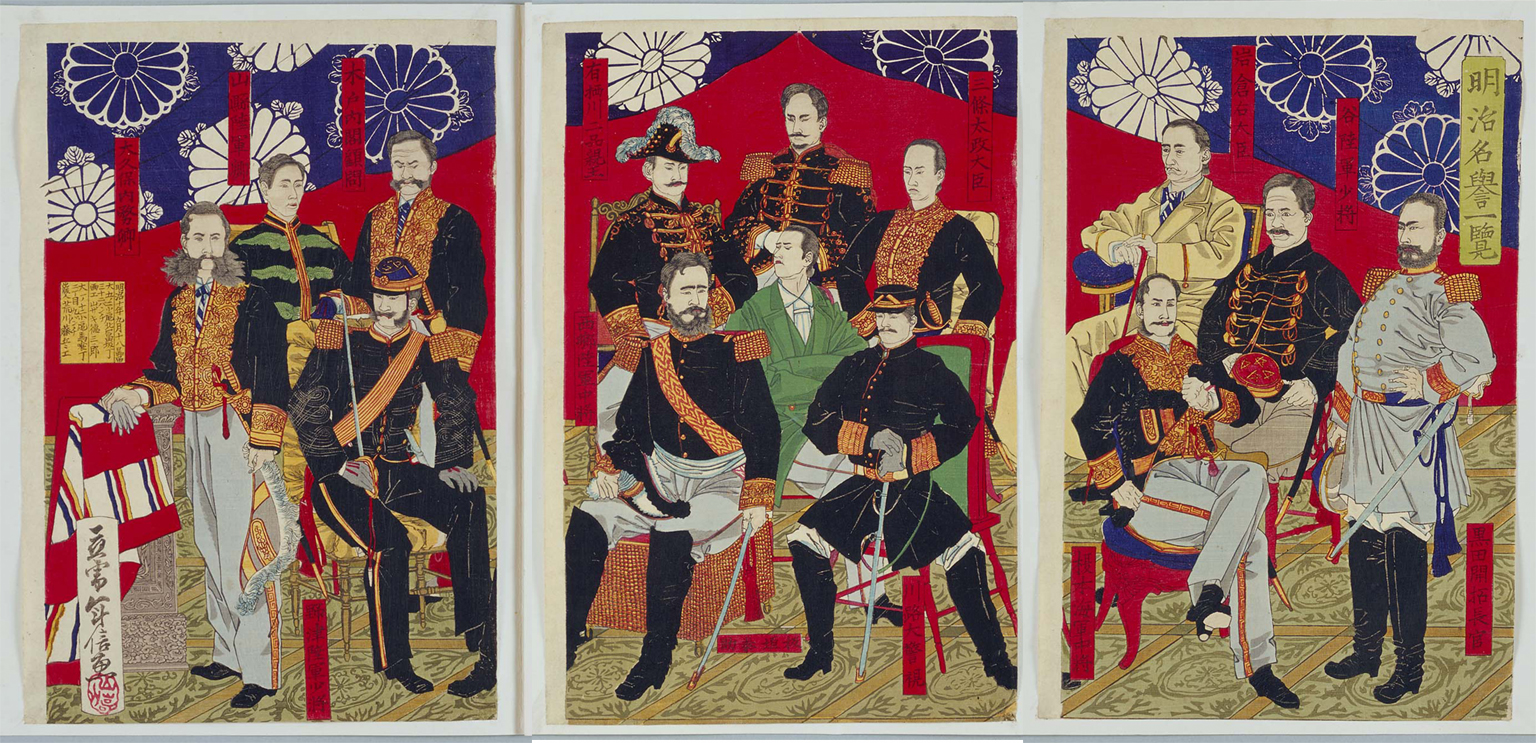
Featured image: “Meiji Dignitaries,” a 1877 woodblock triptych by Yamazaki Toshinobu. Original source: National Diet Library; digital records via the Library of Congress and Wikimedia Commons. The work is in the public domain.
Further reading
- The Meiji Restoration, in The Emergence of Meiji Japan
- Making reform and stability compatible with each other: elite redeployment in Meiji Japan
- Germany: Office of the Historian, U.S. Department of State
- Piedmont-Sardinia: Office of the Historian, U.S. Department of State
- Meiji Dignitaries: Library of Congress

コメント