Japanese trains are often described as quiet.
People usually do not talk loudly. Phone calls are avoided. Many passengers sit or stand in silence, looking at their phones, reading, sleeping, or simply staring somewhere in front of them.
But that does not mean the inside of a Japanese train is empty or silent.
In fact, it is full of messages.
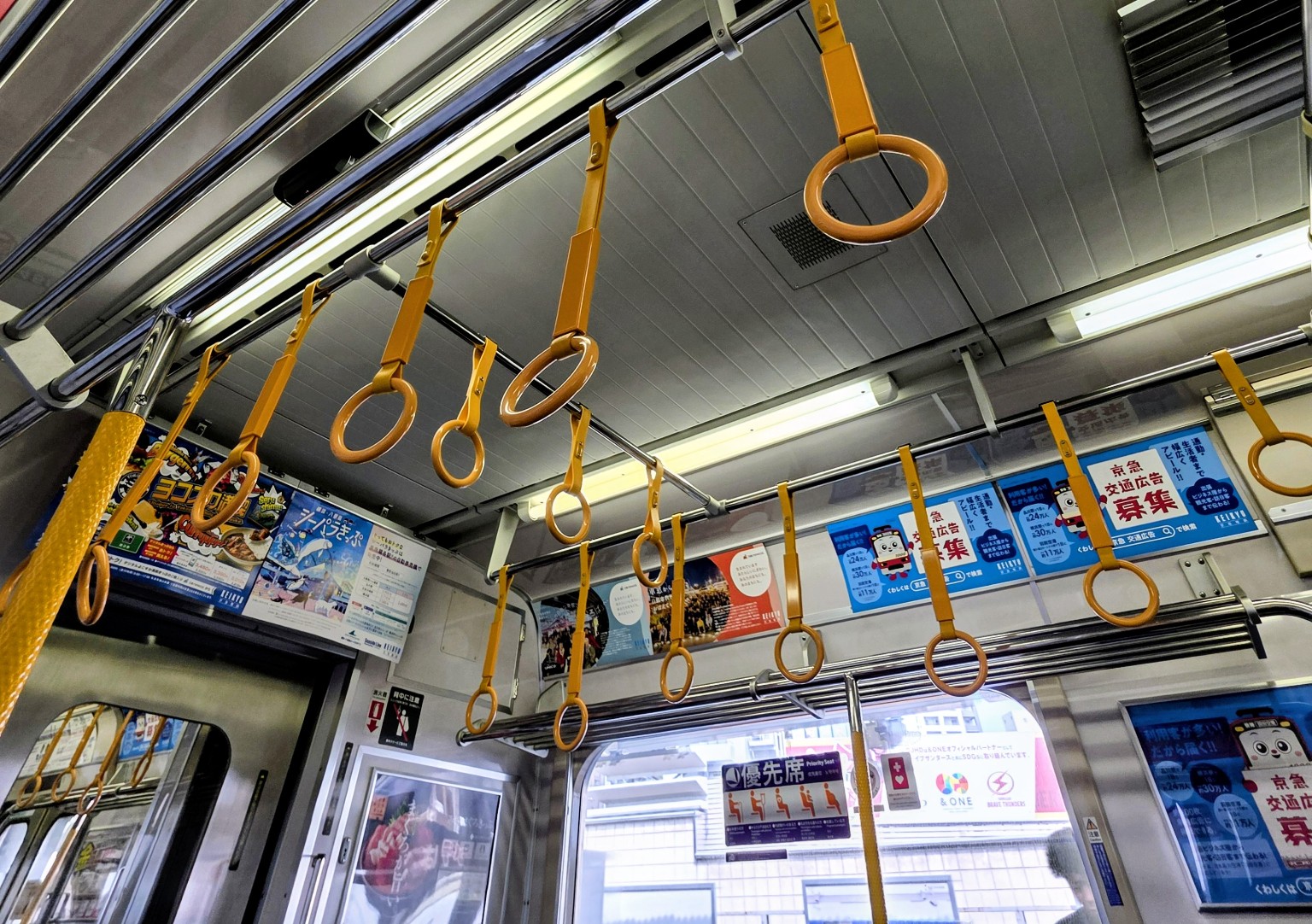
There are posters above the windows. There are ads near the doors. There are screens showing short videos and announcements. In some trains, there are hanging advertisements from the ceiling. Even the space around the hand straps can become part of the advertising environment.
At first, this may look like ordinary public transport advertising. But in Japan, it feels a little different.
Because the passengers are quiet, the ads become stronger.
They do not need to shout. They do not need sound. They are placed exactly where people’s eyes naturally go: above the seats, beside the doors, near the ceiling, across from where passengers are standing.
You sit down and look up.
There is an ad.
You stand and hold a strap.
There is an ad.
You avoid looking directly at other passengers.
Your eyes move to the wall, the screen, or the space above the windows.
There is another ad.
In that sense, a Japanese train is not only a vehicle. It is also a moving media space.
This is a small part of everyday Japan that may not be obvious from the outside. People often talk about how clean, punctual, and quiet Japanese trains are. Those things are true. But the quietness also creates a special kind of commercial space.
The train is quiet, but the ads keep speaking.
They tell passengers about new products, schools, jobs, travel campaigns, public notices, local events, and sometimes things they did not know they wanted to know.
For commuters, this scenery becomes almost invisible. It is just part of the train. The orange hand straps, the metal poles, the window frames, the posters, the screens, and the quiet passengers all blend into one familiar space.
But when you stop and look at it, the amount of information is striking.
A Japanese train can feel calm and crowded at the same time. Quiet and full of voices. Public and commercial. Ordinary and carefully designed.
This is not the kind of Japan that appears in travel guides.
It is not a temple, a festival, or a beautiful seasonal landscape.
It is just the inside of a train.
But for many people in Japan, this is one of the most familiar everyday spaces. A place where silence, routine, commuting, and advertising all exist together.
Japanese trains are quiet.
But the ads are always talking.


コメント